Treasury Management for PE-Backed Insurance Roll-Ups: The CFO's Playbook

PE-backed insurance roll-ups are among the most financially complex businesses in any sponsor’s portfolio.
Each acquisition adds 1 to 5 new bank accounts, a new premium collection workflow, unique carrier relationships, and a Controller who has managed cash their own way for a decade. A 50-agency roll-up might have 75 to 150 bank accounts across 10 banks, premium receivables from 200+ carriers, and zero consolidated cash visibility.
This guide covers the five treasury challenges specific to insurance roll-ups, a framework for building consolidated treasury operations post-acquisition, and how AI-powered treasury automation solves the unique cash management problems that insurance holding companies face.
That is the headline problem. Here is what it looks like in practice when the sponsor needs an answer fast, and the platform is still stitched together with spreadsheets and bank portals.
It’s Monday, 7:48 am, and you’ve loaded everything.
You’re on coffee number one. The sponsor's operating partner just pinged on Slack:
"Pulling the cash snapshot for the IC this afternoon. Can we get a consolidated position across the platform by noon?"
You open the Daily Cash spreadsheet. Inside: 47 tabs. One per agency. Each tab is either a screenshot, a CSV export, or a number called in by a Controller who does that at the end of every working day.
The thing is, you already know what a mess you’ve got to untangle. And the people you need to speak to either aren’t online or aren’t working this week.
The Ohio Controller is on PTO. The Florida agency you closed last month isn't in the file yet. Three of the spreadsheets mix trust accounts with operating accounts, which you'll have to untangle before anything gets sent to the sponsor.
Even more frustrating is that as soon as the first wire lands, or balances get updated, it’s historic data. Not real-time anymore. You run your fingers through your hair. You didn’t have as many greys before you took this job.
Time to get into the weeds.
In your role as a Treasury CFO, a nicer report won’t fix these headaches. Neither will that serve the goals and objectives of your PE sponsor. No, what you need is a real-time cash visibility solution that encompasses every entity, bank account, fiduciary fund account, and if international, currency, at scale.
A 50-agency roll-up might have 75 to 150 bank accounts, or more.
Insurance agencies and corporate treasuries need to be careful to separate policyholder premiums. They’re held in trust before remitting to carriers. These are fiduciary funds. Commingling with operating cash is a regulatory violation.
So, you’ve got to be clear as to the source of funds before confirming your actual, true cash position with a PE sponsor.
TLDR
- Cash positions that need assembling are a morning ritual. Not true, defensible visibility.
- As a CFO, you know that insurance roll-ups have the most complex treasury in PE. You know you need a better, more reliable route to real-time visibility.
- There are four practical paths to cash visibility: spreadsheets, ERP/BI reporting, cash visibility platforms, and full TMS. They differ on one thing that matters above all others: the speed and defensible nature of the real-time truth.
- The goal is the ability to answer a hard liquidity question in five minutes with a number you'd stake your credibility on.
Why Insurance Roll-Ups Have the Most Complex Treasury in PE
1. Extreme entity count
In a PE-backed insurance roll-up treasury, you’re dealing with one legal entity per acquired agency. You could have 50 agencies. Every single one has 5+ accounts, easily. That’s 200 to 400+ bank accounts at scale.
No wonder insurance agency cash management is considered one of the toughest gigs for CFOs.
One of the biggest questions you’re constantly having to answer and be accountable for:
Your current cash position, across every entity and account. Is it accurate?
Or is it a fiction reconstructed every Monday?
This is your problem. But it shouldn’t be a problem you are constantly dealing with. Not when there are tools that can solve it. Provide real-time cash visibility, at scale. Something that bank portals and spreadsheets could never manage.
2. Premium trust account complexity
Insurance agencies hold policyholder premiums in trust before remitting to carriers. These are fiduciary funds. As you know, commingling with operating cash is a regulatory violation.
You’ve got to make sure that doesn’t happen. Or if funds have mingled, they’re un-mingled as quickly as possible. Policyholder funds need to stay in the relevant accounts. Separate from operating cash.
In most cases, that’s funds designated for anywhere from 50 to 200 insurance carriers for every agency.
Those funds need to be tracked compared to operating cash flow across 50+ agencies. Every single one has to be accurate.
3. Carrier reconciliation
Insurance premium collection reconciliation is challenging. Done the traditional way. Thousands of customers per carrier. Different remittance, payment schedules, and due dates.
Different reconciliation dates. That’s multi-entity cash management at scale. You or your team are regularly reconciling for every agency, consolidating, and doing the same for every carrier.
With 50 to 200 carriers per agency, that’s days of work, every month.
4. Post-acquisition integration velocity
A PE sponsor expects financial integration in 90 to 180 days per acquisition. The Platform is acquiring 5 to 15 insurance agencies every year. Insurance agency acquisition integration finance works at scale and speed.
Each agency brings its own unique financial complexity. Finance is permanently in integration mode. With every new agency, the complexity compounds.
Remember the work you started at 7:48 am?
Compiling a consolidated and accurate cash snapshot for the IC this afternoon.
Your PE sponsor's operating partner just pinged again on Slack: “Any updates?”
It’s 11:46 am.
You’re at tab 32 of 47. You aren’t done yet. The problem is you aren’t 100% confident of every piece of data.
Ohio isn’t in the office. Florida isn’t in the file.
And the Friday figures aren’t accurate anymore.
What do you tell your PE sponsor's operating partner?
You feel like you’re 9 years old and have forgotten a pretty important piece of homework again.
This is exactly why a nicer report doesn’t cut it. You need a single source of truth, with real-time, completely up-to-date information.
As an insurance roll-up CFO, you need complete cash visibility across every entity and account. Automated accounting also makes everything a lot easier.
5. Covenant compliance consolidation complexity
At the consolidated level, when cash lives in 100+ accounts, it gets even more complex. Calculating consolidated leverage ratios manually takes days.
Compliance monitoring of covenants and policies is an integral part of that. As CFO, making sure these are accurate is part of the job, too.
In most cases, there isn’t a problem. When there is, it’s difficult to solve and takes even more time. Another reason why real-time visibility is so crucial.
The 5 Treasury Workflows for Insurance Roll-Ups
Here is what actually works. As a CFO, defensible numbers are your moat. Here is how you get them via an automated method compared to the manual way.
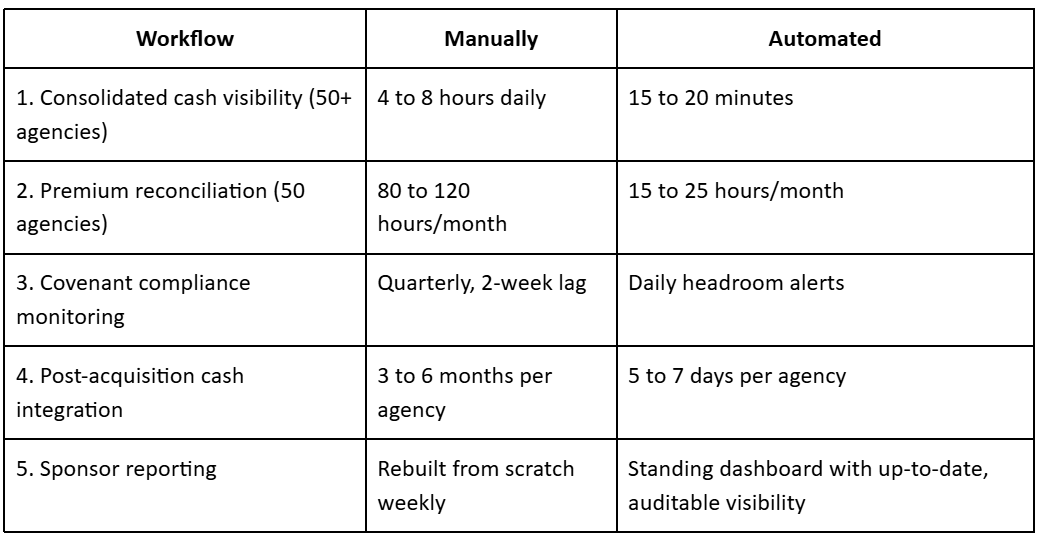
The time and cost savings speak for themselves.
Never mind the accuracy. Manual consolidation and reconciliation are history. By the time you’re talking about the numbers, they’re out of date. Any inaccuracies are on you.
That’s why so many CFOs sweat every figure. PE sponsors don’t like errors. Regulators like them even less. You can’t afford them. Nor can you afford the amount of time this work takes to do manually.
The Insurance Roll-Up Cash Management Maturity Model
This is the maturity ladder most insurance roll-ups move through. The question is not whether you want maturity. The question is whether you want it before the next acquisition closes.
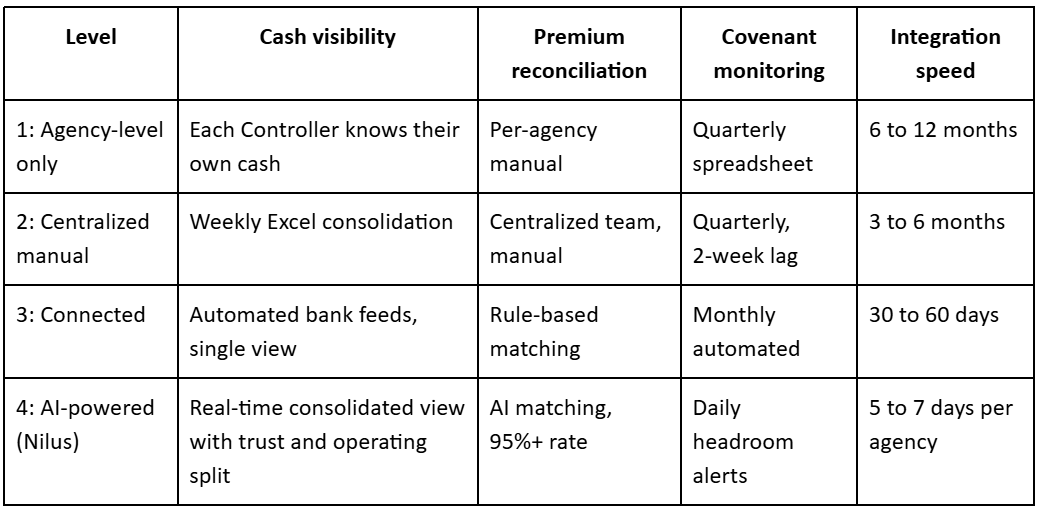
Sponsor reporting is the visible output of maturity. At Level 4, you stop rebuilding liquidity packages from scratch and start sending a link to a dashboard that stays current.
What Changes When You Stop Running Treasury Out of Spreadsheets
Most treasuries don’t go from spreadsheets to a full TMS. And in the PE-backed insurance roll-up world, that isn’t needed.
You don’t need a system that takes 3 to 6 months to set up with a consultant doing the complex bits. It’s going to contain features you and your team never need.
And you don’t need a more polished-looking report.
What you need is a system that can do:
- 100+ bank accounts connected in days, not months
- Trust and operating cash separated automatically in the consolidated view
- Premium reconciliation via rule-based matching and cash application automation where it fits your workflow
- Consolidated covenant ratios calculated daily from live data
- New agency onboarding in 5 to 7 days
- Connect banks, connect ERP, configure matching, and go live
Get a system that takes away the Monday morning scaries. Protect your Mondays. Deliver numbers with confidence, figures you can defend easily.
A single source of consolidated, reconciled, bank-accurate truth.
Nilus for insurance treasury teams provides cash visibility that helps treasury teams reduce manual work, respond faster to risk, and spend less time reconciling numbers and more time supporting the business.
Now imagine your week starting this way:
It's Monday, 7:48 am, and you’ve loaded everything.
You're on coffee number one. The sponsor's operating partner just pinged on Slack:
"Pulling the cash snapshot for the IC this afternoon. Can we get a consolidated position across the platform by noon?"
You open Nilus. Cash positions are showing in real-time across every agency and account, including operating cash flow and premium trust accounts.
It takes you 5 minutes to pull together a report.
“Here it is”, you ping back. Job done.
Insurance treasury management should be as simple as that for PE-backed roll-up CFOs.
How Nilus Solves Insurance Roll-Up Treasury
Connect 100+ bank accounts in days
Nilus connects to major US banks via open banking APIs. Each agency’s operating and trust accounts can be connected and categorized so you can see consolidated cash without portal marathons.
Separate trust from operating cash
Nilus maintains trust and operating cash separation in the consolidated view, which supports the compliance reality of insurance agency models.
Automate premium reconciliation
Nilus helps teams match premium payments to policy records across agencies and reconcile commission income against carrier remittances with auditable workflows.
Monitor covenants across the portfolio
Consolidated leverage and coverage ratios can be monitored more frequently using connected bank data and ERP signals, with headroom alerts at configurable thresholds.
Onboard new agencies in 5 to 7 days
Standard integration playbook: connect banks, connect ERP, configure matching rules, go live. The CFO can have visibility into the new agency’s cash before the 100-day plan is complete.
See how Nilus manages 100+ entities: Live demo for insurance roll-up CFOs.
Onboard your next acquisition in 5 days: Book your setup call.
FAQs
What are the biggest treasury challenges for PE-backed insurance roll-ups?
PE-backed insurance roll-ups are constantly facing a cash visibility problem. Every acquisition adds new banks, new portals, and new spreadsheets.
But no unified view of where the money actually is. A CFO team spends hours each morning stitching together a cash position that's already history before the first transaction.
The core challenges stack quickly after the third or fourth acquisition. Cash sits across hundreds of bank accounts (company and client). Premium collections flow in asynchronously across agencies while claim payments, carrier remittances, and inter-company transfers flow out on different timescales. Excel becomes the way it’s all managed. Even though everyone knows it’s weak, vulnerable, and contains errors.
Sponsor pressure makes this worse. When a Warburg or Abry-backed CFO is asked for consolidated liquidity on a Monday morning, they're looking at Friday's best estimate. That gap is where treasury risk lives in a roll-up. It's also where covenant miscalculations happen, where idle cash gets missed, and where acquisition integration timelines slip.
How do insurance roll-ups manage cash across hundreds of agencies?
Most insurance roll-ups manage cash through a combination of manual bank portal logins, emailed balance reports from agency controllers, and a master Excel workbook that someone owns and everyone worries about.
You could try setting up cash concentration structures using a treasury vendor (Kyriba, GTreasury, Trovata, HighRadius). The problem is, they take a long time (12 to 18 months) to set up across dozens of agencies and hundreds of accounts. The other problem is that established agencies come with legacy banking relationships. Plus, pre-existing sweep agreements and local bank covenants make clean centralization difficult and slow.
In most cases, PE-backed insurance roll-ups take a layered:
- A concentration structure for the accounts that can be migrated
- Manual tracking for the long tail of acquired agency accounts that can't
- And a quarterly reconciliation process that doesn’t really work
The gap between the clean treasury model and the operational reality is where most roll-up CFOs spend too much of their time. Time you know you could put to better use.
What treasury software is best for insurance roll-ups?
In reality, most enterprise TMS platforms are overbuilt for where roll-ups actually are. A 12 to 18 month Kyriba implementation assumes a treasury infrastructure that most PE-backed insurance consolidators don’t have. Nor need. Those platforms aren’t designed for your specific operating environment.
What roll-up CFOs actually need at the $200M to $2B stage is bank connectivity and real-time cash visibility. Live balances across all entities. A single consolidated position. Enough forecasting to manage liquidity between acquisitions. A platform that works with what already exists. Speed is everything in the PE-backed insurance roll-up game.
Nilus was built specifically for this. It connects directly to banks via API and delivers a live consolidated cash position in days. It doesn't require a dedicated implementation team or a treasury management consultant to go live. For lean treasury teams that are adding entities regularly, the ability to onboard in hours instead of weeks matters more than features they don’t need and won’t use.
How long does it take to onboard a new insurance agency after acquisition?
In a traditional treasury setup, onboarding a new acquisition's banking relationships takes four to twelve weeks. You’ve got to:
- Establish signatory authority
- Negotiate sweep agreements
- Map account structures
- Manually add accounts to whatever tracking system the treasury team uses
During that window, the acquired agency's cash is effectively invisible to the parent company's CFO, or the PE sponsor partner.
That lag compounds across a serial acquisition strategy. If a roll-up is closing four to six deals a year, there's always a portion of the portfolio in limbo. Acquired but not yet integrated. You are constantly in integration mode. You know that cash sitting in accounts the treasury team can't see. Sponsors notice this. It shows up in reporting gaps, in liquidity surprises, and in the inability to give an accurate number quickly.
Every acquisition adds 1 to 5 bank accounts, a new premium trust workflow, and a Controller who has tracked cash their own way for a decade. A 50-agency platform might have 150+ bank accounts and zero real consolidated visibility. At the same time, the sponsor expects financial integration in 90 to 180 days per acquisition. The Platform is acquiring 5 to 15 per year.
You need a better way to manage all of this, not just a platform with a shinier UX and the promise of AI.
How do you track covenant compliance across an insurance roll-up?
Covenant compliance in a roll-up is a cash forecasting and reporting problem. Most credit agreements require minimum liquidity thresholds across the consolidated group. Because of this, the CFO needs an accurate, real-time view of total available cash. Not a number that was well-formatted yesterday.
The standard way is a monthly covenant certificate prepared by the finance team. Unfortunately, the underlying cash data is often assembled from multiple sources (bank portals, controller reports, sweep summaries). Consolidating all of that in Excel isn’t accurate enough.
A better approach anchors covenant tracking to live bank data. When the treasury has a real-time consolidated cash position, the covenant certificate becomes a reporting exercise. It also means a CFO can monitor headroom continuously, not just at month-end. This way, you can flag a potential breach before it becomes a lender conversation.

Written by
Your next treasury move is waiting
Get an ROI assessment, and find out where you’re leaving cash on the table.


Your next treasury move is waiting
Get an ROI assessment, and find out where you’re leaving cash on the table.
More Resources
Your next treasury move is waiting
Get an ROI assessment, and find out
where you’re leaving cash on the table.

