Why Finance Teams Are Hiring AI Agents Instead of Treasury Analysts

A CFO told me last month that she had budget approval to hire a Treasury Analyst. $95K base, $120K loaded. Time to hire: 3-4 months. Time to onboard and train: another 2-3 months. Time to first independent contribution: six months total. Cost to the business before the hire produces value: north of $60K.
She asked me a simple question: "What can your AI agent do that this person would do?"
I showed her. She cancelled the req.
The Economics Have Changed
For 30 years, the answer to "we have too much treasury work" was the same: hire another person. The economics of that answer no longer hold.
Here's what the numbers actually look like:
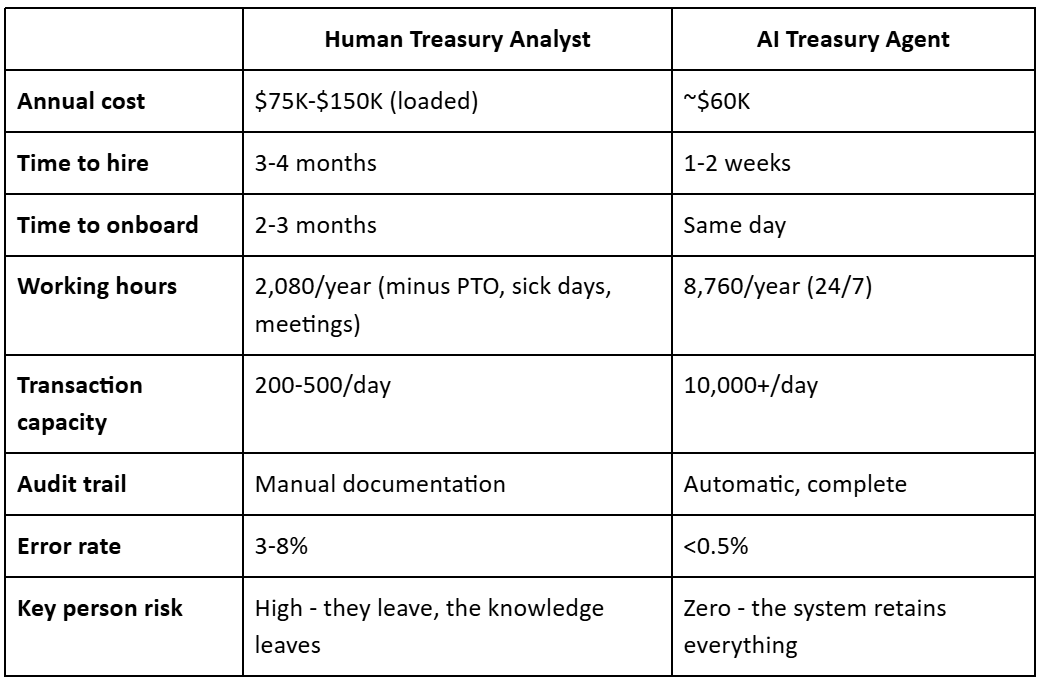
This isn't a theoretical exercise. These are the actual economics companies running AI treasury agents report today.
The cost gap alone would justify the conversation. But cost is the least interesting part of this comparison. The real shift is in what becomes possible when treasury operations run at machine speed instead of human speed.
What an AI Treasury Agent Actually Does at 6am
Most AI claims in finance are vague. "Automates workflows." "Provides insights." I find that useless. Here's what a Nilus AI agent actually does on a Tuesday morning - specifically:
6:00 AM - The agent surfaces real-time bank balances from every account across every entity. It consolidates the cash position. It flags any balance that exceeds operating minimums. Result: idle cash detected - $1.2M sitting in Entity 4's operating account earning zero yield while the parent draws on an 8% revolver.
6:15 AM - Overnight bank statement data arrives. The agent executes automated matching against open invoices and expected receipts. 2,847 transactions reconciled. 43 exceptions flagged for human review - with the specific reason each one failed to match.
6:30 AM - The 13-week rolling cash flow forecast updates with actuals from the prior day. Receipt projections recalculate based on updated collection rates. Forecast accuracy: ±4.2% at 30 days, tracked and attributed to specific drivers.
6:45 AM - Covenant ratios recalculate using the latest financial data. Total net leverage: 3.8x against a 4.0x limit. Headroom: 5%. The agent sends an alert to the CFO: "Covenant headroom below 10% threshold. Review recommended."
7:00 AM - The daily cash position report deploys to the PE sponsor. Entity-level breakdown, idle cash summary, covenant headroom status, TWCF variance vs. prior week. Delivered to the sponsor's inbox before anyone on the finance team has opened their laptop.
Total elapsed time: 60 minutes. Zero human intervention. Complete audit trail for every action.
A human Treasury Analyst doing the same work starts at 8:30 AM. They finish by 4 PM - at which point the data is already eight hours stale. That delay has a name: the latency tax. And it compounds every single day.
The Trust Question - And How Architecture Answers It
Every CFO I talk to raises the same objection, and it's the right one: "I don't trust AI with my treasury."
The answer isn't "trust us." The answer is architecture.
Assurance-Grade AI means every action the agent takes is auditable, reversible, and explainable. The CFO sees exactly why the agent made every decision. Every matching rule shows its logic. Every forecast shows its drivers. Every exception shows the specific reason it was flagged.
Human-in-the-loop isn't a marketing phrase here - it's the operating model. The AI agent executes within policy boundaries the CFO sets. It doesn't make autonomous decisions about cash deployment. It surfaces recommendations. The human enforces the final call.
Here's the part that most people miss: the comparison baseline isn't "perfect human vs. imperfect AI." The comparison baseline is a spreadsheet built by a single Treasury Analyst with zero audit trail, zero automated error detection, and complete key-person risk. That analyst goes on vacation, and the institutional knowledge goes with them.
An AI agent has a complete audit trail for every action. Real-time error detection. Zero key-person risk. The system retains everything - every rule, every decision, every exception - permanently.
Which one should you actually trust less?
When to Hire and When to Deploy an Agent
I'm not making the argument that companies should fire their treasury teams. That argument is lazy, and it's wrong.
Here's the honest framework:
Deploy an agent when the work is repetitive, rule-based, and high-volume: daily cash positioning, transaction matching, TWCF updates, covenant ratio calculations, report generation. This is 60-70% of treasury work at most mid-market companies. It's the work that consumes the most hours, creates the most errors, and produces the least strategic value.
Hire a human when the work requires judgment, relationships, and strategic thinking: lender negotiations, board presentations, M&A due diligence, policy design, vendor relationship management. This is the 30-40% that makes a great treasury professional irreplaceable.
The best outcome isn't replacing the $120K hire. It's deploying it differently. The CFO routes the headcount budget toward a strategic finance lead - someone who governs policy, manages lender relationships, and leads M&A integration. The AI agent handles the 2,000+ hours of operational work that would have consumed that person's year.
One company deploys a $60K agent for operational execution. The other hires a $120K analyst who spends 70% of their time extracting bank data and updating spreadsheets. In 12 months, the gap between those two companies isn't just cost - it's capability.
Three Questions Before Your Next Treasury Hire
Before you approve the next headcount req for a Treasury Analyst, Cash Manager, or Finance Operations role, ask three questions:
- "Is this role primarily operational or strategic?" If 60% or more of the job description involves pulling data, building reports, matching transactions, or updating spreadsheets - that's agent work, not human work.
- "What's the fully loaded cost of this hire vs. a platform that does the same work?" Include recruiting fees (20-25% of first-year salary), onboarding time (2-3 months of reduced productivity), benefits, PTO, and the cost of the next hire when this person leaves in 18-24 months.
- "What happens when this person leaves?" If the answer is "we lose institutional knowledge and have to rebuild" - that's a system design failure, not a staffing problem. An AI agent never leaves. It never forgets a matching rule. It never takes a process home in its head.
The companies that figure this out first don't just save money. They build a treasury function that scales without adding headcount - across acquisitions, across entities, across complexity.
The ones that don't will keep hiring $120K analysts to execute $60K worth of work at human speed while their competitors operate at machine speed.
The economics aren't close. The only question was trust. Assurance-Grade AI answers that.
FAQs
Can AI agents fully replace Treasury Analysts?
AI agents replace the operational work that consumes 60-70% of a Treasury Analyst's day: cash positioning, transaction matching, 13-week TWCF updates, covenant ratio calculations, and report generation. Strategic work - lender negotiations, board presentations, M&A due diligence, policy design - still requires human judgment. The best outcome is redirecting human talent toward strategic roles while AI handles operational volume at 10,000+ transactions per day.
How much does an AI treasury agent cost compared to a new hire?
An AI treasury agent costs approximately $60K/year. A Treasury Analyst costs $75K-$150K/year fully loaded - salary, benefits, recruiting fees (20-25% of salary), and 2-3 months of onboarding before productive output. The AI agent works 24/7, processes 10,000+ transactions daily, and maintains a complete audit trail. Time to productive output: 1-2 weeks vs. 6+ months for a human hire.
Is it safe to trust AI with treasury operations?
With Assurance-Grade AI, every action is auditable, reversible, and explainable. The agent operates within policy boundaries set by the CFO - it recommends actions, and humans approve execution. Every matching rule shows its logic. Every forecast shows its drivers. Compared to a single-person Excel process with no audit trail and complete key-person risk, Assurance-Grade AI is demonstrably safer.
What treasury tasks should be automated first?
Start with the highest-volume, most repetitive operational work: daily cash position consolidation across all bank accounts, automated transaction matching and reconciliation, 13-week rolling cash flow forecast updates, covenant ratio monitoring, and PE sponsor report generation. These five workflows typically consume 60-70% of treasury team hours at PE-backed mid-market companies and show measurable ROI within the first 30 days of deployment.

Written by
Your next treasury move is waiting
Get an ROI assessment, and find out where you’re leaving cash on the table.


Your next treasury move is waiting
Get an ROI assessment, and find out where you’re leaving cash on the table.
More Resources
Your next treasury move is waiting
Get an ROI assessment, and find out
where you’re leaving cash on the table.

