Multi-entity cash management is the process of consolidating cash visibility, managing intercompany flows, detecting idle cash, and generating reporting across multiple legal entities within a single corporate structure. It is the primary treasury challenge for PE roll-ups and real estate operators managing 10 to 100+ entities, where cash is fragmented across entity-level bank accounts with no consolidated view. It is Monday morning. Your alarm goes off, and before your feet hit the floor, the same question shows up in your head. Which of my entities actually has cash right now? If you manage 10 to 100+ entities, that is not a dramatic thought. It is the operating reality. Cash is fragmented, bank logins multiply, and a quick check becomes a two-hour ritual that steals the best hours of your day. This guide gives you a unified, practical framework for tracking, moving, and optimizing liquidity across a multi-entity portfolio. The goal is simple: turn static, fragmented balances into a single coherent cash strategy that you can trust before the first meeting starts. Whether you are managing five entities or fifty, the work is the same at its core. You need visibility, clean intercompany flow tracking, idle cash detection, and reporting that works at every level of the hierarchy. Once you have those four pieces, the morning becomes calmer, decisions get faster, and the portfolio stops leaking yield through preventable misallocation. Three quantified costs of the status quo:
- Time: 2 to 4 hours daily building a manual cash position
- Idle cash: 5 to 15% of total cash misallocated across entities
- Close delay: 3 to 5 days added to monthly close from manual intercompany reconciliation This guide covers the two archetypes of multi-entity cash complexity, a named framework called the 4 Pillars of Multi-Entity Cash Management, the hidden costs of fragmentation, and a 6-step automation path you can execute without a multi-quarter implementation.
What Is Multi-Entity Cash Management?
If you oversee a single entity, multi-entity cash management can sound like a problem from another planet. Checking balances across a couple of accounts is annoying, but manageable. Now add two or three entities. Then add three more after a small acquisition. Then add a few special-purpose entities, a holding company, and a couple of new accounts that were supposed to be temporary. Suddenly, you are spending two to four hours a day building a cash position by hand. That is time you could spend negotiating vendor terms, reviewing covenants, planning deployment, or simply doing work that moves the business forward. Multi-entity cash management is the discipline of consolidating cash visibility, managing flows across entities, detecting idle cash, and producing reporting across multiple legal entities under a single corporate structure. The core question is not “how do I view balances.” It is “how do I move from fragmented cash to coordinated liquidity.”
The Two Archetypes of Multi-Entity Cash Complexity
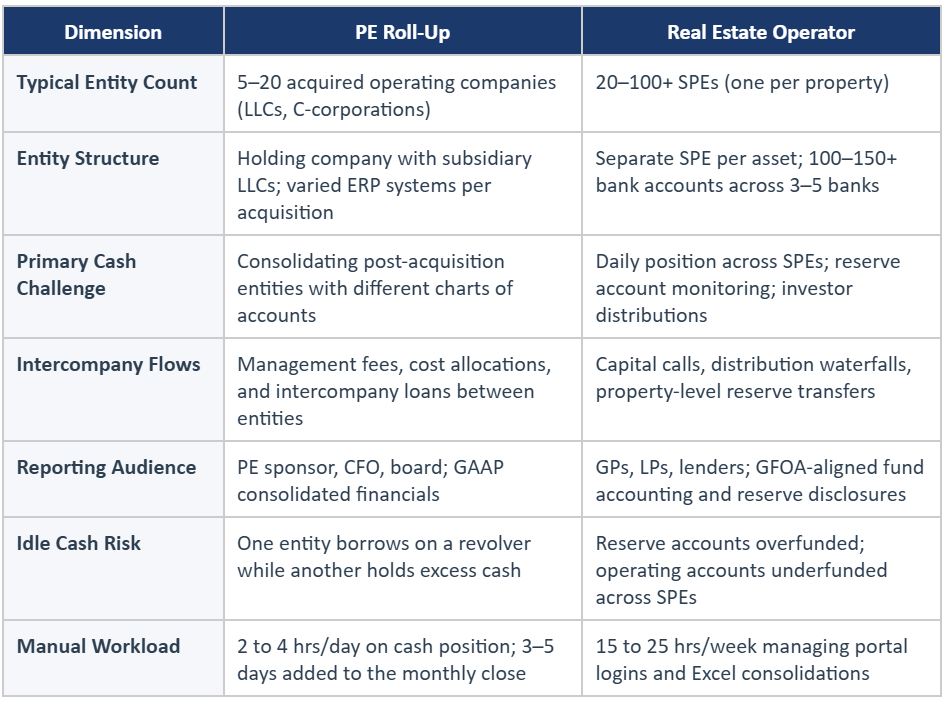
Not all multi-entity structures are the same. The way your portfolio is organized changes the shape of the problem. Two archetypes show up most often.
Archetype 1: PE Roll-Up
Imagine you closed your sixth acquisition in 18 months. Each company came with its own banking relationships, its own chart of accounts, and its own accounting stack. Now you are effectively living inside multiple bank portals. None of them speaks to each other, and reconciliation becomes the hidden tax you pay every close. PE roll-ups often involve 5 to 20 operating companies under a holding entity. The cash challenge is not just visibility. It is the continuous movement of management fees, allocations, tax distributions, and intercompany loans. When those flows are recorded differently across tools, matching them becomes a monthly time sink. What should be a quick confirmation becomes days of detective work.
Archetype 2: Real Estate Operator
Picture a 50-property multifamily portfolio. Each asset lives inside its own Special Purpose Entity (SPE), the structure most lenders require to ring-fence liability. Of course, each SPE has its own operating account, reserve account and, often, its own bank. This is property management treasury at its finest. You could be dealing with 150 bank accounts across 5 institutions. Real estate operators managing 20-100+ SPEs typically spend 15-25 hours per week just on cash monitoring. You’re logging into bank portals, exporting balances to Excel, and manually checking reserve levels. Investor distributions add yet another layer. You’ll need precise timing across a waterfall that touches a dozen entities at once. Organizations like the Government Finance Officers Association (GFOA) emphasize the importance of reserve fund monitoring and transparency. These standards will be next to impossible to meet if your cash data is living in fifteen spreadsheets. You need real estate cash management software.
PE Roll-Up vs. Real Estate Operator: How the Challenges Compare
The 4 Pillars of Multi-Entity Cash Management (Named Framework)
Whether you are a roll-up operator or a real estate operator, the pattern is consistent. Manual work expands until it fills the week. The fix is not “work harder.” The fix is to build a system that is designed for multi-entity reality. Effective multi-entity cash management rests on four core capabilities. If you miss one, the cracks show up at the worst possible time, usually late Friday when something urgent needs funding.
Pillar 1: Consolidated Cash Visibility
Everything starts here. Consolidated cash visibility means you can see every account balance across every entity in one place, with updates frequent enough to support decisions. In practice, this requires connecting entity-level bank accounts into a central platform through bank feeds or APIs. The platform aggregates balances, applies your entity hierarchy, and produces a cash position that reflects current reality. Without this, your finance team spends hours logging into portals and copying numbers into spreadsheets. That is not treasury work. That is data entry performed by people who should be doing higher-value analysis.
Why It Matters
A PE roll-up with 12 acquired entities may have 30+ active bank accounts across 5 banks. A real estate operator with 40 SPEs could have 80–120 accounts. Manual consolidation at this scale is a clear and present liability.
Pillar 2: Intercompany Flow Tracking & Reconciliation
In a multi-entity structure, money moves constantly. Fees from subsidiaries to a parent, allocations, tax distributions, intercompany loans, reserve transfers. You need to track, document, and reconcile these flows on both sides of the ledger. Manual intercompany reconciliation often adds days to the monthly close. The core problem is matching transactions across multiple accounting systems with different chart-of-account structures. A transfer recorded one way in one system may look different in another. When you automate, you can reconcile all of your accounts in a single day, with 90% of your transactions matched automatically and exception-based workflows handling the remainder. It becomes a fundamentally different close process than what you’re probably used to.
Industry Benchmark
AFP research consistently finds that intercompany reconciliation ranks among the top five treasury pain points for organizations managing decentralized or multi-entity structures. The manual error rate across 20+ bank portals runs between 3 to 8%.
Pillar 3: Idle Cash Detection & Deployment
How’s this for a scenario playing out every day in multi-entity portfolios: one LLC is sitting on $1.2M in its operating account. That money is earning nothing. Meanwhile, a neighboring SPE is drawing on a revolving credit facility at 8%. That’s $96,000 per year in avoidable cost… and that’s just one pair of entities. Multi-entity companies typically have 5 - 15% of total cash misallocated across entities at any given time. Idle cash detection identifies those pockets and flags them for redeployment. This could mean an intercompany sweep, a short-term investment, or paying down a line of credit. The math is straightforward: $1M idle at 0% yield costs you $80K per year at an 8% deployment rate. Multiply that across a 50-entity portfolio, and you’re looking at a material improvement in your portfolio yield. And all you have to do is detect what’s already there.
Quick Calculation
$1M idle cash earning 0% vs. 8% = $80,000 annual opportunity cost. A 50-entity portfolio with 5% cash misallocation on $20M total cash = $1M idle. That’s $80K/year you’re leaving on the table every year.
Pillar 4: Entity-Level & Consolidated Reporting
Multi-entity operators get pulled in multiple directions. An LP wants a cash position across specific assets. A CFO wants consolidated liquidity. A lender wants a reserve account statement for one SPE. You need reporting that slices the same data at every level of the hierarchy. Entity, fund, region, full consolidation. The system should produce that without a full day of spreadsheet work. Effective reporting includes variance analysis, distribution reporting, and reserve monitoring. It cannot be a template someone fills in manually every week.
The Hidden Costs of Fragmented Multi-Entity Cash
Fragmentation costs money in obvious ways and quiet ways. The quiet ways show up when something goes wrong.
Time
A finance team running manual cash operations costs $75,000 to $100,000 per year at today’s $75–$100 per hour loaded rate. Are they even working on the right things? Your treasury analyst spends three hours logging into portals on Monday morning. She could be forecasting, covenant monitoring, or raising the capital you’ve been pushing for six months. Multiply that across a team, across 52 weeks, and you’re looking at hundreds of hours per year spent on work that automation handles in twenty minutes.
Idle Cash
The typical multi-entity portfolio has 5–15% of its total cash misallocated across entities at any given time. That means one entity is borrowing while another sits idle. One SPE’s reserve account is overfunded while its neighbor’s is underfunded. Just $1M idle earns you nothing at 0%. Detect it, deploy it, and you’re making an extra $80K each year at an 8% return. Most operators have an SPE cash management problem because they can’t see the idle cash. You can’t optimize what you can’t measure.
Close Timeline
Manual intercompany reconciliation adds 3–5 days to the monthly close. For a PE roll-up with 15 entities and multiple ERPs, that’s a structural delay that pushes investor reporting, board packages, and tax filings back every single month. Automated reconciliation with 90%+ matching brings that down to same-day. The time saved compounds: faster close means faster reporting, which means faster decisions, which means fewer opportunities missed while the team is buried in reconciliation.
Error Risk
Manual consolidation across 20+ bank portals carries an error rate of 3–8%. That might sound small, but in a $50M portfolio, a 3% error in cash position reporting is a $1.5M misstatement. Errors in multi-entity cash management don’t just create accounting problems. They create trust problems with investors, lenders, and boards who depend on accurate reporting to make decisions. Automated systems obviously cannot eliminate every error, but they can eliminate the ones introduced by logging in, copying, and pasting. See your consolidated cash position in 48 hours. Book a Nilus demo today.
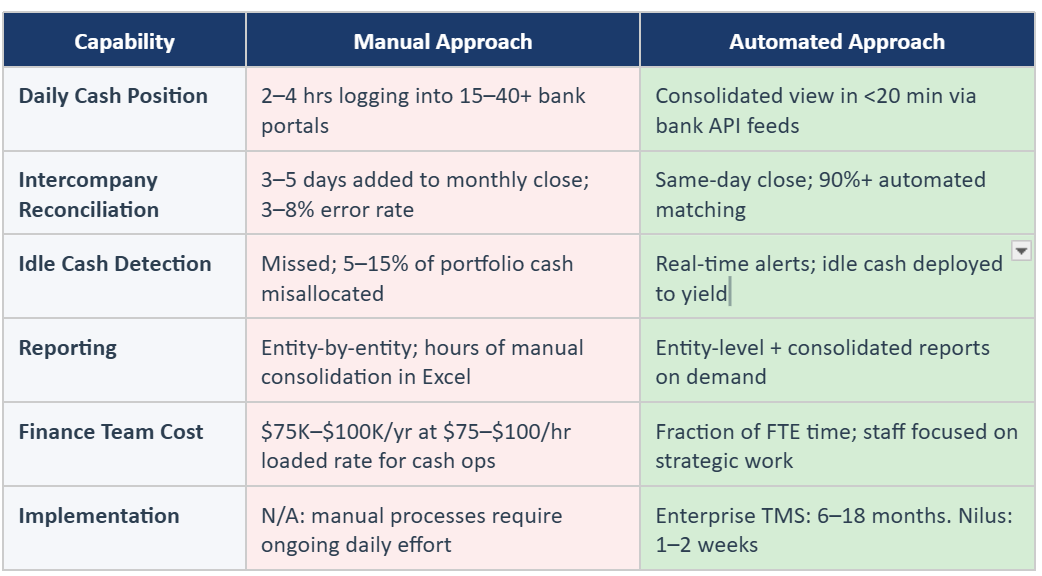
Manual vs. Automated Multi-Entity Cash Management
Here, you can get the full picture side-by-side. Whether you’re evaluating a new platform or defending the business case internally, this comparison makes clear the cost of sticking with what you’ve always done.
How to Automate Multi-Entity Cash Management
Of course, automation sounds like a big deal. But in practice, it follows a clear sequence, and each step has a measurable outcome you can point to. Here’s how operators make that shift without making it a big deal:
Step 1: Bank Connectivity
Connect your bank accounts via open banking APIs or bank feeds. Target: all entity-level accounts live in the platform within 48 hours. Outcome: daily cash position built automatically, portal logins eliminated.
Step 2: Entity Structure Configuration
Map your entity hierarchy, the holding company, subsidiary LLCs, SPEs, and any fund structures. Target: every entity tagged and visible at the right level of the org. Outcome: consolidated and entity-level views available on demand.
Step 3: ERP Integration & Intercompany Mapping
Integrate your ERPs (QuickBooks, NetSuite, Yardi, or others) to sync GL data and chart-of-accounts mappings. Target: automated transaction matching across all entity pairs. Outcome: intercompany reconciliation reduced from 3–5 days to same-day, with 90%+ automated matching.
Step 4: Idle Cash Rules & Alerts
Set idle cash detection thresholds, with minimum balances, yield targets, and redeployment alerts. Target: all accounts with balances above the threshold and no yield flagged within 24 hours. Outcome: 5–15% of misallocated cash identified and ready for deployment.
Step 5: Reporting Configuration
Build your reporting templates with entity-level, consolidated, fund-level, and reserve monitoring. Align with the disclosure requirements your LPs, lenders, or board expect. Outcome: on-demand reports replacing manual Excel builds; audit-ready output with no extra effort.
Step 6: Operationalize & Iterate
Train the team, set up exception workflows, and establish a weekly treasury rhythm. Target: Monday morning cash position available before 8:00 AM without a single portal login. Outcome: finance team hours redirected from data entry to analysis and strategy.
Multi-Entity Cash Management with Nilus
Nilus is purpose-built multi-entity cash management software for the two archetypes that enterprise TMS platforms were never designed for: PE roll-ups and real estate operators. Where platforms like Kyriba or GTreasury require 6-18 months to implement, Nilus deploys in 1-2 weeks… and eliminates your portal ritual on Day 1. Four capabilities map directly to the four pillars of multi-entity cash management:
- Consolidated Cash Visibility: Real-time balance aggregation across all entity-level bank accounts, with entity hierarchy support for LLCs, SPEs, holding companies, and fund structures.
- Intercompany Flow Tracking & Reconciliation: Automated transaction matching across multiple ERPs, with exception-based workflows for unmatched items and a full audit trail for every intercompany flow.
- Idle Cash Detection & Deployment: Rules-based alerts for underperforming balances, with yield benchmarking and redeployment workflows built in. Operators using Nilus typically recover $80K+ per year per $1M of idle cash identified.
- Entity-Level & Consolidated Reporting: On-demand reports at every level of the hierarchy, whether it be entity, fund, region, or full portfolio, all with distribution tracking, reserve monitoring, and investor-ready output aligned to AFP and GFOA standards. Your Monday morning looks different from Day 1: no portals, no manual consolidation, no guessing which entity has cash and which one doesn’t.
FAQs
What is multi-entity cash management?
Multi-entity cash management is the process of consolidating cash visibility, managing intercompany flows, detecting idle cash, and generating reporting across multiple legal entities within a single corporate structure. It’s the primary treasury challenge for PE roll-ups (5–20 acquired companies), real estate operators (20–100+ SPEs), and international mid-market companies with subsidiaries. The core problem: cash is fragmented across entity- level bank accounts with no consolidated view.
How do you consolidate cash across multiple entities?
Cash consolidation across entities requires connecting all entity-level bank accounts to a single treasury platform via open banking APIs or bank feeds. The platform aggregates real-time balances, applies entity hierarchy rules, and produces both entity-level and consolidated cash position reports. Without automation, this process takes 2–4 hours daily as the finance team logs into 15–40+ bank portals manually.
What is idle cash in a multi-entity structure?
Idle cash in a multi-entity structure occurs when cash accumulates in one entity’s bank accounts while another entity is borrowing on a revolving credit facility or line of credit. The cost: $1M idle at 0% yield while another entity borrows at 8% = $80,000/year in avoidable cost. Multi-entity companies typically have 5–15% of total cash misallocated across entities at any given time.
How long does intercompany reconciliation take?
Manual intercompany reconciliation for a 20+ entity structure typically adds 3–5 days to the monthly close. The challenge is matching intercompany transactions (management fees, cost allocations, loans) across multiple ERPs with different chart-of-accounts structures. Automated reconciliation reduces this to same-day, with 90%+ automated matching and exception-based workflows for the remainder.
What is the best multi-entity cash management software?
The best multi-entity cash management software must handle: (1) bank connectivity across 10–100+ accounts, (2) multi-ERP integration, (3) intercompany reconciliation automation, (4) idle cash detection, and (5) entity-level plus consolidated reporting. Enterprise TMS platforms (Kyriba, GTreasury) handle this but require 6–18 months to implement. Nilus deploys in 1–2 weeks and is purpose-built for PE roll-ups and real estate operators.
How do real estate companies manage cash across SPEs?
Real estate companies typically structure each property as a separate SPE (Special Purpose Entity) with its own bank accounts. A 50-property portfolio may have 100–150 bank accounts across 3–5 banks. Cash management involves daily cash position consolidation, distribution timing to investors, reserve account monitoring, and intercompany flow tracking. Most operators manage this manually through bank portals and Excel, a process that consumes 15–25 hours per week.