Every CFO has now sat through a vendor demo where the word “agentic” did most of the work. The screen shows a chat window. Someone types a question about cash. The system answers with a number. Everyone nods. Someone says “AI.” The deck moves on. That’s not agentic AI. That’s a chatbot with access to a balance sheet. Agentic AI for treasury is a class of AI systems that don’t just analyze cash data. They execute treasury workflows inside the CFO’s governance rules. Unlike chatbots or dashboards, agentic systems take action: forecasting, reconciliation, liquidity moves, covenant tracking, with a full audit trail and reversible controls. The distinction matters more in 2026 than it did in 2025. Why? Rates are higher, so the cost of idle cash is higher. Account complexity is up: in many PE-backed environments, companies now operate across 12 or more banks and 15 or more entities. AI accuracy on 13-week cash forecasting has now crossed the threshold where it can be defensible to a board, not just interesting to a finance team. This is the year AI in treasury stops being a panel topic. AI in treasury is now a system of action. The journey from Era 1, Excel, to Era 2, Dashboards, to Era 3, Agentic, is a necessary shift from tools that describe what happened to systems that decide what happens next. This guide draws the line down the middle of that shift and explains why the line matters. Decisions you can defend. Actions you can audit.
What Makes an AI System “Agentic”?
The word agentic gets used for everything from a help desk chatbot to a fully autonomous trading algorithm. But when we look specifically at the treasury context, the definition goes deeper than all that. An agentic system, at least insofar as treasury is concerned, has five attributes. And all five have to be present for the agentic label to hold.
1. Autonomy
An agentic system takes action; it doesn’t just answer questions. A chatbot that tells you your cash position is purely informational. An agent that detects idle cash, formulates a sweep recommendation, and executes it within your approved rules is autonomous. The output is a decision, not a display.
2. Multi-Step Planning
Agents sequence sub-tasks toward an outcome. In treasury, that means pulling live bank balances, matching against the ERP, flagging the exception, formulating options, and proposing the better one. A single-step query-response tool cannot do this. An agent plans the chain and executes it.
3. Tool Use
An agentic system integrates with banks, ERPs, and payment rails. It’s not a model sitting in a browser tab. It’s a model with hands: direct API connections to your banking partners, live reads from your ERP, and write access bounded by your governance rules. Without tool use, you have analysis. With it, you have execution.
4. Persistence
Memory across sessions is what separates an agent from a one-shot assistant. Yesterday’s exception is the context for today’s decision. A cash position anomaly from Tuesday shapes how the agent weighs a similar pattern on Thursday. Persistence is what makes the system get smarter over time, rather than starting from zero with every prompt.
5. Reversibility
Every action an agentic system takes is defined, bounded, and undoable. This is not a nice-to-have. It is the property that makes agentic AI defensible to a board and acceptable to an auditor. If the agent proposes a revolver paydown and the CFO approves it, the action is logged and the rationale is recorded. If conditions change before settlement, the action can be reversed with the original state recoverable from the audit log. In short: A chatbot answers questions. A dashboard shows charts. RPA follows rules. An agent reasons, acts, and is accountable for the outcome.
Agentic AI vs. Probabilistic LLMs: Why the Difference Matters in Treasury
The biggest problem you’ll have in any kind of finance with probabilistic large language models is that they can hallucinate. Their output may vary between calls. The same prompt, run twice, can produce different answers. And sure, that’s a reasonable tradeoff when you’re drafting an email or summarizing a meeting transcript. It is not a reasonable tradeoff for a system that decides whether to draw on the revolver tonight. The Probabilistic Trap is what happens when a treasury team buys a chatbot dressed up as an agent. The system looks capable in a demo. It answers natural language questions fluently. It produces numbers with apparent confidence. But when the lender calls at 4pm and asks why $4 million moved at 3pm, the answer “the model decided” is not an answer. It’s a liability. Deterministic agents run structured financial logic through bounded workflows and governed controls. Same inputs should produce the same outputs inside the workflow. Every decision can be traced, audited, and replayed. When the lender calls, the answer is: “Rule R12 fired against threshold T7, the cash balance in Entity A crossed the sweep floor, and here’s the log entry with every input that was used.” Decisions you can defend. Actions you can audit. This is not a subtle distinction. The NIST AI Risk Management Framework (NIST AI RMF) and ISO 42001 both treat auditability and explainability as foundational requirements for AI systems operating in high-stakes environments. A system that cannot explain its outputs in machine-readable, replayable form does not meet the standard a CFO, auditor, or board should require. In treasury, where every cash move has to be defended to the board and the lender, probabilistic behavior without deterministic controls is not a tradeoff. It is a disqualifier.
The 5 Differentiators of Agentic Treasury Systems
1. System of Action, Not Insight
An agentic treasury system executes. It doesn’t visualize a problem and wait for a human to decide what to do about it. This is the direct answer to the Dashboard Delusion: the TMS platforms and BI tools that have spent a decade showing CFOs beautiful charts of problems they still have to solve manually. The dashboard shows you that cash is stranded in a subsidiary. The agent proposes or executes the next approved action.
2. Explainable by Design
Driver attribution and confidence scores are required on every forecast and every proposed action. Not optional reporting features. Required outputs. “This $2M variance came from the Atlanta entity’s accounts receivable delay” is the kind of explanation that belongs in an audit file. “The model thinks” does not.
3. Liquidity Defensibility
Every cash move has a board-defensible rationale built into the action record. The agent doesn’t just log what it did. It logs why: the rule that fired, the threshold that was crossed, the alternatives that were considered, and the confidence score attached to the recommendation. When the board asks, the CFO has an answer.
4. Assurance-Grade Governance
NIST AI RMF and ISO 42001 aren’t marketing references. They’re the frameworks your auditor and your IT security lead will ask about. An agentic system built for treasury maps its autonomy levels, approval thresholds, and audit trail design directly to those standards. SOC 2 alignment follows from the same design discipline.
5. Deterministic Agents, Not Probabilistic LLMs
Structured logic. Defined rules. Same inputs, same outputs inside governed workflows. This is what makes decisions you can defend and actions you can audit possible. Without deterministic controls, auditability is theater. Why deterministic? Read the Mike Dion fireside conversation for a practitioner’s view of why this architecture decision shapes everything downstream.
How Do Agentic AI, Chatbots, Dashboards, and RPA Compare?
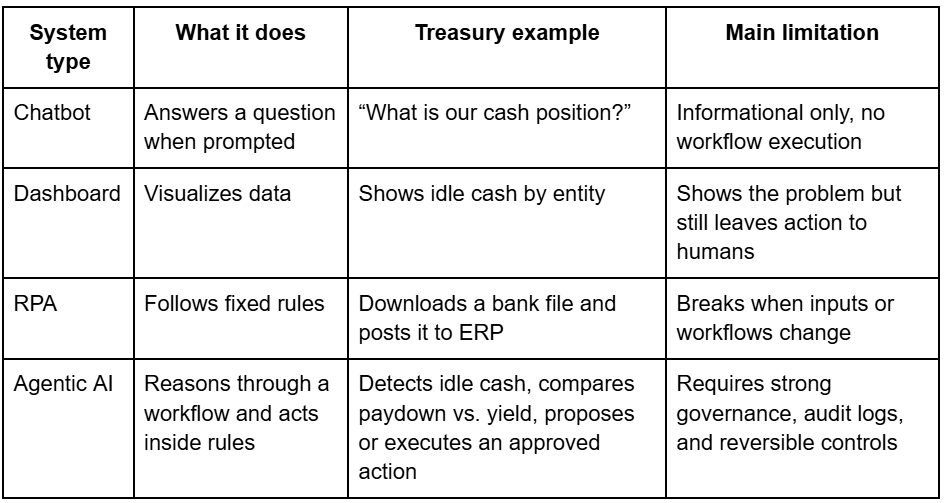
An agentic system isn’t a chatbot that knows your bank balance. It is a deterministic agent operating inside your governance rules.
How Does an Agentic System Handle a Real Treasury Workflow?
And yet, abstract definitions only carry so far. So here’s what Agentic AI for treasury looks like at 2:47pm on a Tuesday, when the Nilus Liquidity Agent is deciding whether to sweep idle cash to the money market or pay down the revolver.
Step 1: Data Ingestion
The Agent pulls live bank balances across all connected accounts via direct API. In that same moment, it refreshes ERP context: current payables schedule, outstanding receivables, any covenants with balance thresholds. The data layer is live.
Step 2: Pattern Detection
The Agent identifies that Entity A has crossed its idle cash threshold. The balance has been sitting above the floor for 36 hours. Based on your rules, that triggers a liquidity decision workflow.
Step 3: Hypothesis Formulation
Two options are formulated. Option A: sweep the idle cash to the money market fund. Option B: apply it to the revolving credit facility given the current spread between the MMF yield and the revolver cost. The Agent pulls the current rate data and runs the comparison.
Step 4: Confidence Scoring
The Agent assigns an 87% confidence score to the revolver paydown recommendation. The confidence score reflects the historical pattern match, the rate environment, and the proximity of the next forecasted outflow.
Step 5: Rule-Bounded Action Proposal
The Agent knows its autonomy level. This action exceeds the auto-execute threshold, so it generates a proposal rather than executing directly. The proposal lands in the CFO’s approval queue with the full rationale attached.
Step 6: Approval Within CFO Rules
The CFO reviews the proposal at 2:47pm. It matches the rationale they’d have reached manually. They approve. The Agent executes the action.
Step 7: Audit Log Entry
Every input is logged: the bank balance that triggered the workflow, the ERP context used in the decision, the two hypotheses formulated, the confidence scores assigned, the rule that governed the autonomy level, the CFO approval timestamp, and the action executed. The log is immutable and replayable.
Step 8: Variance Tracking and Feedback Loop
By Friday, the agent checks the outcome. Did the revolver paydown produce the expected cost reduction? Did the forecasted AR collection arrive on schedule? The actual vs. predicted variance feeds back into the forecast model. The Agent learns from the outcome without changing its underlying rules without human authorization. Decisions you can defend. Actions you can audit. See Agentic AI in action. Schedule a 30-minute walkthrough today
How Do CFOs Stay in Control of Agentic Systems?
The governance model isn’t just a footnote. For the CFO who has to explain the system to their board, and for the auditor who has to sign off on it, the governance design is the product. Governing an agentic system isn’t a matter of trusting the AI and hoping for the best. It’s a matter of setting the rules the AI operates inside, and auditing every action it takes within them.
The Four Autonomy Levels
Agentic systems operate on a defined autonomy spectrum. Each level is set by the CFO and can be adjusted without touching the underlying AI: Advise: The Agent surfaces analysis and recommendations but takes no action. A human makes every actual decision. Propose: The Agent formulates a recommended action and sends it to the approval queue. It will engage in zero execution without human sign-off. Execute with approval: The Agent executes actions up to a defined threshold automatically. Actions above the threshold require CFO approval before execution. Autonomous within bounds: The Agent executes within a defined parameter set without per-action approval. Every action is logged in real time and can be reviewed and/or reversed.
Approval Thresholds and Escalation Logic
All cash moves below a CFO-defined threshold auto-execute. Any moves above that threshold require CFO approval. Moves above a second, higher threshold require CFO and CEO approval. These thresholds are configuration, not code. The CFO sets them. The CFO changes them. The audit trail records every change.
Audit Trail Design
Every action is logged with the initiating trigger, the rule fired, the inputs used, alternatives considered, confidence scores, and what was executed. The log is machine-readable for external audit and human-readable for board presentation.
Reversible Actions by Default
Nothing the Agent executes is irreversible without explicit human override. The original state is recoverable from the audit log. If a sweep executes and conditions change before settlement, the action can be reversed with a single approval.
NIST AI RMF and ISO 42001 Mapping
The NIST AI Risk Management Framework and ISO 42001 provide the governance architecture that auditors and risk committees recognize. Auditability requirements map to the audit trail, transparency requirements to driver attribution and confidence scores, and accountability requirements to the autonomy level structure.
SOC 2 and Internal Audit Alignment
The audit trail an agentic system produces gives internal audit something they’ve rarely had before: a complete, replayable record of every financial decision the AI made, with the inputs, the logic, and the outcome. The Strategic Treasurer 2026 Treasury Technology Analyst Report identifies governance-grade audit trails as a priority feature among enterprise treasury teams evaluating AI platforms. Download the Agentic AI Governance Checklist
How Should CFOs Evaluate Agentic AI for Treasury?
Before a finance team lets an AI agent touch forecasting, liquidity, reconciliation, or payments, it should be able to answer five questions.Can the system explain every recommendation? Ask for driver attribution, confidence scoring, and a sample audit trail.Can the system operate inside defined approval thresholds? Autonomy should be configurable by amount, entity, risk level, and workflow.Can every action be reversed or reviewed? Reversibility is not optional in treasury. It is a governance requirement.Does the system integrate with the actual operating stack? Bank APIs, ERP data, payment rails, and reconciliation workflows matter more than a chat interface.Does the vendor separate deterministic workflows from generative outputs? The agent can use AI, but the treasury workflow needs bounded logic, repeatable controls, and auditability. This is the difference between AI agents for treasury and chat-shaped demos. One gives a CFO a tool to govern. The other gives a CFO another output to second-guess.
Why Does Agentic AI Matter in 2026?
Era 3 isn’t coming. It’s here. Four things converged this year that make agentic treasury not just interesting but necessary.
Higher Rates Make Idle Cash Expensive
Every $1 million sitting in a low-yield account costs between $40,000 and $80,000 per year in foregone yield at current rates. A company with $50 million in structural cash drag may be leaving $2 million to $4 million on the table annually. The agent that catches those idle balances and proposes the right action can pay for itself quickly when the opportunity is already present.
Account Complexity Is Rising
In many PE-backed and multi-entity environments, companies now span 12 or more banking relationships and 15 or more legal entities. Manual cash consolidation at that scale takes hours every morning. And it’s already outdated by the time it’s complete. The agent that ingests all 12 banks in real time and flags the exception before the CFO’s 9am call is doing work that a human team simply cannot replicate at anywhere near the same speed.
AI Forecast Accuracy Has Crossed the Usability Threshold
AI accuracy at 13-week cash forecasting can reach 88 to 92% in 2026 production deployments, based on observed agentic treasury environments using deterministic workflows on live bank data. At that accuracy level, the forecast becomes defensible to a board and usable as the basis for a liquidity decision.
2026 Is the Execution Year
PwC’s 2026 CFO Pulse Survey, the Bottomline Technologies Treasury Insights Report, and the Strategic Treasurer 2026 Technology Analyst Report all identify AI-driven treasury automation as moving from pilot to production this year. The discussion is over. The systems are shipping. The question is whether the system your team deploys was built with governance-first architecture or bolted together from a chat interface. 2025 was the year AI in treasury became real. 2026 is the year it becomes accountable.
Agentic AI Treasury Glossary
Deterministic agent: An AI system that produces the same output for the same input inside a structured workflow, using defined rules and controls instead of relying on free-form probabilistic generation. In treasury, determinism is the property that makes audit trails meaningful and board presentations possible. Autonomy levels: A four-tier model defining how much independence an agent has: advise, propose, execute-with-approval, and autonomous-within-bounds. Each level is set by the CFO and determines which actions require human sign-off before execution. Audit trail: A complete record of every action an agent takes, including inputs used, rules fired, alternatives considered, confidence scores assigned, and the final decision executed. In a well-designed agentic system, the audit trail is immutable, machine-readable, and replayable. Driver attribution: The mechanism that explains which underlying factors drove a forecast or decision. Example: “This $2M variance came from the Atlanta entity’s AR delay.” Driver attribution is required output for any agentic system operating in a governed finance environment. Confidence score: A numerical estimate of how reliable a specific output is, expressed as a percentage. Required for any action the agent proposes to a human. A confidence score below a defined threshold can trigger escalation to a higher autonomy tier. Reversibility: The property that any action an agent executes can be undone by a human operator, with the original state recoverable from the audit log. Reversibility is a design requirement, not an after-the-fact safety net.
Frequently Asked Questions
1. What is agentic AI for treasury?
Agentic AI for treasury is a class of AI systems that execute treasury workflows inside the CFO’s governance rules, rather than simply displaying data or answering questions. These systems take action on forecasting, reconciliation, liquidity moves, and covenant tracking, with a full audit trail and reversible controls.
2. How is agentic AI different from a chatbot or AI assistant?
A chatbot answers questions. An agentic system executes workflows. Specifically, a chatbot for treasury might tell you your current cash position when you ask. An agentic system detects that the cash position in a specific entity has crossed a threshold, formulates a sweep recommendation, scores it against your governance rules, and either executes or proposes the action without waiting for a prompt.
3. Is agentic AI safe to use with company cash?
Agentic AI is safe when it is deterministic, governed, and designed with reversibility by default. The relevant safety architecture includes: defined autonomy levels set by the CFO, approval thresholds above which no action executes without human sign-off, immutable audit trails on every action, and full reversibility with state recovery.
4. What governance frameworks apply to agentic AI in finance?
The two primary frameworks are the NIST AI Risk Management Framework (NIST AI RMF) and ISO 42001. Both address auditability, explainability, and accountability for AI systems in high-stakes environments. A well-governed agentic treasury system maps its audit trail design to NIST AI RMF transparency requirements, its driver attribution outputs to explainability requirements, and its autonomy level structure to accountability requirements.
5. Can an AI agent execute a payment without human approval?
It depends on the autonomy level the CFO has configured. At the execute-with-approval tier, all actions above a defined threshold require human sign-off. At the autonomous-within-bounds tier, actions within defined parameters execute automatically, but every action is logged in real time and reversible.
6. What’s the accuracy of an agentic forecast vs. a manual one?
In observed 2026 production environments, agentic 13-week cash forecasts can reach 88 to 92% accuracy when powered by live bank data, ERP context, and deterministic controls. Manual 13-week forecasts in complex multi-entity environments often run closer to 65 to 75% accuracy, depending on the quality of the inputs and the analyst’s time.
7. Which treasury platforms use agentic AI in 2026?
Nilus offers deterministic AI agents built specifically for cash visibility and liquidity decisions, with governance-first architecture and direct bank API connections. Trovata focuses on bank data aggregation and cash forecasting with AI-assisted analysis. HighRadius targets enterprise order-to-cash and treasury automation with AI features across its broader finance platform. Bottomline Technologies includes Bea, an AI assistant for payments and treasury. Agicap offers an AI assistant oriented toward cash flow forecasting for mid-market companies. For a broader buyer comparison, see Best AI Treasury Platforms 2026 or this Trovata alternatives guide.
8. How do I get started with agentic AI in my treasury function?
Start with cash visibility rather than automation. The prerequisite for a well-functioning agentic system is a clean, consolidated, real-time cash position across all banks and entities. Once that data layer is in place, the right starting workflow is forecasting: run the agent in advise-only mode, compare its 13-week forecasts to your manual process, and measure the accuracy gap. Only after you’ve validated the forecast layer should you move to proposal and execution workflows. The governance checklist below is a practical starting framework.