AI-native treasury platforms use AI to help finance teams interpret cash positions, surface liquidity risks, and recommend the next treasury action. But the right platform depends on where your cash process breaks today. Some software is built around AI-supported workflows, while others are established treasury or finance systems adding AI to mature workflows. We included both because buyers evaluating AI treasury software usually compare them side by side. Nilus fits PE-backed and multi-entity teams that need policy-backed liquidity decisions. Kyriba and Ripple Treasury support large enterprises with broad TMS needs. Trovata gives teams a stronger bank-data foundation, while HighRadius helps improve forecast reliability when receivables data plays a major role. Below are the best treasury management software in 2026 by positioning, strengths, pricing, and limitations. Written by the Nilus team, this guide focuses on fit: what each platform does best and who it serves.
How we evaluated these AI-native treasury platforms
Not every AI treasury platform plays the same role in the treasury stack. Some are enterprise TMS platforms adding AI to mature treasury infrastructure. Others focus on bank visibility, cash forecasting, receivables automation, or cash management. A smaller group is built around AI-supported treasury decisions from the start. That’s why this isn’t a feature-count exercise. We evaluated each platform across 7 criteria that affect buyer fit, implementation risk, governance, and long-term cost. Use the rubric below to compare each platform by operating model fit.
1. Treasury stack role
What role does the platform need to play in your treasury stack? Identify whether the platform functions as a system of record, a visibility layer, a receivables platform, or a system of action. A system of record supports core treasury operations like payments, FX, debt, investments, and risk. A visibility layer gives finance a faster cash view, whereas a receivables platform improves the inputs behind the forecast. A system of action connects cash insight to the next controlled step, such as an approval or documented exception. Treasury tools can look similar in a demo while solving very different problems. For instance, an enterprise may need deepe TMS coverage, while a PE-backed company may need clearer usable cash and controlled liquidity decisions. The right fit depends on where your process breaks today.
2. AI behavior and decision control
What does the AI actually do once it has access to treasury data? “AI-powered” is too broad to be useful on its own. Find out what the AI actually does once it has access to treasury data. Some platforms use AI to summarize balances, classify transactions, or explain variances. Others apply AI to reconciliation, forecasting, anomaly detection, or liquidity recommendations. If you want the platform to support cash decisions, test whether it can apply policy, explain recommendations, route approvals, and preserve the rationale for later review.
3. Time to trusted output
How quickly can finance use the platform’s output without rebuilding it elsewhere? Time to value is not the same as time to dashboard. Ask each vendor to show the first output your team can rely on without recreating it elsewhere. That might be a daily cash position, forecast update, reconciliation result, receivables view, or liquidity recommendation. Then ask what has to be connected first: banks, ERPs, payment processors, entities, historical transactions, approval rules, or workflow configuration. The real test isn’t how fast the software goes live. It’s how fast finance can use the output in a decision.
4. Multi-bank and multi-entity fit
Can the platform preserve cash context across the structure you actually operate? Bank visibility tells you where cash sits. It doesn’t always tell you whether that cash is usable. That gap matters for PE-backed, acquisitive, multi-entity, and international companies. There, cash is often restricted by entity, debt requirements, internal policy, timing, currency, or near-term obligations. During diligence, use your actual entity and bank structure. Ask each vendor to show how the platform handles usable cash, restricted balances, funding needs, intercompany movement, and liquidity rules. The stronger fit is the platform that preserves enough context for your team to make the next cash decision without rebuilding the view elsewhere.
5. Governance and audit trail
Can the platform explain how a treasury decision was made? Finance may need to show where the number came from, why a forecast changed, who approved the decision, and what action was taken. Look for an evidence trail that matches how the platform will be used. If it supports receivables, it should preserve deduction, remittance, and posting logic. If it supports broader treasury operations, it should show the controls behind payments, risk, approvals, and cash actions.
6. Pricing transparency
How will pricing change as your treasury footprint grows? Have each vendor explain the pricing model clearly. Costs may increase with added bank connections, accounts, entities, users, transaction volume, modules, integrations, implementation support, or managed connectivity. Then model year-two and year-three usage. What happens if you add entities, expand reconciliation coverage, bring in more approvers, increase transaction volume, or activate another workflow? Know exactly how the pricing model scales against the complexity you’re trying to manage.
7. Best-fit customer profile
Does the vendor’s strongest customer profile match your operating reality? A platform can be strong and still be wrong for your team. Look at the customers it serves best: enterprise treasury teams, PE-backed finance teams, lean mid-market teams, receivables-heavy businesses, or companies formalizing cash management for the first time. Then compare that profile with your own complexity, team size, control requirements, and implementation capacity. The risk is mismatch. If the platform is too heavy, implementation can absorb the value. If it’s too narrow, finance still has to build the real process around it.
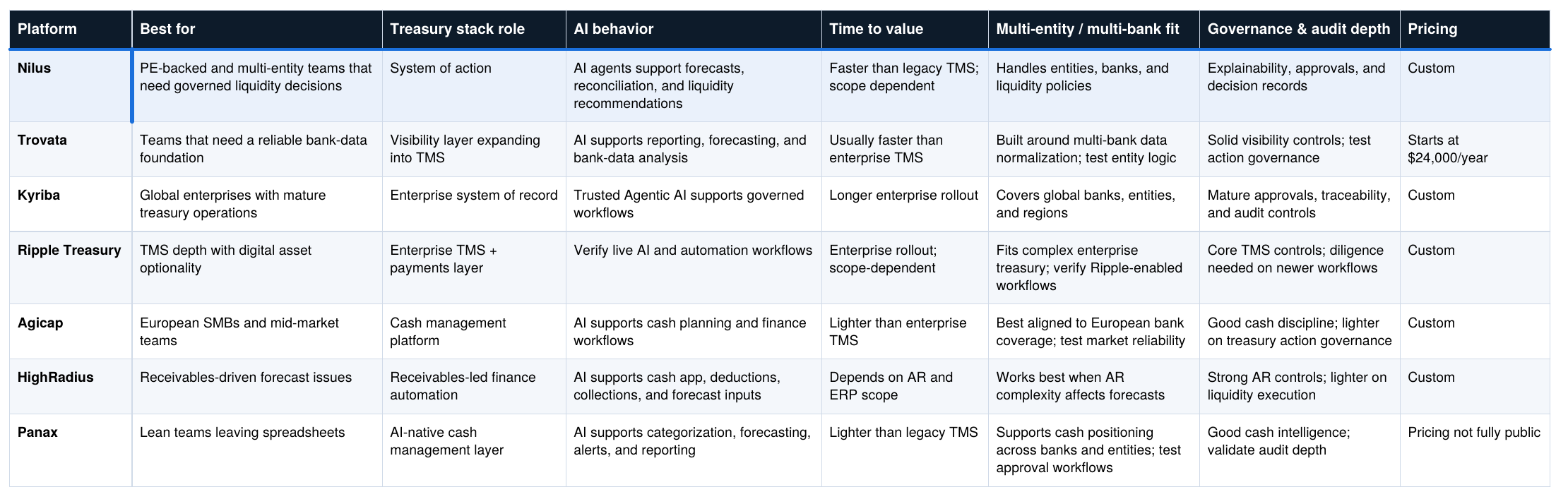
At-a-glance comparison table: Best AI treasury software in 2026
Talk to a treasury platform advisor - free 30-min consult
1. Nilus - Best for PE-backed and multi-entity companies that need governed liquidity decisions
Nilus is an AI-powered treasury platform for finance teams that need cash positioning, forecasting, reconciliation, and liquidity actions in one controlled system. It’s built for PE-backed and multi-entity companies that have outgrown cash reporting as a standalone exercise. These teams need to know which cash is usable, why the forecast changed, and what response is required. Nilus brings that work into one workflow. Finance can review the current cash position, trace forecast drivers, and compare recommended cash moves against company policy. Its Liquidity Agent monitors cash against your rules and flags issues that need review, such as funding gaps or threshold breaches. When action is needed, the recommendation moves through approval with supporting evidence attached. That connected record makes decisions easier to review and defend later. Strengths
Shows usable cash across entities, banks, and accounts. Connects cash positioning, forecasting, and reconciliation context. Routes liquidity recommendations through policy-based approvals. Preserves the rationale and evidence behind cash decisions. Best-fit scenarios
- PE-backed or sponsor-backed companies that need better control over cash across entities and bank accounts
- Mid-market finance teams that want AI-supported treasury workflows without the cost or complexity of a full enterprise TMS
Pricing: Custom; you’ll have to contact sales for pricing based on your entities, accounts, integrations, workflow scope, and implementation needs. Limitation: Nilus isn’t the natural fit if you need a full enterprise TMS for complex FX, debt, hedging, payment factory, or global risk workflows. See where Nilus fits in 30 minutes
2. Trovata - Best for teams that need bank visibility before broader treasury automation
If your team still relies on bank portals or spreadsheet-built cash reports, Trovata gives you a cleaner bank-data foundation. Its Cash Management platform brings balances and transactions into one place, so you can understand cash activity, build cash-position reports, and forecast from bank data without stitching the view together manually. That makes Trovata useful when your first problem is trust in the numbers. The ATOM acquisition also gives it more TMS depth across debt, investments, FX, intercompany activity, and bank account management, which may help teams that want to start with cash visibility and expand over time. Strengths
Strong real-time bank-data foundation. Good starting point for cash visibility before heavier treasury workflows. Expanded treasury scope through ATOM. Best-fit scenarios
- Mid-market companies where the main priority is faster, cleaner liquidity view across banks
- Finance teams that want API-led treasury infrastructure and are comfortable evaluating a platform expanding into broader TMS functionality
Pricing: Trovata publishes base pricing at $24,000/year, including 1 bank, 100 accounts, 1 million transactions, and 10 users. Limitation: Trovata’s broader TMS depth is still acquisition-led. Its capabilities beyond cash visibility come largely through ATOM, so buyers should test how mature and integrated those workflows feel inside the Trovata platform.
3. Kyriba - Best for global enterprises with mature treasury operations
Kyriba makes a solid choice when your treasury team has outgrown regional workarounds and needs one control layer for global operations. Cash, payments, risk, debt, and investment workflows may still be owned by different teams, but the policies, approvals, and audit trail need to hold together across the business. That’s where Kyriba is strongest. It gives mature treasury teams the infrastructure to standardize how decisions move from analysis to approval to recordkeeping. Its Trusted Agentic AI fits that model because recommendations stay inside the control path, with traceability and human review built in. Strengths
- Broad enough to consolidate multiple treasury workflows in one TMSStrong control trail for recommendations, approvals, and audit records
- Best suited to mature treasury teams that can support a full rollout
Best-fit scenarios
- Global multinationals with dedicated treasury teams and complex risk requirements
- Enterprises that need deep TMS breadth more than fast implementation or lightweight usability
Pricing: Custom; you’ll have to contact sales for a quote tailored to your treasury setup and implementation scope. Limitation: Kyriba may be more system than you need if your main priority is a faster daily cash view and clearer liquidity decisions without a full TMS rollout.
4. Ripple Treasury (formerly GTreasury) - Best for enterprises that need TMS depth and want digital asset optionality
Ripple Treasury is built on GTreasury’s enterprise TMS foundation, with Ripple’s payments network and digital asset infrastructure layered on top. The core platform still starts with traditional treasury management: cash positioning, forecasting, payments, risk, debt, investments, and reporting. It fits enterprises managing treasury across multiple entities, regions, banks, exposures, and approval workflows. Ripple adds the modernization path. If your team is exploring digital asset accounts, fiat-and-digital cash visibility, or faster payment rails, Ripple Treasury can give you room to evolve beyond a traditional TMS. Strengths
Covers complex treasury work like risk, debt, investments, payments, and exposures. Relevant if your team is exploring digital assets or modern payment rails. Suitable for large treasury transformations. Best-fit scenarios
- Enterprise companies with meaningful risk, hedging, debt, or investment management needs
- Treasury teams that want a proven TMS foundation with a path toward digital asset-enabled treasury capabilities
Pricing: Custom; you’ll have to contact sales for a quote tailored to your treasury setup and implementation scope. Limitation: Ripple Treasury is still a diligence-heavy choice if you want GTreasury’s traditional TMS depth and Ripple’s payments or digital asset capabilities in one workflow. Verify what’s native, what’s integrated, and what requires separate Ripple infrastructure.
5. Agicap - Best for European SMBs and mid-market teams formalizing cash management
Agicap fits when your finance team has outgrown spreadsheet-based cash planning but still isn’t ready for a full enterprise TMS. You need better control over incoming cash, upcoming payments, and forecast changes without building a dedicated treasury function yet. Agicap addresses that gap by connecting the data behind your weekly cash process, including bank balances, ERP data, AP, AR, payments, and consolidation. That helps you manage short-term liquidity without rebuilding the cash view manually. Its European focus is part of the fit. Bank connectivity, payment workflows, and consolidation needs can vary by market, so Agicap is especially relevant if you operate across countries like France, Germany, or Spain. Strengths
Replaces fragile spreadsheet-based cash planning. Brings AP, AR, and bank data into short-term liquidity planning. Adds cash structure without forcing an enterprise TMS rollout.3,000+ European bank connections. Best-fit scenarios
- European SMBs and mid-market teams that need better cash planning without enterprise TMS complexity
- Finance teams moving from spreadsheet-based cash tracking to a dedicated cash management platform
Pricing: Custom; you’ll have to contact sales for a quote tailored to your treasury setup and implementation scope. Limitation: Agicap’s value depends heavily on bank connectivity, so test reliability during diligence. Some users report broken or unreliable bank connections.
6. HighRadius - Best for companies where receivables drive treasury uncertainty
You can try HighRadius when your treasury forecast is only as reliable as the receivables data feeding it. In high-volume businesses, cash may already be in the bank, but you still can’t use it confidently if payments sit unapplied, deductions stay unresolved, or collections timing keeps shifting. HighRadius tackles that problem from the order-to-cash side. Its strength is cash application, deductions, and collections automation, helping your team post received cash faster and reduce the receivables noise that weakens forecast confidence. Its cash application software supports 90%+ straight-through processing through AI-driven payment matching and exception handling. That said, the software becomes less relevant if your main challenge is moving liquidity across banks and entities. HighRadius can improve the quality of forecast inputs, but it’s less centered on governing the treasury action that comes after the cash position is clear. Strengths
Improves receivables data for more reliable forecasts. Connects payment matching to cleaner cash reporting. Deep ERP integrations (SAP, NetSuite, Oracle). Best-fit scenarios
- Large enterprises where AR delays make liquidity forecasts harder to trust
- Finance teams that want better forecasts from cleaner, faster receivables data
Pricing: Custom; you’ll have to contact sales for a quote tailored to your treasury setup and implementation scope. Limitation: HighRadius may not fit if your main issue is liquidity execution rather than receivables accuracy.
7. Panax - Best for lean teams moving from spreadsheets to AI-native cash management
Panax is worth evaluating when manual cash reporting is slowing your team down, but a legacy TMS would be too heavy for the problem you’re solving. It helps you bring bank and ERP data into a more current cash view, use AI to classify activity, spot unusual movements, and build forecasts without rebuilding reports each week. That makes it useful for lean finance teams that need a faster read on cash position and forecast changes. Panax is strongest for cash visibility and forecasting. Some plans extend into reconciliation and cash application, but don’t treat it as a broader treasury execution system without testing approval paths, documentation, and liquidity decision workflows. Strengths
- AI-driven forecasting built from bank and ERP history
- AI agents that support reconciliation, categorization, reporting, and data upkeep
- Dynamic reporting for anomalies, trends, and cash opportunities
Best-fit scenarios
- Finance teams that need AI-native cash management without a long enterprise TMS rollout
- Multi-entity companies that need better cash positioning and forecasting before enterprise risk or payments infrastructure
Pricing: Custom; Panax offers Start, Grow, and Pro tiers, but doesn’t publish pricing. Limitation: Panax can still require meaningful setup across banks, ERPs, entities, and cash workflows. Make sure to test implementation effort rather than assuming it is plug-and-play.
How to choose between these platforms: a 5-step framework
Use this framework to separate strong demos from strong fits. The right shortlist should reflect where your treasury process breaks today.
1. Is your primary pain visibility or execution?
Start with the last few treasury bottlenecks. If the issue was missing bank data or manual cash reporting, prioritize visibility. If the issue was deciding what cash to move, who needed to approve it, or how to document the decision, prioritize execution.
2. Do you operate under PE, lender, or audit pressure?
Treasury software matters more when the number has to be defended. If sponsors, lenders, auditors, or the board review your cash decisions, the platform needs to preserve the “why” behind the number. Ask vendors to show the evidence trail in the demo.
3. How much operating complexity does the platform need to handle?
Don’t evaluate the tool against a simplified version of your business. Bring the messy version: entities, banks, ERPs, PSPs, currencies, restrictions, and approval paths. Then ask the vendor to walk through a real scenario, such as funding a short entity from one with excess cash.
4. What do the AI features actually do?
Ignore the AI label until the vendor shows the workflow. If the system flags a forecast variance or liquidity gap, what happens next? Does it only summarize the issue, or can it recommend the next step and preserve the decision record? AI that explains cash data saves time. AI that supports a controlled treasury action changes the workflow.
5. How will you defend the decision to your board in 12 months?
Before you sign, write the renewal case. By month 12, the platform should have a clear job to prove: less manual cash work, stronger forecast confidence, better control over liquidity decisions, basically, something concrete. If the value case is still vague, the platform probably doesn’t belong on the shortlist. Download the Treasury Platform Decision Test PDF
FAQs about the best AI treasury software
What is the best AI treasury platform in 2026?
The best AI treasury platform in 2026 depends on your treasury operating model. Nilus is strongest for PE-backed, multi-entity, and mid-market teams that need AI-supported treasury action. Kyriba and Ripple Treasury fit large enterprises that need full TMS depth. Trovata is strongest when the first priority is a reliable multi-bank cash view.
What’s the difference between AI-native and AI-bolted-on treasury platforms?
AI-native treasury platforms are built around AI-supported workflows, not just AI features. The main difference is whether AI can support forecasting, reconciliation, liquidity decisions, approvals, and audit trails inside the platform. AI-bolted-on tools often act more like assistants for summaries, reporting, or navigation.
How long do AI treasury platforms take to implement?
Implementation depends on bank connectivity, ERP complexity, entities, modules, and workflow depth. Lighter cash visibility platforms can often move faster, while enterprise TMS implementations usually take longer because they require more configuration and controls. The better question is: how soon can your team use the platform to make or defend a cash decision?
Which treasury platform is best for PE-backed companies?
Nilus is a strong fit for PE-backed companies that need weekly cash discipline, multi-entity visibility, and governed liquidity decisions without taking on a full enterprise TMS. The key requirement is not just seeing cash. It is knowing which cash is usable, what changed, what action should happen, and how that decision gets approved.
Which treasury platform has the best forecasting accuracy?
There’s no universal “most accurate” treasury forecasting platform. Accuracy depends on bank data quality, ERP inputs, receivables behavior, entity structure, and forecast methodology. HighRadius may fit receivables-driven forecasts. Nilus is stronger when teams need explainable forecasts tied to drivers and treasury actions.
Which AI treasury platforms have transparent pricing?
Trovata publishes base pricing at $24,000/year. Panax publishes plan tiers, though higher-tier pricing still requires a quote. Most other treasury platforms, including Nilus, Kyriba, Ripple Treasury, Agicap, and HighRadius, use custom pricing.
How does agentic AI compare to AI assistants in treasury?
AI assistants help users find, summarize, classify, or explain information faster. Agentic AI goes further by supporting the next controlled step, such as a recommendation or documented action. In treasury, that difference matters because cash decisions need a control path, not just a faster answer.