It’s the life of a CFO:
Your sponsor wants a TMS in place by the end of the year. The board wants weekly cash visibility. The auditor wants a real audit trail. The Controller wants to stop logging into nine bank portals at 8 am. Five vendors are on the shortlist, three are on the same platform with different logos.
You’ve got ninety days.
A Treasury Management System (TMS) is software that centralizes a company’s cash visibility, forecasting, payments, bank connectivity, and treasury reporting. Modern TMS platforms also automate reconciliation, liquidity management, and covenant tracking using AI agents that execute workflows inside CFO-defined rules.
That definition has changed more in the last 24 months than in the previous 20 years. In the beginning, your only real TMS option was Excel. Now, you’re choosing from among two camps:
- Legacy platforms, built for a quarterly reporting world
- Modern agentic platforms, built for daily decision-making
What you need at this point is a frame. Not a feature checklist. A frame.
Knowing which camp you’re shopping in determines what you’ll pay, how long you’ll wait, and what you’re actually going to get on the other side.
This guide is the frame. Use it before demos start.
What Does a Treasury Management System Do?
A TMS sits at the intersection of your banks and your books. It handles the workflows that finance teams would otherwise build out of spreadsheets, emails, and, of course, late mornings.
In practice, it covers six core functions:
- Multi-bank cash visibility. Consolidate balances across every bank and entity in a single view.
- Cash flow forecasting. Typically on a 13-week horizon, with continuous updates as actuals arrive.
- Payment execution and approval workflows. Initiate, approve, and audit wires, ACH, and intercompany transfers.
- Bank account management and connectivity. Open, close, manage, and monitor accounts across the bank network.
- Reconciliation and accounting integration. Match bank activity to the ERP, post entries, and close the books faster.
- Risk and compliance reporting. Covenant tracking, liquidity reporting, and audit-ready records.
A TMS isn’t a dashboard you log into. It’s the operating layer between the bank and the books. When it works, that morning ritual disappears. When it doesn’t, your finances live in spreadsheets.
Who Needs a TMS?
The honest answer: you outgrow Excel before you think you do.
The triggers aren’t subtle once you know what to look for. Most companies hit one or two before they act. By the time they hit four, you’re already feeling the pain through someone’s extra labor hours.
- 3+ legal entities. Intercompany cash gets complicated fast. Manual tracking introduces lag and reconciliation debt.
- 5+ bank relationships. Logging into portals doesn’t scale. Nine logins, two-factor codes, and export buttons stop being a morning routine and start becoming a risk.
- $200M+ revenue. At this size, the cost of bad visibility is real money. A missed liquidity signal isn’t an inconvenience. It’s a margin event.
- 5+ person finance team. Multiple people need the same number, and when they each build it separately, the number stops being a number. It becomes an opinion.
- PE-backed or pre-IPO governance pressure. The auditor wants a trail. The sponsor wants controls. “We track it in Excel” is no longer the appropriate answer.
- Multi-currency operations. FX adds a dimension that spreadsheets handle poorly, and ERPs handle slowly.
If you hit two of these, you’re probably already feeling the pain. If you hit four, you’re way past due. If you hit all six, you’re losing time you never get back.
Legacy TMS vs. Modern (AI-Native) TMS: Which Era Are You Shopping In?
Here’s the frame most vendors won’t give you.
The TMS category didn’t evolve gradually. It split. And the split happened because the underlying question a treasury team needs to answer changed.
The old question was: what did our cash do?
Era 1 was Excel, so we answered that question manually.
Era 2 was Legacy TMS, platforms like Kyriba, GTreasury, and ION. They answer this question systematically with visibility, dashboards, and reporting. It was a genuine improvement over spreadsheets. These platforms built deep coverage, strong audit infrastructure, and enterprise-grade reliability. They earned their place in the market.
But the question that runs a treasury team today is different: what should our cash do, and when? That’s an Era 3 question. Modern, AI-native platforms like Nilus were built to answer it.
- Era 1: Excel. Flexible, fragile, and entirely dependent on who made the file.
- Era 2: Legacy TMS (Kyriba, GTreasury, ION). System of record. Visibility-first. Built for quarterly reporting cycles. Deep functional coverage, slow time-to-value.
- Era 3: Modern, agentic TMS. System of action. Execution-first. Built for daily decision-making. Deterministic AI agents that act inside CFO-defined rules.
The table below shows where the eras diverge on the dimensions that actually matter at vendor selection:
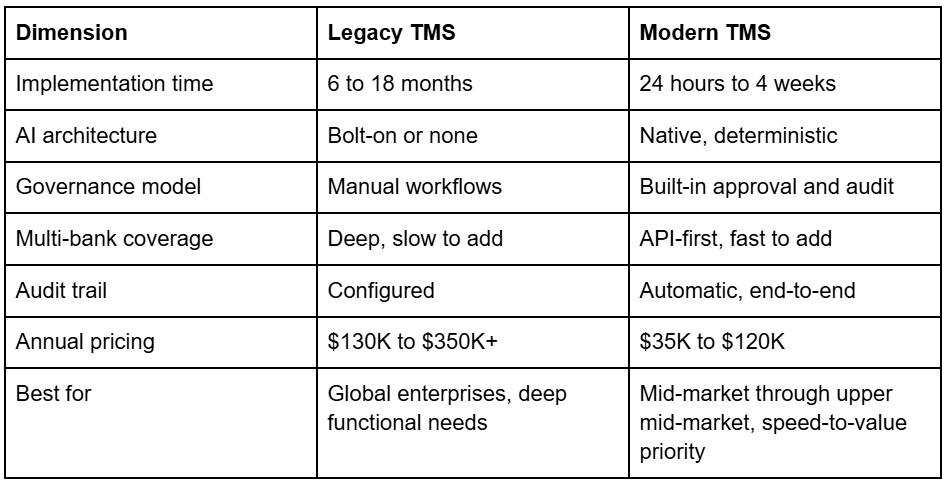
A TMS isn’t a dashboard you log into. It’s the operating system your treasury runs on. The question isn’t whether you need one. It’s the era you’re shopping in.
Want to skip the legacy timeline? See agentic implementation.
Core TMS Capabilities Explained
Each of the six core functions is a self-contained answer to a specific treasury problem. Here’s what they actually do.
- Cash visibility. Real-time consolidated balances across every bank and entity, pulled directly from the bank, not inferred from the ledger. That difference matters: ERP-sourced balances show accounting truth. Bank-sourced balances show cash truth. At 8:12am when payroll has to move, you need the second one. See how cash positioning works.
- Cash flow forecasting. A rolling 13-week forecast that updates continuously as actuals arrive, not once a week when someone rebuilds the model. Modern platforms attribute variance by driver, so when the number moves, you know why it moved, not just that it did. How forecasting works in practice.
- Payments execution. Initiation, multi-level approval workflows, and full audit capture across wires, ACH, and intercompany transfers. The workflow matters as much as the execution: every payment should require the right approvals, leave a clean trail, and be reversible by design. A TMS that executes payments without controlled workflows isn’t an improvement over the spreadsheet. It’s a faster way to make the same mistakes.
- Reconciliation. Match bank activity to the ERP automatically. Surface exceptions rather than making your team find them. When reconciliation runs in the background, the close gets faster, and the exceptions that matter actually get attention. How reconciliation works.
- Liquidity management. Operating minimums, idle cash detection, and deployment recommendations based on current balances and forecasted flows. This is where a TMS moves from visibility to action: knowing that cash is idle is interesting. Getting a recommendation to deploy it is useful.
- Covenant compliance and reporting. Daily ratio calculation, headroom alerts, and lender-ready packages built automatically. When a covenant breach is 30 days away, you want to know on day one of that 30, not on day 29, when the lender calls.
- AI and agentic execution layer. Deterministic agents that execute treasury workflows inside CFO-defined rules. Not probabilistic AI that suggests and waits for a human. Agents that act when conditions are met, within guardrails set by the finance leader. How agentic AI works in treasury.
See how Nilus runs treasury end to end →
How Long Does TMS Implementation Take?
The implementation timeline is the single biggest signal as to which era a TMS belongs to. It’s also the number most buyers underestimate when they’re comparing platforms.
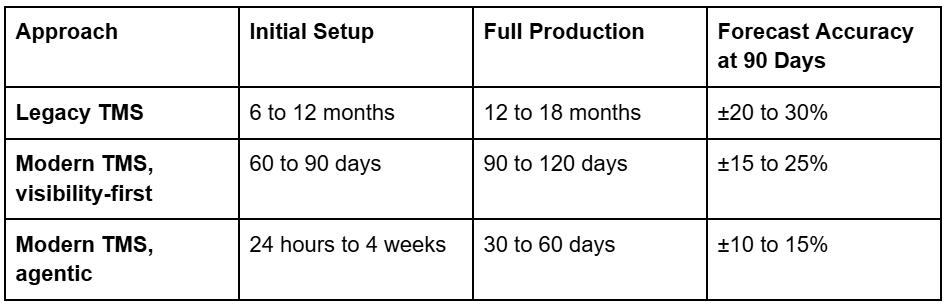
The timeline differential isn’t about complexity. It’s about architecture. Legacy platforms require multi-quarter configuration because the system was built before APIs were standard. You have to build, test, and map connectivity to a data model. Then you have to reconcile it against the ERP.
That process takes what it takes.
Modern platforms ship live in days to weeks because the data plumbing was designed for it from day one. API-first bank connectivity, pre-built ERP connectors, and a forecasting engine that calibrates on your actuals rather than requiring manual tuning aren’t merely features. They’re architectural choices that make up a 12-month difference in time-to-value.
If a vendor is quoting you a 6-month implementation, ask why. The answer you get will tell you whether you’re buying Era 2 or Era 3.
What Do I Look for in a Modern TMS in 2026?
Once you’ve decided you’re shopping in Era 3, explore these seven dimensions that separate the platforms.
1. AI architecture
You’re looking at deterministic vs. probabilistic and auditable vs. not. A deterministic agent will execute within the rules you set and produce outcomes you can trace. A probabilistic model suggests what might happen. For treasury, the first is a control. The second is a recommendation. They’re not the same thing. See how deterministic AI works.
2. Multi-bank API coverage
How many banks are natively supported? How long does it take to add a new one? Banks that require file-based connectivity instead of APIs introduce the lag you’re trying to eliminate. Get the list before you sign on the dotted line.
3. ERP integrations
Native connectors for NetSuite, SAP, Workday, and Microsoft Dynamics, not middleware that requires a consultant to configure. If the integration needs a statement of work, that’s an implementation cost that doesn’t appear in the license fee.
4. Audit trail depth
Every action logged. Every change traceable. Reversible by design. This is table stakes for PE-backed companies and pre-IPO governance. If the vendor can’t demo a complete audit trail in 10 minutes, that trail doesn’t exist the way you need it to.
5. Governance frameworks
NIST AI RMF and ISO 42001 mapped. SOC 2 Type II in place. If an AI agent is executing treasury workflows, the governance framework around it has to be defensible to an auditor, a lender, and a board. Ask for the documentation. Legitimate platforms will have it.
6. Time-to-value commitment
Days, weeks, or quarters? The word “phases” is a warning sign. Demand a date, not a roadmap.
7. Pricing transparency
Is it per-bank, per-entity, per-user, or is there a platform fee? The list price is not the total cost. Implementation, integrations, training, and year-two expansion all have a price. Get the full TCO in writing before you sign.
TMS vs. ERP vs. Cash Management Software: What’s the Difference?
Many buyers conflate these categories, especially at the start of a search.
Here are the precise differences.
- ERP (NetSuite, SAP, Workday) is the system of record for accounting. It tells you what happened to your money… with a lag. It closes the books. It was never designed to tell you what your cash is doing right now.
- Cash management software is a subset of TMS: visibility and forecasting, usually without payments, bank account management, or full governance coverage. It’s a faster, narrower tool. It’s useful for teams whose mandate hasn’t yet expanded beyond cash positioning.
- TMS is the broader operating layer for treasury. You’ll get visibility, forecasting, payments, reconciliation, liquidity management, and governance in one system.
An ERP closes the books. A TMS opens the day. They’re complementary. Most companies running a mature treasury function need both.
TMS Pricing in 2026
Here’s a quick look at the three TMS tiers. The ranges below reflect all-in platform fees, not just license costs.
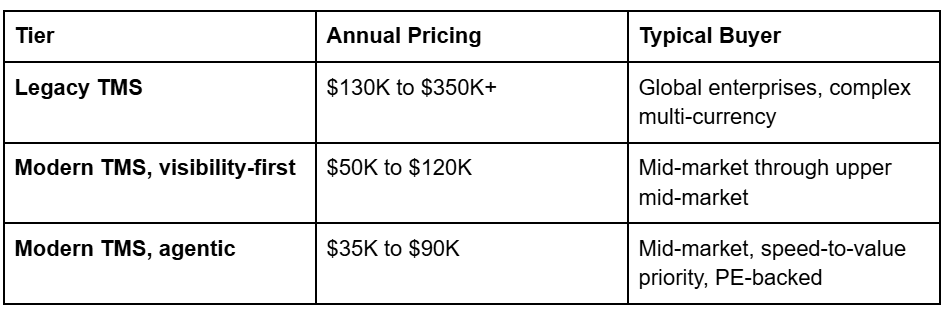
One important note on legacy pricing: the license fee is often not the highest cost in your first year. Implementation fees, integration work, and training routinely exceed the annual license at the upper end of the legacy tier.
A $200K annual contract can carry $300K in the first year of professional services.
Ask for the total cost of ownership across three years, including implementation, integrations, training, and expansion. That number is the real comparison.
Modern platforms are typically platform fees with predictable scaling. The reason the implementation cost is lower isn’t that you’re getting a discount. It’s that you’re getting a shorter, simpler deployment that doesn’t require multi-quarter configuration by a partner team.
How Do I Choose a TMS? A 5-Question Decision Framework
1. What era are you shopping in?
Era 2 (legacy, deep, slow) or Era 3 (modern, agentic, fast)? This is the fork in the road. Everything downstream follows from it.
2. What’s your time-to-value requirement?
If you need cash visibility within 90 days, only Era 3 platforms qualify. If you have 18 months and a full IT resource, Era 2 may fit. Be honest about which situation you’re actually in.
3. What’s your AI posture?
Deterministic and auditable, or willing to accept probabilistic outputs? If an AI agent is going to execute treasury workflows, the board and auditors will have questions. Know your answer before the vendor asks theirs.
4. What’s your governance bar?
What do your sponsor, auditor, or lender require for audit trail depth and approval workflows? The governance bar determines the minimum spec. Don’t buy below it, and don’t overbuy above it.
5. What’s your full TCO ceiling?
License, plus implementation, plus integrations, plus training, plus year-two expansion. Set the ceiling before you enter a demo. Vendors who know you haven’t set it will use the demo to set it for you.
If you can answer these five questions before the first demo, you’ll cut your evaluation timeline in half.
Compare modern TMS platforms. See the buyer’s guide.
Frequently Asked Questions
What is a treasury management system?
A treasury management system (TMS) is software that centralizes a company’s cash visibility, forecasting, payments, bank connectivity, and treasury reporting. Modern TMS platforms also automate reconciliation, liquidity management, and covenant tracking, using AI agents that execute workflows inside CFO-defined rules.
What does a TMS do?
A TMS handles the six core functions of a treasury operation: multi-bank cash visibility, cash flow forecasting, payment execution and approvals, bank account management, ERP reconciliation, and compliance reporting. In a modern, agentic TMS, it also executes workflows automatically when predefined conditions are met, rather than waiting for a human to trigger them.
What’s the difference between a TMS and an ERP?
An ERP records what happened to your money. A TMS manages what your money is doing right now and what it should do next. NetSuite, SAP, and Workday are systems of record for accounting: they close the books. A TMS is the operating layer for treasury: it opens the day. Most companies running a mature treasury function use both and keep them connected.
How long does TMS implementation take?
It depends on which era you’re buying. Legacy TMS platforms (Kyriba, GTreasury, ION) typically run 6 to 18 months from contract to full production. Modern, visibility-first platforms run 60 to 120 days. Modern, agentic platforms like Nilus deploy initial visibility in 24 hours to 4 weeks, with full production at 30 to 60 days. The timeline difference isn’t about complexity. It’s about architecture.
How much does a TMS cost?
Legacy TMS platforms run $130K to $350K+ annually, not including implementation fees that frequently exceed the first-year license. Modern, visibility-first platforms run $50K to $120K annually. Modern, agentic platforms run $35K to $90K annually with shorter, lower-cost implementations. Always ask for the total three-year cost of ownership. Make sure that price includes implementation, integrations, training, and expansion.
Do I need a TMS or just cash management software?
If your mandate is limited to daily cash positioning and forecasting across a small number of banks and entities, a cash visibility platform might be plenty for you. The moment your mandate expands to payment execution, covenant compliance, multi-entity governance, or board-level reporting, you’re in TMS territory. Here’s a practical test: if an auditor or sponsor reviewed your treasury operation tomorrow, would a visibility platform satisfy their questions? If not, you need a TMS.
What’s an AI-native TMS?
An AI-native TMS is built from the ground up to use AI for execution, so it goes beyond reporting. The key distinction is deterministic vs. probabilistic: a deterministic AI agent executes treasury workflows within rules you define and produces auditable outcomes. A probabilistic AI model makes recommendations and waits for a human to act. In a treasury context, the first is a control. The second is a suggestion. Nilus uses deterministic AI agents. This means the system acts within guardrails set by the CFO, not outside them. See how agentic AI works in treasury.
How do I evaluate TMS vendors?
Start with the five-question framework above: era, time-to-value, AI posture, governance bar, and full TCO. Then run every vendor through the same seven capability dimensions: AI architecture, multi-bank coverage, ERP integrations, audit trail depth, governance frameworks, time-to-value commitment, and pricing transparency. The vendors who give you specific answers on all seven are operating in a different category than those who redirect to a demo.