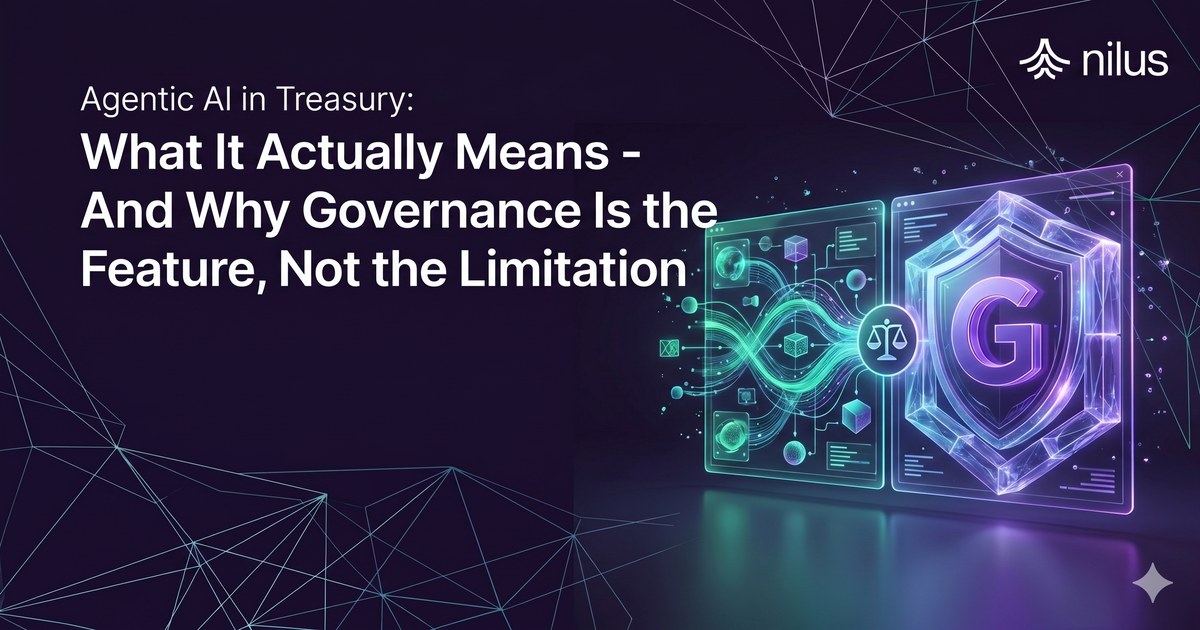
Agentic AI refers to software that can take a defined financial signal and move it toward an approved action. In treasury, that might mean preparing a reconciliation or payment route for finance approval.
But agentic doesn’t mean autonomous. Agentic AI can accelerate treasury work, but it shouldn’t move control away from finance.
If AI recommends a transfer, you need to see the data behind it, the policy it followed, the approval record, and the result. Governance cannot sit outside the workflow. It has to be part of how the work moves.
That shift changes what a treasury management system (TMS) is supposed to do. To understand why, it helps to look at how the category has evolved.
The three generations of treasury software
Treasury software has evolved through three generations: systems that record cash, systems that show cash, and systems that act according to your defined rules.
Each generation solved a different problem. First, treasury teams needed to organize cash data. Then they needed to see cash positions more clearly. Now, the challenge is turning the data into timely, controlled action with a record that can stand up to review.
| Era | Category | Examples | Primary Role | Treasury Impact |
|---|---|---|---|---|
| Era 1 | System of Record | Kyriba, SAP Treasury, Excel | Stores and organizes treasury data | Creates a central place to manage cash records, balances, entities, and reports |
| Era 2 | System of Insight | Trovata, Agicap, dashboards | Surfaces and visualizes cash data | Helps teams see cash positions and liquidity issues faster |
| Era 3 | System of Action | Nilus | Identifies cash conditions, prepares recommended actions, routes them for approval, and executes only after authorized approval | Turns cash visibility into controlled action with human approval and a clear decision record |
Era 1: System of record
For companies managing multiple entities and bank accounts, the first generation created much-needed order. Instead of chasing spreadsheets and bank portal exports, treasury teams could bring core cash data into one system.
But the system’s job was still mainly to hold the record.
You still had to read the numbers, decide what to do, prepare the movement, get approval, execute the transfer, and document the decision. The software improved organization, but the operating model remained manual.
Era 2: System of insight
The second generation improved cash visibility for treasury teams.
Bank-connected tools and dashboards made it easier to monitor positions and identify liquidity issues faster, especially across distributed accounts or fast-moving cash cycles.
However, more visibility didn’t solve the execution problem. A dashboard may show excess cash in a low-yield account, but someone still has to check the policy, get approval, and move the money.
Era 3: System of action
The third generation moves from visibility to controlled action.
It can flag excess cash, recommend the next step, and route the action for approval with the expected impact and decision record attached. If approved, the system can help carry the action through execution without separating the cash movement from the control record.
Era 1 knew where your cash was. Era 2 showed you what changed. Era 3 moves cash work from signal to approved execution within the rules you set.
What ‘agentic’ actually means in treasury
Agentic AI requires four capabilities:
- It perceives a state: The system reads live treasury data and identifies a condition that needs attention.
- It evaluates that state against defined rules: It checks the condition against company policies and limits.
- It prepares the next action: It creates the next step in the workflow and routes it to the right person.
- It records the outcome: It ties the action back to the source data, rule, approval, and result.
Let’s say you have $5 million sitting in a non-interest-bearing account.
If your company policy says any balance above $2 million should be swept into a money market account, an agentic system can flag the excess cash and check whether near-term outflows are covered. From there, it prepares the sweep recommendation for approval and records what happened after review.
That matters because cash moves faster than manual follow-through. As Nilus CEO Daniel Kalish has put it, “Humans can no longer keep up with the speed of money.” Agentic treasury helps close the gap between identifying what needs to happen and having the approved action ready.
Deterministic agents vs. probabilistic AI: why it matters for treasury teams
A deterministic treasury agent follows approved rules. Given the same data, policies, and approval limits, it produces the same recommendation every time.
Probabilistic AI works differently. It predicts the most likely response, which makes it useful for summarizing variance or supporting analysis. But cash workflows need rule-based execution.
A governed treasury agent applies structured financial data to finance-approved rules. If the rules are met, it prepares the next step. If they aren’t, it routes the exception for review.
| Category | LLM / Chatbot AI | Deterministic Agentic AI |
|---|---|---|
| How it works | Predicts likely responses from a prompt | Applies approved rules to structured treasury data |
| Output | May vary across similar prompts | Produces consistent results for the same inputs and rules |
| Explainability | Shows the prompt and generated response | Shows the data used, rule applied, approval path, and result |
| Audit trail | Captures interaction history | Preserves decision lineage for every action |
| Treasury fit | Useful for language-based support | Fit for governed workflows that affect cash |
| Error handling | Can produce a plausible but incorrect answer | Routes exceptions to human review when rules are not met |
When cash is involved, you should be able to see what triggered the recommendation and which policy allowed it. That’s what makes approval defensible.
What is assurance-grade AI, and why does treasury need it?
Assurance-grade AI lets you automate treasury work without moving authority outside your finance controls.
A treasury recommendation can shape a cash movement, payment route, forecast update, or liquidity decision. Before finance acts on it, the system has to show why the recommendation appeared, what policy it followed, and whether the action can still be stopped.
Precisely why every recommendation must be explainable, reviewable, and tied to a decision record.
| Property | What it means |
|---|---|
| Explainability | You can trace every recommendation back to the data and rules that produced it. |
| Reversibility | You can review, hold, change, or stop a recommendation before execution. |
| Auditability | You can prove what happened, why it happened, and who approved it. |
Explainability
Explainability comes first because you can’t approve what you can’t verify.
When a forecast changes or a recommendation appears, the system should show the financial driver behind it before you approve the action. Without that context, AI may produce a useful recommendation, but you won’t be able to defend the decision under review.
Reversibility
Reversibility means a recommendation won’t execute by default. The system can prepare a sweep or payment route, but release stays under your control. You can review the context and adjust or stop the action before cash moves.
That control is important because treasury decisions don’t live only in the data. A board decision or an upcoming acquisition may change the right action.
Auditability
Auditability means every treasury action remains reviewable after it happens.
In the Nilus platform, every agent decision is captured in agent reasoning logs, including Chain of Thought logs. That record connects the recommendation to its source data, governing rule, approval path, and final outcome.
That turns auditability into part of the control environment, not an after-the-fact reporting task.
NIST AI RMF and ISO/IEC 42001 reinforce the same expectation: AI systems need governance that can be reviewed, managed, and improved over time. NIST AI RMF is a framework from the National Institute of Standards and Technology for identifying and managing AI risk. ISO/IEC 42001 sets requirements for responsible AI management across the organization.
Nilus is compliant with both, which means governance is built into how work moves through the platform, from recommendation to approval to record.
Read the CFO’s Guide to Evaluating AI in Treasury
The governance architecture: how Nilus keeps finance in control
Agentic AI in treasury only works if authority is explicit.
In Nilus, agents can identify when cash work needs attention and prepare the next step for approval. But they don’t replace finance’s control over cash movement. Every action still has to follow your company’s approval rules before anything moves.
Human-in-the-loop by design
Cash actions follow a ‘propose, review, approve, then execute’ workflow.
A Nilus agent prepares the route, but no agent executes a payment, moves cash, or takes an irreversible action without explicit human approval at the defined step.
Segregation of duties
Nilus supports 4-eyes approval for controlled cash actions. One user can initiate an action, but another authorized user must approve it before the action moves forward.
That keeps approval authority separate from initiation, so cash work can move faster without weakening the control point.
Least-privilege access
Nilus agents operate within the policies, approval thresholds, and permissions your team defines.
It can connect to ERP, banking, accounting, and treasury systems, but agents do not get open-ended authority over those systems. They can prepare work and, where configured, update records or carry actions forward only within approved guardrails.
Full audit trail
Nilus provides full Chain of Thought logs for every agent decision and a SOX-compliant audit trail.
That gives you a reviewable record of how an agent reached a recommendation, how the action moved through approval, and what happened after review.
Reversibility window
Actions are queued before execution.
During that window, an authorized user can review, halt, or modify the action before cash moves. Speed only helps treasury when the control point remains intact.
The result isn’t blind trust in AI, but a treasury workflow where the recommendation, approval, and evidence stay connected.
Ready to see the audit trail? Request a demo
What agentic AI actually does in treasury: the 8 sub-agents
Agentic treasury systems use specialized sub-agents to handle core treasury workflows. In Nilus, those agents cover cash visibility, forecasting, reconciliation, liquidity optimization, anomaly and risk detection, FX exposure, payments, and coordination. Together, they move cash work toward approval without separating execution from control.
Cash visibility agent
The Cash Visibility Agent gives treasury a current view of usable cash across banks, entities, and accounts. It shows you where cash has moved and whether that movement affects available liquidity.
Without this baseline, every cash decision starts from a weaker operating picture.
Forecast agent
The Forecast Agent keeps your 13-week rolling forecast and 12-month cash view updated as new cash data comes in.
When the forecast changes, it ties the movement back to the financial driver behind it, such as a changed payment date or balance movement. You see why the number changed before acting on it.
Reconciliation agent
The Reconciliation Agent classifies transactions and matches bank activity to the right records.
For high-volume finance teams, this removes hours of manual review. At Flare, for example, Nilus reduced reconciliation effort from 50+ hours per month to under 10 hours by automating transaction tagging, matching activity across systems, and flagging anomalies as they appeared.
Clean reconciliation makes cash reporting usable. When exceptions surface early, your team spends less time fixing data before decision-making.
Liquidity optimization agent
The Liquidity Optimization Agent identifies cash that could be used more effectively.
It can surface idle or trapped cash, or yield opportunities that treasury might otherwise have to find manually. More importantly, it can prepare a recommendation for you to review and act on.
Anomaly & risk agent
The Anomaly and Risk Agent flags cash activity that falls outside expected patterns.
That might include a possible fraud signal or a liquidity issue starting to form. The agent brings the issue forward with evidence attached.
FX exposure agent
The FX Exposure Agent tracks how currency movement affects expected cash flows.
As cash assumptions change, it shows where FX exposure is becoming material. You can assess the impact before it becomes a surprise in reporting or liquidity planning.
Payments agent
The Payments Agent prepares payment actions for controlled approval and release.
It checks the payment against the authorized entity, funding source, and release requirements before anything moves. Payment execution stays connected to the recommendation and approval.
Coordination agent
The Coordination Agent connects the work of the other sub-agents. It routes work to the right agent and keeps dependent actions in order. It also helps prevent one workflow from creating a control issue in another.
That coordination matters because treasury workflows affect each other. The agent stack keeps those dependencies visible before finance approves the action.
What to ask AI treasury vendors before you buy
When evaluating AI treasury platforms, the demo will usually show the cleanest version of the product. You want to test the control model behind it.
Ask these questions before you buy.
1. Is your AI deterministic or probabilistic?
For cash workflows, you need rules-based execution on structured financial data.
Ask whether treasury actions are governed by deterministic logic or generated by an LLM. If an LLM is involved, ask where it sits in the workflow. Using AI to summarize a forecast variance is one thing. Using it to prepare a cash movement is another.
You should know where AI informs the user and where it advances the workflow.
2. What happens after the AI recommends an action?
Look at what the system does after it creates a recommendation.
The system should send the recommendation to an authorized user with the reason and supporting data attached. Nothing should affect cash until the right user reviews and approves the action.
3. Can you show the decision lineage for a real production action?
Ask to see the record behind a real action, not a staged demo.
That’s the record your internal audit team or external reviewer will ask for later: input data, applied rule, proposed action, approver, timestamp, and result. If the vendor cannot produce that trail, the risk moves back to your team.
4. Which governance frameworks do you comply with?
Ask how the system maps to NIST AI RMF, ISO/IEC 42001, SOC 2 Type II, and your company’s existing financial controls.
Governance should shape how the product works. If those controls have to be added during implementation, the system isn’t ready for treasury execution.
5. How do you enforce segregation of duties?
Ask whether one user can initiate and approve the same action.
For cash workflows, the answer should be no. A strong system enforces 4-eyes approval inside the workflow, so no action moves forward until the required approval path is complete.
6. What is your ERP write-back architecture?
Ask what the system can read and what it can change.
The treasury agent should have enough access to prepare work, but not enough to take unnecessary control over core finance records. For example, Nilus reads ERP data, bank feeds, and treasury systems, but doesn’t write back to your ERP. Financial execution happens through defined payment rails and authorization limits.
7. What happens if the AI recommends the wrong action?
Ask how the system contains risk before cash moves.
You should be able to pause, change, or stop an action before execution and see what gets logged when the recommendation changes.
See assurance-grade AI in action: 24-hour proof demo on your real data