Introduction
Treasury operations rarely stand still.
In fact, as companies grow, the processes that support Treasury management must evolve alongside the business. What starts out as a handful of bank accounts to be managed and a simple daily cash report can become a complex network of systems, data flows and decision points.
Over time, Treasury teams need to adapt their processes to keep up with the pace of the business. Unfortunately, this can often lead to layers of process and controls without considering the bigger picture.
This evolution follows a pretty standard pattern. Early stage companies will rely on highly manual and reactive processes, requiring the collection of data before decisions can be made to support the business.
As these operations mature, processes become more structured, bringing about consistency in daily Treasury operations. The next stage involves the integration of systems and data, allowing information to flow more freely across banks and supporting systems.
With this foundation, Treasury teams can start to be more proactive in their approach, moving from after the fact reporting toward predicting future needs. At the most advanced stage, Treasury data becomes a continuous input for decision making, enabling the Treasury team to advise on funding, investments and risk management in real time (or close to it) with high conviction.
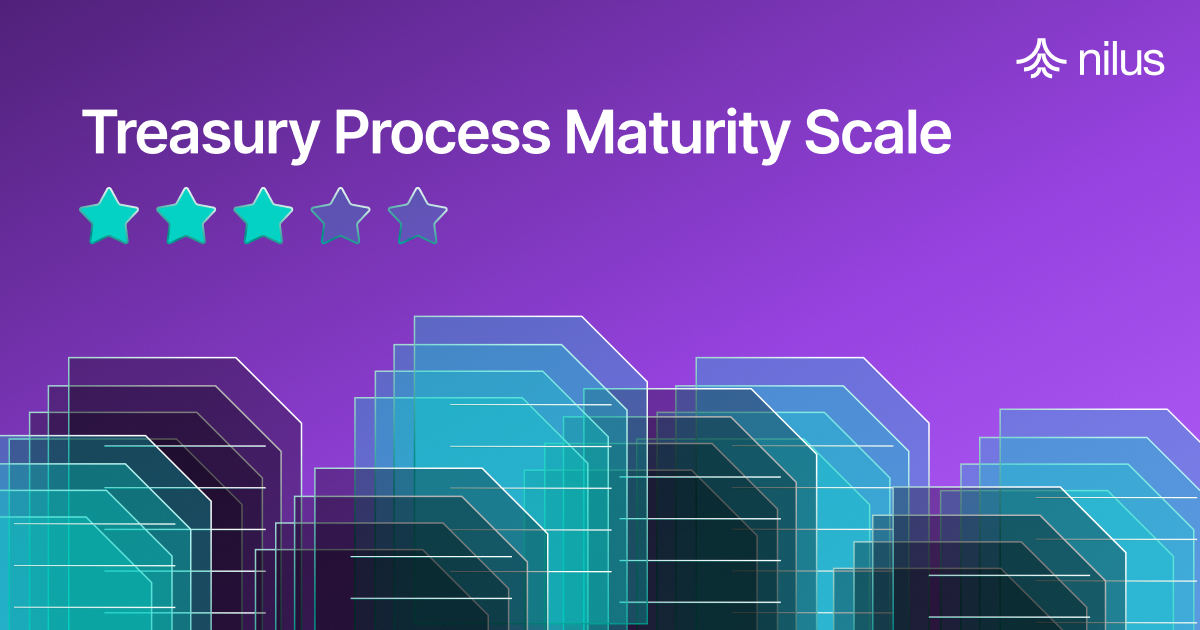
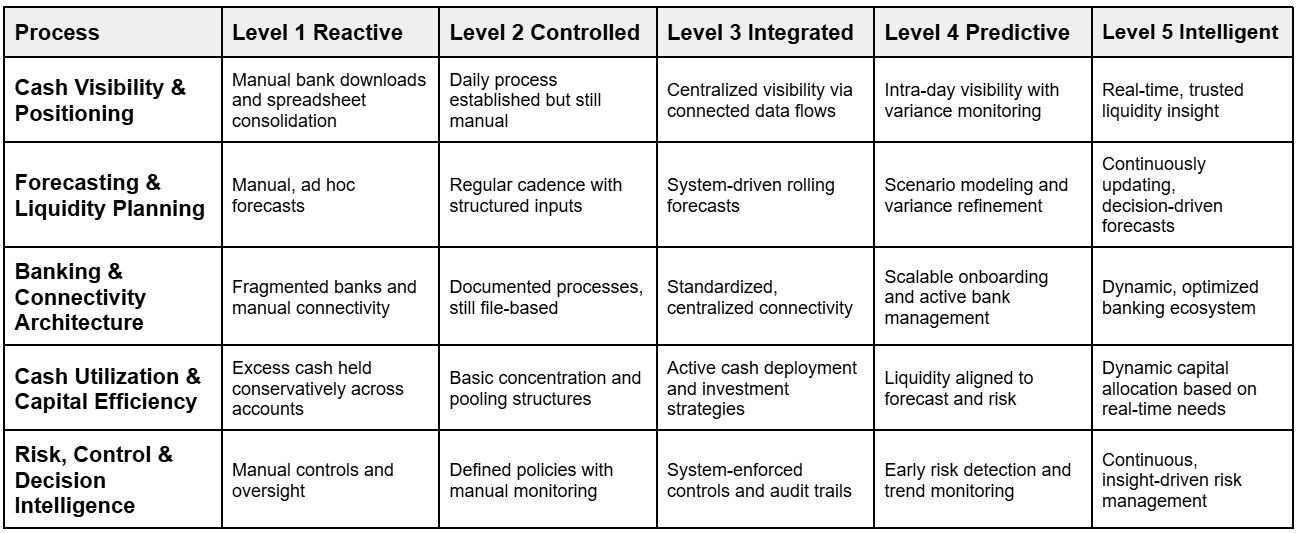
In this article, we will explore this five-step Treasury Process Maturity Scale: ReactiveControlledIntegratedPredictiveIntelligent
We will look at what each stage represents and apply this scale across five core Treasury process areas to illustrate how operational maturity develops in the real world and how organizations can identify where their own processes sit today.
Cash Visibility & Positioning
Cash visibility is an essential part of making decisions for Treasury teams. Before forecasting can take place, Treasury teams must first understand where liquidity sits across the entire company. This extends to key decisions on funding, investing and managing risk. While this might sound relatively straightforward, the effort to produce a reliable cash position varies from company to company. In many organizations, daily cash visibility is crucial. Teams may need to log into multiple banking portals, download statements, normalize formats and consolidate results on a daily basis to meet this expectation. Even with well established processes (and years of practice), these steps rely on manual coordination to move information from banks and into a format that the Treasury team can analyze. As a Treasury team’s operations mature, the very nature of this work starts to shift. Instead of manually gathering bank balances, companies prioritize getting liquidity information flowing directly into a centralized tool where it can be trusted and analyzed quickly. This progression reduces the effort required to produce the daily cash position and allows Treasury teams to shift their focus from data collection to driving meaningful insights that support decision making for funding, investments and other liquidity events.
Level 1 - Reactive
Cash balances are gathered manually from multiple sources, often requiring logins to separate bank portals and manual consolidation of data before a cash position can be produced. Visibility exists, but only after a highly manual exercise. As a result, it’s typically backward-looking by the time the data is finally consolidated and analyzed. With the process heavily dependent on manual steps, delays caused by errors or missing data can impact liquidity decisions and execution timing.
Level 2 - Controlled
A daily process is in place to produce the cash position, bringing consistency to the timing and format, even if key steps are still manual. Treasury teams can rely on the output, but the process depends on the coordination and individual ownership to complete. Scaling this process becomes the challenge, requiring additional effort or even headcount as the number of banking partnerships and/or complexity increases.
Level 3 - Integrated
Banking data flows into a centralized system through established integrations, allowing the Treasury team to access bank balances without physically collecting the data first. The cash position becomes an output of the system as opposed to a product of manual collection and consolidation. The Treasury Team’s role shifts from gathering data to validating completeness and investigating exceptions as part of ensuring accuracy.
Level 4 - Predictive
Visibility to cash extends beyond daily static balances and includes intra-day updates, variance monitoring and early identification of unexpected swings. The Treasury team is beginning to interpret liquidity trends as they emerge rather than reconciling them after the fact. With more timely insight, Treasury teams are able to respond earlier to funding needs, act on surplus cash opportunities and investigate unusual account activity.
Level 5 - Intelligent
At the highest operating level, liquidity information is continuously available and trusted as a real time decision input across the company. Treasury teams operate with confidence that cash visibility is complete, timely and capable of highlighting risk (and opportunities) without the need for manual analysis. At this level, the daily cash position becomes less of a reporting output and more of a continuously updated view on liquidity across the organization.
Forecasting & Liquidity Planning
Forecasting cash is a top priority for any Treasury team. It bridges the gap between daily liquidity and broader financial planning. While cash visibility is important to confirm where liquidity sits today, forecasting provides the forward-looking perspective needed to confirm how that liquidity should be managed over the coming weeks and months ahead. Key decisions around borrowing, investing and investment of capital all rely on the confidence behind the cashflow forecast. For many companies, forecasting starts as a manual exercise that relies heavily on inputs from across the business, linked to complex spreadsheet models. The Treasury team collects inputs from the Accounts Receivable team, the Accounts Payable team, as well as other business teams that contribute to the forecasting process. These inputs are then consolidated into a view of the expected cash inflows and outflows for the forecast duration and while these forecasts provide directional value, they are often time consuming to prepare and challenging to maintain frequently. As the forecasting process matures, businesses are connecting their operational data directly into the forecasting model and shift toward a rolling/continuous forecast. This improves the accuracy of future forecasts and allows the Treasury team to move beyond planned reporting cadences to more proactive planning that supports key business decisions.
Level 1 - Reactive
As a starting point, forecasts are built manually, using spreadsheets and periodic input from business stakeholders. The process is time consuming and often completed on an ad hoc basis vs consistently as a result. This leads to forecast snapshots that become out of date quickly.
Level 2 - Controlled
The Treasury team maintains a defined forecasting process with a regular cadence, typically weekly or monthly depending upon the business’ needs. Inputs are collected manually, but applied to a consistent template. This approach brings discipline to the forecasting process, but still requires heavy manual effort to gather and reconcile the necessary data that drive the forecast.
Level 3 - Integrated
We start to see operational data from systems such as ERP, Accounts Payable and Accounts Receivable platforms begin to feed directly into the forecasting model. This approach reduces the reliance on manual inputs and allows the forecast to be refreshed more efficiently (and frequently). The Treasury team is able to focus more of their time validating the forecast assumptions and analyzing the output vs preparing the data.
Level 4 - Predictive
At the next level, Treasury teams can model multiple scenarios to understand how changes in customer collections, vendor payments and capital investments may impact future liquidity. Forecast updates occur more frequently and variance analysis supports refinement of the forecast assumptions over time. The forecast is now a planning tool used to evaluate and support key business decisions tied to liquidity.
Level 5 - Intelligent
At the highest operating level, forecasting operates as a continuously updated liquidity view that adapts to new data and emerging trends. The Treasury team can quickly evaluate the impact of operational and/or market changes and provide guidance on funding and investment strategies for the business. Forecasting insights become an embedded part of the process, supporting key business decisions rather than being viewed as a periodic reporting exercise.
Banking & Connectivity Architecture
A company’s banking relationships and the way in which its Treasury team connects to them plays a significant role in operational efficiency. As companies grow, whether through global expansion, establishing new entities or via M&A, banking networks often expand organically. Over time, this can result in an unintended complex mix of banks, account structures, file formats and connectivity methods. For many businesses, bank connectivity evolves opportunistically as new needs arise. A new bank account may be added to support a local operation overseas, or a new banking relationship established following an acquisition. While these changes solve immediate business needs with the required agility, they will gradually increase the operational effort required to gather data, process transactions and maintain strong controls across the entire banking ecosystem. As companies mature, they start to treat their banking architecture as a fully integrated system vs a collection of historical relationships. By standardizing connectivity and consolidating banking structures, companies are reducing operational friction while improving both the reliability and accessibility of bank data across the entire organization.
Level 1 - Reactive
Banking relationships are highly fragmented and connectivity is typically managed manually through portals or ad hoc file exchanges. Each bank may require a different process for retrieving data and initiating transactions. The Treasury team spends a significant amount of time navigating these differences to maintain visibility and control across the banking ecosystem.
Level 2 - Controlled
Bank accounts and connectivity to those bank accounts are documented and managed through defined processes. The Treasury team has visibility into its banking footprint and maintains consistent operational routines across all accounts. The difference in file formats and connectivity methods still requires manual handling across banks.
Level 3 - Integrated
Banking data and payment processes flow through standardized connectors into a centralized Treasury platform. The Treasury team interacts with a consolidated view of banking activity rather than managing each bank account individually. As a result, the operational effort to add or manage bank accounts is significantly reduced.
Level 4 - Predictive
This is where a company’s banking architecture supports the efficient onboarding of new banking relationships, bank accounts and geographies without disrupting existing operations. The Treasury team can evaluate banking relationships based upon cost, service levels and operational efficiency. This level of connectivity enables more proactive management of liquidity and payment activity across the business.
Level 5 - Intelligent
At the highest operating level, the banking ecosystem operates as an integrated network that supports real time liquidity visibility and efficient transaction processing. The Treasury team can actively manage banking relationships, optimize banking costs and adjust structures with agility as the business evolves over time. With this, banking infrastructure becomes an enabler of operational efficiency vs a constraint, as we saw at lower maturity levels.
Cash Utilization & Capital Efficiency
Managing cash effectively is not only about maintaining sufficient liquidity to support business operations, but also about ensuring that excess cash is deployed efficiently e.g. minimizing idle cash. The Treasury team plays a key role in balancing these priorities by determining how much liquidity the business should hold and how any surplus funds should be invested. For many organizations, cash balances are intentionally managed conservatively, because of uncertainty around forecasts or visibility makes it difficult to use excess cash with confidence. Companies will often maintain precautionary buffers across accounts to ensure obligations can be met, even at the expense of idle cash sitting across their banking ecosystem. As the Treasury processes mature, businesses gain confidence in their visibility and forecasting capabilities, allowing them to better manage liquidity in support of utilization and efficiency. This progression allows companies to minimize idle cash, improve investment returns and align large cash movements with strategic business objectives, such as M&A.
Level 1 - Reactive
In the early stages, cash balances are maintained conservatively to ensure obligations are met and overdraft positions avoided. Excess liquidity often sits idle across multiple accounts, because the Treasury team lacks the visibility and/or confidence in the forecasting process to deploy the excess cash actively. Cash management here focuses primarily on maintaining safety over optimizing returns.
Level 2 - Controlled
This is where we start to introduce strategies like simple pooling arrangements. Treasury teams start to consolidate account balances and reduce the natural fragmentation across bank accounts. At this stage, deployment of cash continues to be managed cautiously.
Level 3 - Integrated
The Treasury team actively manages liquidity through structured investment programs, automated sweeps and coordinated cash pooling. Surplus cash is more regularly identified and moved around according to defined policies. This approach allows the business to reduce idle cash balances while maintaining appropriate liquidity buffers.
Level 4 - Predictive
Cash deployment decisions are now informed by forecasting insights and what-if/scenario analysis. The Treasury team adjusts liquidity buffers based on expected inflows and outflows, while balancing risk. The allocation of capital becomes more deliberate and aligned with the broader financial planning process.
Level 5 - Intelligent
At the highest operating level, liquidity is continuously evaluated and allocated based on the evolving needs of the business and opportunities that present themselves. The Treasury team can confidently optimize idle cash balances, while supporting funding, investment and other business initiatives. This is where actively managed cash can contribute to the overall financial performance of the business.
Risk, Control & Decision Intelligence
Treasury teams operate at the center of financial risk management. With responsibilities across bank account access, payment approvals, monitoring liquidity risk and ensuring compliance with internal policies, Treasury teams protect the businesses they serve while supporting efficient financial operations. In many organizations, risk management processes begin with manual oversight and clearly defined approval structures. Treasury teams rely on these established procedures to ensure policies are followed and any irregular activity is identified as quickly as possible. While these controls provide protection, they often depend on a human monitoring the process to function effectively. As these processes mature, companies will embed controls directly into their systems and data flows. This shift allows risk management processes to move from reactive detection after the fact toward more proactive identification of potential issues. This enables Treasury teams to address issues with speed and maintain strong governance across financial operations.
Level 1 - Reactive
Controls rely primarily on manual oversight and the experience of specific Treasury team members. Approval processes and reconciliations are performed through spreadsheets and emails. With this approach, risk is managed through manual vigilance vs automated monitoring.
Level 2 - Controlled
Policies and procedures are well documented and define how financial activities should be executed and approved. Segregation of duties (SoD) and approval hierarchies are clearly established. This level of governance is an improvement on level one, but still depends heavily on manual reviews.
Level 3 - Integrated
At this level, controls start to become embedded within Treasury and financial systems, providing a consistent enforcement of policies. Transaction approvals, access controls and audit trails are managed through structured workflows, typically within an ERP or TMS (or both). This level of control reduces the likelihood of errors and has the benefit of improving transparency.
Level 4 - Predictive
The Treasury team can quickly identify unusual activity or emerging risk through data monitoring as well as trend analysis. Early warning indicators highlight potential liquidity and operational issues before they escalate. At this level, risk management becomes much more proactive and insight driven.
Level 5 - Intelligent
The risk monitoring process operates continuously alongside the Treasury team’s activities, automatically flagging anomalies that require further investigation and providing actionable insight. Treasury teams can quickly evaluate potential exposures and adjust decisions accordingly. Strong governance is maintained while enabling faster and more confident business decisions.
Final Thoughts
Every company is different. The levels discussed in this article are a guide toward how high performing teams are operating today. At the end of this article you will find a “Treasury Process Maturity Matrix” that summarizes these levels across the five processes we explored. Is your team ready for the next evolution of Treasury operations? Are you looking to take your Treasury operations from Level 1 to Level 4, or perhaps from Level 2 to Level 5? Ask yourself these 10 questions before choosing an AI treasury platform!