Introducing the Nilus Liquidity Agent: Your Treasury's Always-On Policy Monitor

Today we're launching the Nilus Liquidity Agent - a continuous monitoring layer that tracks your cash positions, FX exposures, and other policy thresholds across every entity, bank, and currency, and then flags breaches the moment they occur, followed by a recommendation on what to do next.
Instead of cycling through ten bank portals each morning, you get a single, real-time view that shows exactly which metrics are on target and which need your attention.
We built it because every treasury team we work with describes the same problem.
The Morning Ritual Every Treasurer Recognizes
Ten bank logins. Five currencies. Three ERPs. Copy the numbers into a spreadsheet. Normalize. Reconcile. By the time you have a position you trust, two hours have passed - and the number is already stale.
Meanwhile, a subsidiary's operating balance drifts below its liquidity buffer overnight. Euro exposure creeps past your policy limit while you're still logging into portal number six. An entity's balance quietly concentrates at a single counterparty until it represents 65% of your total deposits.
These are the specific conditions the Liquidity Agent is built to detect - in real time, against your own policy guardrails.
What the Liquidity Agent Actually Does
The Liquidity Agent is a configurable monitoring layer that sits on top of your live cash data inside Nilus. You define the metrics that matter and the agent tracks them continuously across all entities. Examples of policies treasury teams are monitoring today:
- Liquidity buffers: entity-level balance floors (e.g., €6-7M operating minimum for your European HQ)
- Payroll readiness: ensuring payroll accounts hold sufficient funds ahead of each cycle
- Revolver headroom: tracking drawn amounts against available credit on your revolving facility
- FX exposure caps: currency-level ceilings (e.g., no more than 2M CAD net exposure)
- Counterparty concentration: maximum percentage of total deposits held at any single bank
Payment account balances: confirming accounts designated for vendor payments or debt service maintain target levels
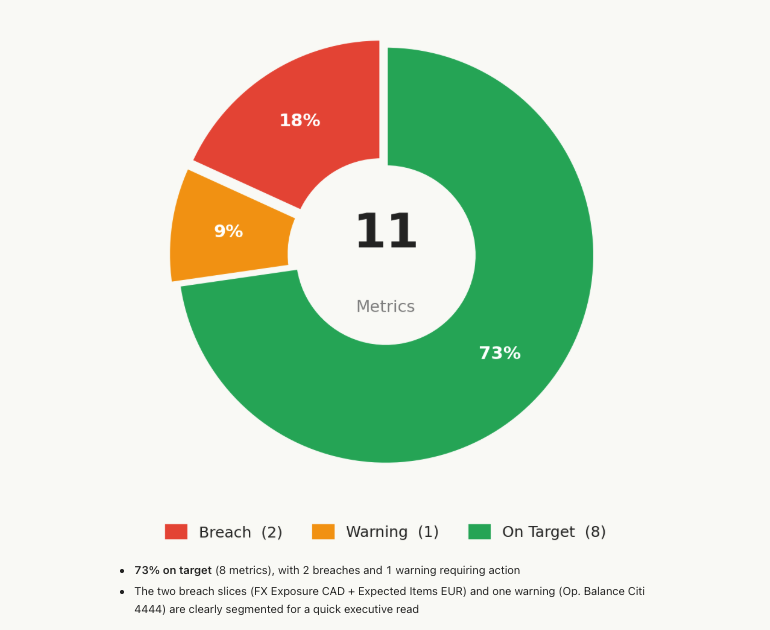
Here's what that looks like in practice, across four core capabilities.
1. Policy-Bound Liquidity Monitoring
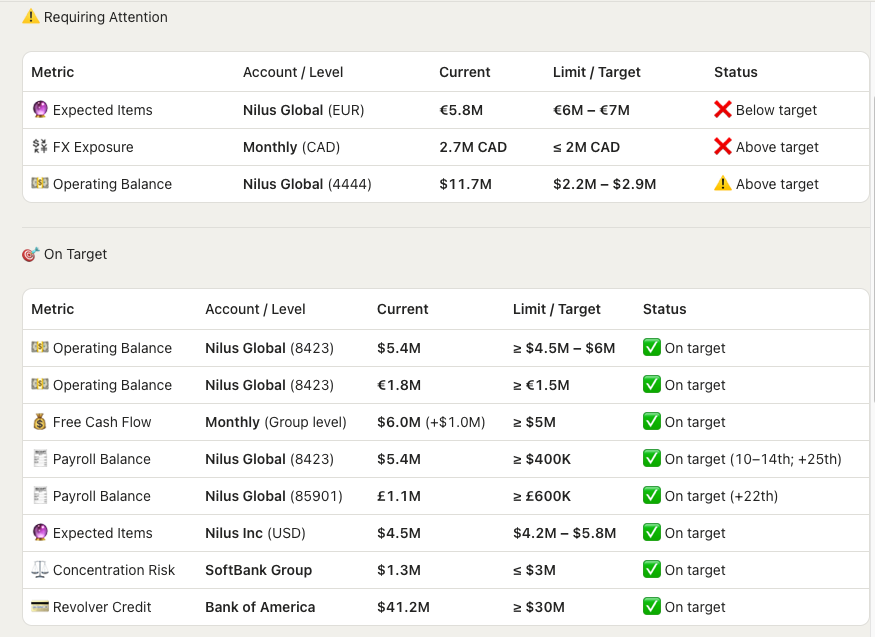
The agent displays every metric in a single dashboard view: green for on-target, red for breached. No digging. No assembling.
When ACME's balance drops to €5.8 million against a defined €6-7 million target, the agent surfaces it immediately - contextualized against your pre-set liquidity buffers. You see the breach, the magnitude, and the entity responsible, all without opening a single bank portal.
Every threshold is configurable: fixed amounts, percentage-based ranges, or factor-based rules tied to your specific policy. The agent enforces your definitions, not a vendor's assumptions.
2. Automated FX Exposure Signals
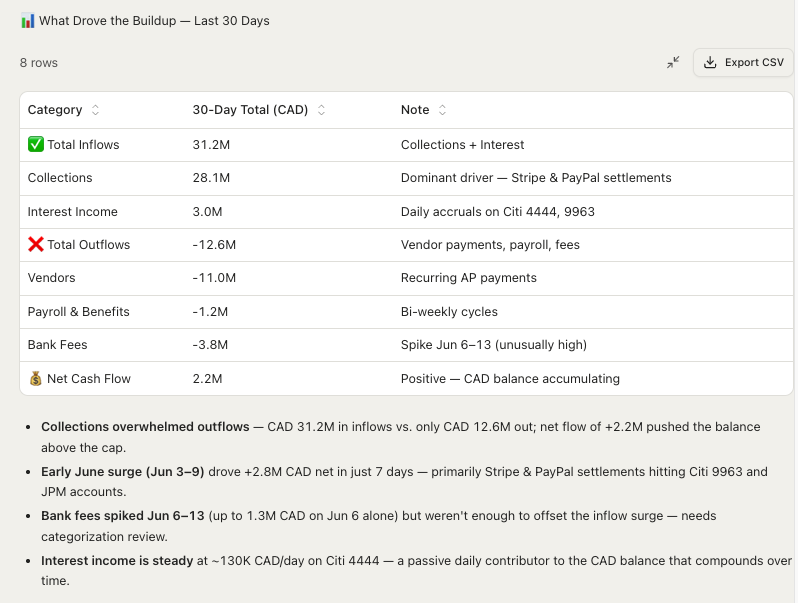
Currency risk doesn't wait for your weekly FX review. The Liquidity Agent monitors exposure against your defined limits in real time.
When CAD exposure crosses your 2 million CAD ceiling, the agent flags it, triggers a rebalancing signal, and suggests the best course of action - before the market shifts and your margin erodes. The reading is live, drawn from your actual position against the guardrails you set.
For companies operating across multiple currencies, this collapses the detection window from "whenever someone checks the spreadsheet" to "the moment it happens."
3. Global Cash Visibility and Concentration Risk
The agent consolidates your total cash position by subsidiary, bank, and currency - giving you a single source of truth across your entire banking stack.
More importantly, it flags concentration risk and raises an optimal course of action automatically. When one institution - say, Silicon Valley Bank - holds $96 million, representing 65% of your total deposits, the agent surfaces that exposure immediately. No analyst needs to run the calculation. No quarterly review needs to catch it.
In the wake of SVB's collapse in March 2023, the AFP reported that 56% of treasury professionals accelerated their bank diversification efforts. The Liquidity Agent makes that diversification measurable and monitorable every single day.
4. Runway Analysis and Stress Testing
A daily cash position tells you where you are. Runway analysis tells you how long you can stay there.
The agent calculates available runway across multiple scenarios: last month's actuals, a three-month average, and a conservative estimate. Each gives you a different view of your monthly net burn and how far your current liquidity extends.
From there, you can run stress tests directly inside the interface. Model revenue contraction. Simulate a collections delay. Test market volatility against your current position. The output is an auditable narrative you can present to your board - with the data trail to back it up.
Every table, metric, and stress-test scenario exports to CSV for further reporting or board presentations.
From Monitoring to Action - Inside a Single Interface
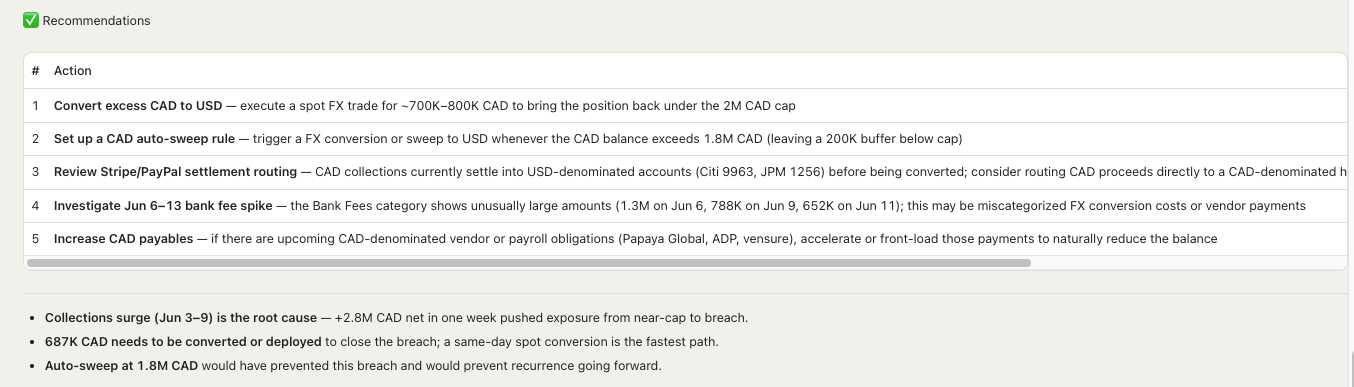
The Liquidity Agent surfaces breaches and connects them to impact analysis and next steps.
In the Impact and Findings section, the agent maps each breached threshold to its downstream consequences - the specific risks associated with that FX exposure spike or that liquidity buffer shortfall. From there, you can drill into any item using natural-language queries or follow the agent's suggested next steps to resolve the breach.
This is the difference between a dashboard that shows you a red number and an agent that tells you what it means and what to do about it.
Why This Matters Now
According to Gartner, 40% of B2B procurement and finance queries will be resolved through AI-driven interfaces by 2026. Treasury teams that still rely on manual monitoring are operating in a model that the rest of the finance function is already leaving behind.
The math is unforgiving. Every $1 million sitting idle in a low-yield operating account while another entity borrows on a revolver at 8% costs $80,000 per year. Every undetected FX breach compounds. Every concentration risk that surfaces in a quarterly review instead of in real time is a risk you accepted without knowing it.
The Liquidity Agent doesn't eliminate the need for treasury judgment. It eliminates the hours of manual assembly that delay it.
Ready to See Your Liquidity Position in Real Time?
The Nilus Liquidity Agent is built on Assurance-Grade AI: every metric is traceable, every threshold is auditable, and every action stays within your defined policy. Watch the product walkthrough to get a taste or a book a 20-minute demo with a treasury specialist and see the agent configured against your actual accounts and thresholds.
FAQs
What is the Nilus liquidity agent?
The Nilus Liquidity Agent is an AI monitoring system that continuously tracks cash positions, FX exposures, and policy thresholds across all entities and bank accounts. Unlike a static dashboard, it actively flags breaches against your defined guardrails in real time and connects each alert to impact analysis and recommended next steps. Nilus's Liquidity Agent operates within a conversational interface where treasury teams can drill into any metric using natural-language queries.
How does the Nilus Liquidity Agent differ from a treasury management system (TMS)?
A traditional TMS aggregates bank data and displays it in dashboards - but it doesn't act on what it finds. The Nilus Liquidity Agent monitors your data against your specific policy thresholds (balance ranges, FX limits, concentration caps) and alerts you the moment a metric is breached. It also provides contextual analysis: what the breach means, what caused it, and what steps to consider. The AFP has noted that most mid-market treasury teams still rely on manual monitoring; The Nilus Liquidity Agent automates that detection layer entirely.
What metrics can the Nilus Liquidity Agent monitor?
The Nilus Liquidity Agent monitors any metric you define: global and entity-level balance thresholds (fixed, percentage, or factor-based), FX exposure limits by currency, counterparty concentration risk, payroll readiness levels, and cash runway scenarios. Thresholds are fully configurable within the Nilus interface and can be updated conversationally - no configuration tool or IT involvement required.

Written by
Your next treasury move is waiting
Get an ROI assessment, and find out where you’re leaving cash on the table.


Your next treasury move is waiting
Get an ROI assessment, and find out where you’re leaving cash on the table.
More Resources
Your next treasury move is waiting
Get an ROI assessment, and find out
where you’re leaving cash on the table.

