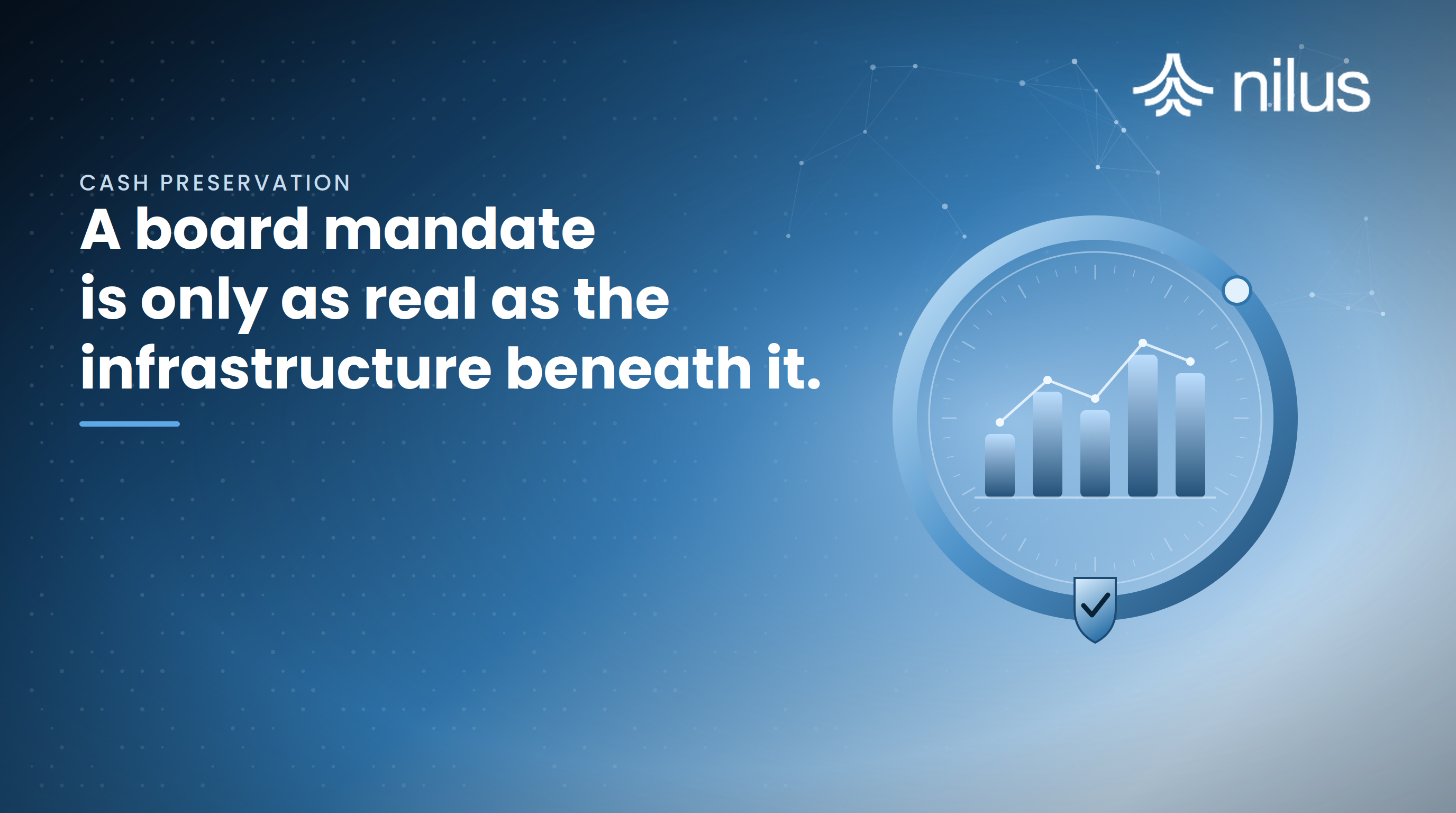
Deloitte’s Q4 2025 CFO Signals survey, which sets out finance leaders’ priorities for 2026, found that 50% of CFOs now name digital transformation of finance as their single biggest priority - the top response of the year.
The second priority on the list is just as revealing: cash management optimization, ahead of capital allocation. Read together, those two findings describe the same shift. The way you execute a cash preservation mandate in 2026 is by building the treasury infrastructure to see, track, and optimize cash in real time - not by running tighter controls on top of a weekly Excel model.
This piece is about what “cash preservation” actually requires at the operational level, and the gap between that requirement and the infrastructure most mid-market treasury functions have in place today.
The Board Conversation That Changed
Twelve months ago, the board question was “how are you growing?” Today, with cash discipline climbing the agenda, it is “how are you protecting the balance sheet while you grow?”
Deloitte’s data shows finance chiefs entering 2026 with a sharper focus on efficiency, cash preservation, and disciplined investment - even as confidence and risk appetite have recovered to their highest levels in years.
For treasury, that reframing has a direct consequence. The function that was invisible when conditions were benign is now a board-level topic, and when the board asks where the cash is, “approximately” is no longer an acceptable answer.
What “Cash Preservation” Actually Requires
Preservation is an operational capability before it is a strategy. A mandate to preserve cash quietly assumes four things are already in place - and for most mid-market teams, they are not:
| Requirement | Why it is non-negotiable |
|---|---|
| Real-time position across all entities | You cannot preserve what you cannot see. A position assembled on Friday is a guess by Tuesday. |
| An accurate 13-week forecast | Decisions made on a 60%-accurate forecast are not preservation. They are estimation with better branding. |
| Automated covenant-headroom alerts | PE-backed companies need to know automatically when the cash position approaches a covenant threshold - not at the next reporting cycle. |
| Optimized revolver management | Draw-and-repay decisions made on live cash data, not conservative estimates, so you are not paying to borrow cash you already hold. |
The Gap Between the Mandate and the Infrastructure
Here is the uncomfortable part. Most mid-market treasury teams are handed a preservation mandate while operating on bank-portal logins, spreadsheet reconciliation, and a weekly cash report assembled by hand.
The board’s instruction is to preserve cash. The infrastructure in place cannot reliably say where cash is today, let alone where it should be placed. That is not a strategy problem that more discipline will fix - it is an infrastructure problem. Discipline applied to bad data just produces confident errors faster.
What the Right Infrastructure Enables
The difference shows up in a single sentence - the one you say out loud in the board meeting:
| From | To |
|---|---|
| ”Our cash position is approximately $X, based on last Friday’s reconciliation." | "Our cash position is $X across eight entities right now; our 13-week forecast shows a $1.2M surplus in weeks six through eight, and here is where we’d place it.” |
The second version is specific, current, and proactive. It turns the treasury update from a range with caveats into a decision the board can act on - which is exactly what a preservation mandate is asking for.
Three Infrastructure Actions for Q2 2026
If your board has handed you a cash preservation mandate, three moves convert it from intention into capability:
- Automate your bank feed connections. Eliminate the daily manual download. Every position should refresh itself - across every entity and currency - without a person logging in.
- Stand up an AI-generated 13-week rolling forecast. Replace the weekly Excel model with a forecast built from actual transaction and balance data, so the number is current the moment you open it.
- Set automated covenant-monitoring alerts. Know that you are approaching a threshold before the board meeting - not during it.
Measure Your Infrastructure Against the Mandate
Cash preservation is now a board-level expectation. The question is whether your treasury infrastructure can execute it.
Find out how yours measures up - book a 20-minute demo to see what real-time cash visibility looks like across your entities.