Agentic treasury management is a system where AI agents actively perform treasury operations - reconciling transactions, generating forecasts, assembling reports, flagging anomalies - within policy guardrails set by the CFO.
Unlike legacy TMS platforms that display data and wait for humans to act, an agentic platform proposes actions, awaits approval, then executes. Nilus customers are live in 30 days, saving 85% of reconciliation time and improving forecast accuracy by 30%+.
The TMS Trap - Why “Implemented” Doesn’t Mean “Working”
You know how this story goes. The board approved the budget. The implementation kicked off. Fourteen months, three consultants, and a data migration project that nearly ended someone’s career later - you were “live.” The system was implemented. The project was closed.
And your team was still doing reconciliation in Excel.
That experience isn’t a failure of execution. It’s the predictable output of a category of software built for a different era, sold to a different buyer, on a business model that profits from complexity.
What legacy TMS platforms were built to do
Legacy treasury management systems were architected in the 2000s for large multinational enterprises with dedicated treasury departments, IT teams, and multi-year technology roadmaps. They were built to consolidate cash positions across dozens of banking relationships, manage complex debt portfolios, and satisfy the reporting requirements of Fortune 500 treasury functions. They are genuinely good at those things.
Mid-market companies are not those buyers. A $200M business with a three-person finance team and eight banking relationships does not need the same platform as a $10B conglomerate. But until recently, there wasn’t a real alternative - so mid-market CFOs bought enterprise platforms, paid enterprise implementation costs, and got enterprise-sized timelines in return.
What “implementation complete” actually meant
The consultant’s final slide says “go live.” What it means in practice: the system is connected, the data is migrated, and the training sessions are complete.
What it doesn’t mean: your team has stopped doing things manually. The dashboard shows your cash position. Someone still has to reconcile it. The reports are available. Someone still has to build them. The forecast module exists. Someone still has to populate it. Implementation complete means the tool is there. It doesn’t mean the work went away.
The core problem
A dashboard that shows you data is not a system that acts on it. If your team is still doing manual reconciliation after implementation, the system did not solve the problem - it digitized it.
What Agentic Treasury Actually Means
The term is new. The problem it solves is not.
Agentic treasury is the shift from passive systems - platforms that display information and wait - to active systems that operate continuously within boundaries you define. The agents reconcile transactions, surface anomalies, generate forecasts, and assemble reports. You review exceptions and approve actions. The platform executes.
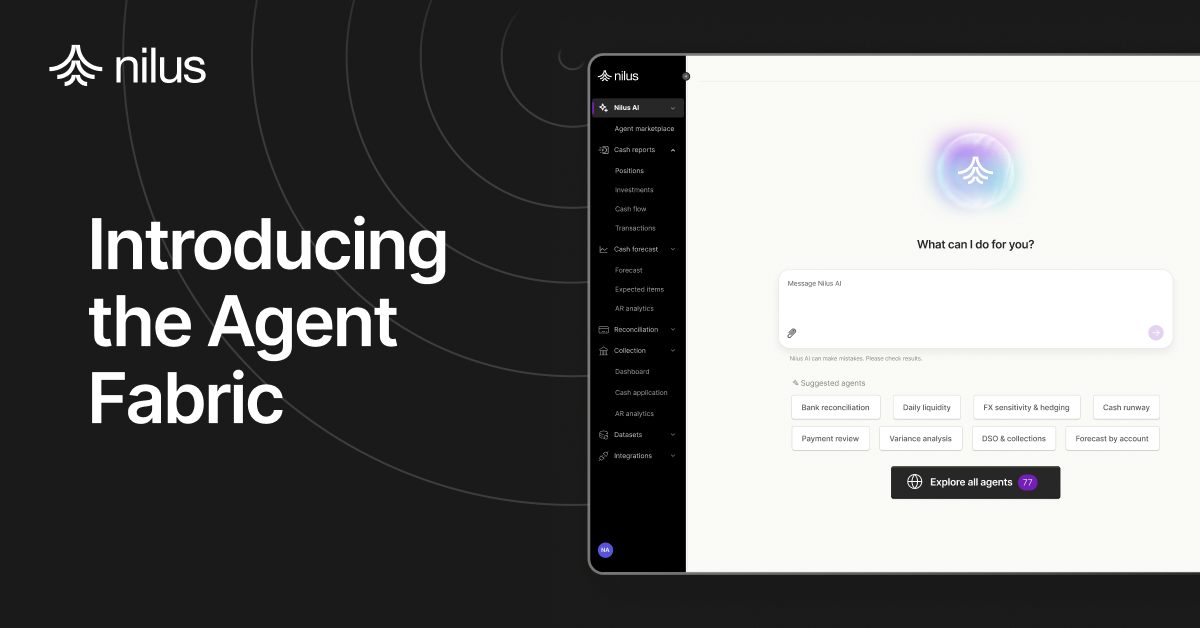
Agents propose, you approve, Nilus acts.
That’s the operational model. Not AI making autonomous decisions about your cash. Not a black box generating outputs you can’t explain to your board. Agents doing the repeatable work, within policy guardrails you set, with a full audit trail on every action taken.
The four agent types that replace manual work
Automation Agents handle transaction matching and reconciliation. 95-99% match rate without human review. Your team handles the exceptions - which is what they should have been doing all along, instead of processing the other 98%.
Reporting Agents assemble cash position summaries, board packs, and covenant compliance reports automatically. The CFO reviews and approves. The agent sends. No more Sunday-evening formatting sessions before Monday board calls.
Analysis Agents run continuous working capital analysis - FX exposure monitoring, idle cash identification, counterparty risk flags. This is the analysis your team never had bandwidth to run consistently. Learn more about how Automation Agents work.
Prediction Agents generate and maintain 13-week rolling cash flow forecasts with scenario modeling - covenant headroom projections, late-payment sensitivity analysis, FX stress testing. Updated in real time as inputs change, not once a week when someone remembers to refresh the spreadsheet.
Why this is not a chatbot
Fair concern. The market has been flooded with AI tools that are, at their core, a language model wrapped in a finance-branded UI. They answer questions. They summarize documents. They do not act.
Agentic treasury is categorically different. The agents take actions - reconciling real transactions, generating real forecasts, moving real data - within policy rules you configure. Every action is logged. Every output is explainable: not “the forecast changed” but “the forecast changed because these three inputs moved, by these amounts, for these reasons.” Nothing executes without approval. The CFO controls the guardrails. The audit trail is complete.
You cannot present a black-box AI output to your board and call it a forecast. Agentic treasury without explainability is a liability. Explainability is not a feature - it’s the foundation.
How to Implement Agentic Treasury in 30 Days - A Step-by-Step Framework
Here is exactly what happens across the four weeks. No “our team works closely with yours.” No “seamless integration.” Just what occurs, in sequence.
Week 1 - Connect your banks and ERP
Nilus connects to your banking platforms within 48 hours via direct bank APIs or SFTP feeds - no manual export required. ERP integration (NetSuite, SAP, Oracle, Microsoft Dynamics) pulls A/R aging, A/P schedules, and historical transaction data. By end of week one, Nilus has ingested 12-24 months of transaction history and begun training the reconciliation and forecasting models on your actual data - not a generic benchmark dataset.
Week 2 - Configure policy guardrails and approval workflows
You define what agents can propose and what requires sign-off. Reconciliation matches above your confidence threshold auto-approve. Matches below it queue for review. Forecast changes above a dollar threshold trigger a CFO notification before publishing. Cash movements above any amount you specify require explicit approval. The CFO controls the policy. The agents operate within it. This is the week where control and automation stop being a trade-off.
Week 3 - Activate automation and run parallel
Agents go live alongside your existing processes. Your team continues their current reconciliation workflow - Nilus runs simultaneously and you compare outputs. By day three or four, the match rate is visible: 95-99% of transactions matched automatically, exceptions surfaced for review. Your team is already spending less time on reconciliation.
By end of week three, most finance teams are ready to switch over entirely. Some run parallel for a fourth week. Either is fine - the point is you see the data before you commit.
Week 4 - First forecast, first board pack, full handoff
The first 13-week rolling forecast is generated - with driver attribution showing which inputs drove the opening position and what the variance scenarios look like. The first automated board pack is assembled by the Reporting Agent and queued for CFO approval. Your team reviews, approves, and publishes. That’s implementation complete. Not “the system is live.” The work has actually moved.
See a 30-day implementation in action
We’ll run a live demo on your actual data - not a sanitized dataset - so you can see exactly what week one through week four looks like for your specific banking and ERP setup.
What Changes After Implementation
Here is the before and after that CFOs are looking for - and the proof that it’s real.
Reconciliation
Before: your team spends the majority of their week matching transactions, chasing A/P and A/R for data, and correcting errors from the previous cycle.
After: 85% less time on reconciliation. The team handles exceptions. The agents handle everything else, at a 95-99% match rate.
Idle cash
Before: working capital analysis happens quarterly, at best, when someone has bandwidth. Idle cash sits in low-yield accounts because no one is running continuous analysis across all your entities.
After: Analysis Agents surface it continuously. Nilus customers typically unlock $1-2M in idle cash in the first 90 days - not through smarter treasury strategy, but through visibility that simply didn’t exist before.
Forecast accuracy
Before: the 13-week forecast is built on weekly manual inputs from A/R and A/P, translated from accrual to cash basis by hand, updated with FX rates that are already stale.
After: 30%+ improvement in accuracy. Live inputs. Driver attribution that tells you what changed and why. A forecast you can explain to the board - not just present to them.
The CFO’s Monday morning
Before: three hours of report assembly, forecast review, and data chasing before the 9am board call.
After: one approval queue. Automated board pack ready for sign-off. Forecast updated overnight. The CFO’s job on Monday morning is to review and decide - not to compile and format.
The strategic shift
85% less reconciliation time does not mean 85% of your team disappears. It means 85% of your team’s time that was spent on manual matching is now available for the analysis, scenario planning, and strategic work that a CFO actually needs from a finance team. That’s the real ROI - not cost reduction, but capability unlocked.
The CFO’s Checklist Before Choosing a Treasury Platform
Before you sign anything, get answers to these questions. They are not trick questions. They have clear right answers. Any vendor that hedges on them is telling you something important.
- Can you be live in 30 days? Not “we can begin the implementation process.” Live - reconciliation running, forecast generating, board pack assembling. Get a specific commitment with a specific scope.
- Are AI outputs explainable? When the forecast changes, can the system tell you exactly which inputs moved and by how much? If the answer is a variance report you run manually, that’s not explainability - that’s a spreadsheet.
- Do I retain approval authority over every agent action? Policy guardrails should be CFO-configured and CFO-controlled. No agent should execute anything above your defined threshold without explicit approval. If the vendor can’t describe their approval workflow in one sentence, the workflow doesn’t exist.
- Is pricing designed for mid-market? Ask for a number, not a “custom pricing” conversation that takes three weeks and involves procurement. Platforms built for mid-market can quote mid-market prices. Platforms built for enterprise cannot.
- Is there a full audit trail on every action? What was reconciled, when, by which agent, approved by whom, at what threshold. This is a compliance and governance question as much as a treasury one. The audit trail is not optional.
- Can it show you idle cash within the first 90 days? Not “our analysis module can surface optimization opportunities.” Ask for a specific number: how much idle cash did the last three comparable customers unlock? If they don’t track it, they’re not confident in the answer.
- Does the system connect to your specific ERP and banking stack? Not “we support major ERP platforms.” Name yours. Ask for a reference customer on the same ERP. The integration is either built or it isn’t. There is no “we can build it for you” that ends well.
Frequently Asked Questions
What is agentic treasury management?
Agentic treasury management is an approach where AI agents actively perform treasury operations - reconciling transactions, generating forecasts, assembling reports, and flagging anomalies - within policy guardrails set by the CFO. Unlike passive dashboard tools that display data and wait for humans to act, agentic systems propose actions, await approval, then execute. The result: 85% less reconciliation time, 30%+ better forecast accuracy, and a treasury function that runs continuously rather than on weekly batch cycles.
How long does it take to implement a treasury management system?
Legacy TMS platforms typically require 12-18 months to implement. Nilus deploys in 30 days. Week 1 covers bank and ERP connectivity. Week 2 covers policy configuration and approval workflows. Week 3 activates automation agents in parallel with existing processes. Week 4 delivers the first automated forecast and board pack. The difference is architectural: Nilus was built for rapid integration, not for consulting-led multi-year rollouts.
What is the difference between a treasury dashboard and an agentic treasury platform?
A treasury dashboard shows you data. An agentic treasury platform acts on it. Dashboards surface cash positions, aged receivables, and forecast variances - but a human still reconciles the transactions, builds the forecast, and assembles the board report. Agentic platforms use AI agents to do those tasks continuously, surfacing exceptions for human review rather than raw data for human processing. If your team is still doing manual reconciliation after “implementation,” you have a dashboard.
How does AI improve cash flow forecasting accuracy?
AI improves forecast accuracy by replacing manual, batch-collected inputs with real-time data feeds from your ERP and banking platforms, and by applying driver attribution - identifying exactly which inputs caused the forecast to change and by how much. Nilus customers see 30%+ improvement in forecast accuracy versus their Excel baseline. That improvement is driven by data freshness (live A/R, A/P, and FX inputs rather than weekly manual submissions) and by models trained on each company’s own historical payment patterns.
Can mid-market companies afford enterprise treasury automation?
Yes - and the more relevant question is whether they can afford not to. Nilus is built for mid-market treasury management at $50M-$500M revenue, with pricing designed for that segment. The ROI case is direct: Nilus customers typically unlock $1-2M in idle cash, save 85% of reconciliation time, and avoid the consultant fees associated with legacy implementations. Most customers reach positive ROI within the first quarter - before the second invoice arrives.
See a 30-day implementation in action. Book a demo and we’ll show you exactly what the 30-day timeline looks like for your banking stack, your ERP, and your team - on your real data, not a sanitized example.