
Introduction
Scalability is top of mind for the vast majority of businesses, yet many of them are not set up for success when it comes to scaling their business. Despite successful ERP and TMS implementations, Finance teams are still struggling with manual reporting, real time visibility and managing processes outside their core applications. With the rise of AI solutions in the Finance and Treasury space, businesses are looking at ways to scale their back office effectively and efficiently.
In this blog post, we’ll explore 10 signs to look out for when considering the scalability of your financial operations. While many of these signs apply to the broader scope of finance, we will be focused on areas that have a more significant impact on the Treasury function.
Spotlight: See how Yotpo saved 100+ hours per month on manual cash operations here.
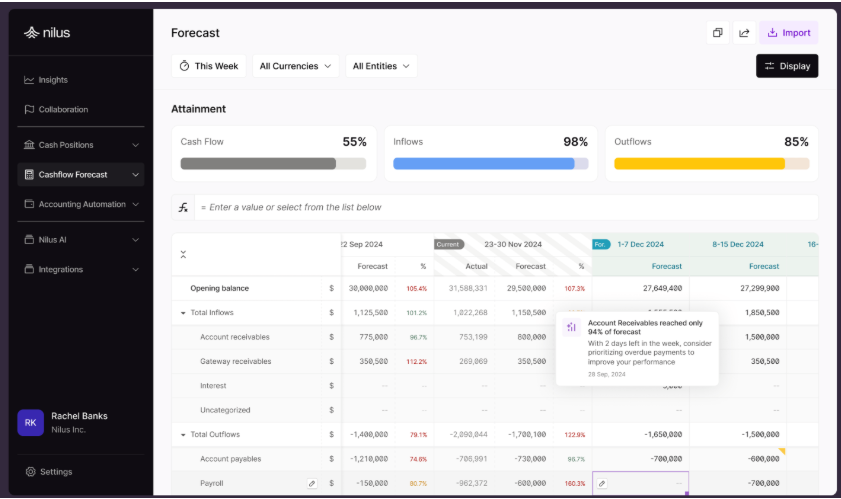
1. You’re still living in Excel
Businesses are investing hundreds of thousands of Dollars (or more) on the implementation and ongoing use of ERP and TMS applications and yet, the teams using these tools continue to spend a significant proportion of their day-to-day in Excel. If your team is spending their time manually preparing reports and pivoting data then it’s unlikely they will be able to absorb additional work that comes with new business models, acquisitions or other operational changes.
Teams still preparing their cashflow forecast in Excel will struggle to keep up with the pace of the business and the need for real time insights into liquidity. If significant investments have been made in ERP and TMS, then why are teams still downloading manual reports and “massaging” the data to prepare a forecast based upon data from last week or even last month?
Sometimes it will be the result of legacy processes that continue to operate as they always have, even with the introduction of new technology. Other times it is the result of a lack of connectivity between the ERP and TMS (which we will explore further later in this blog post).
In today’s environment, it is no longer sufficient to run your forecasts in Excel. They are too prone to human error and cannot support real time forecasting, which continues to be the expectation of the business leaders to support critical liquidity decisions. After all, how can you support real time forecasting when your forecast is “offline”?
2. Bank connectivity is file based
Even mature Treasury tech stacks leverage SFTP for bank to ERP/TMS connectivity. They’re relatively simple, predictable and generally available regardless of who you bank with. While this means of connectivity works, it does not support the need for real time balances and intraday activity.
To address this, Treasury teams are now implementing API connections between banks and ERP/TMS. This allows Treasury teams to be more agile, addressing any potential integration errors point in time vs waiting until the next day for a file transfer to fail. These Treasury teams are able to support same day reconciliations, which is especially impactful at period end.
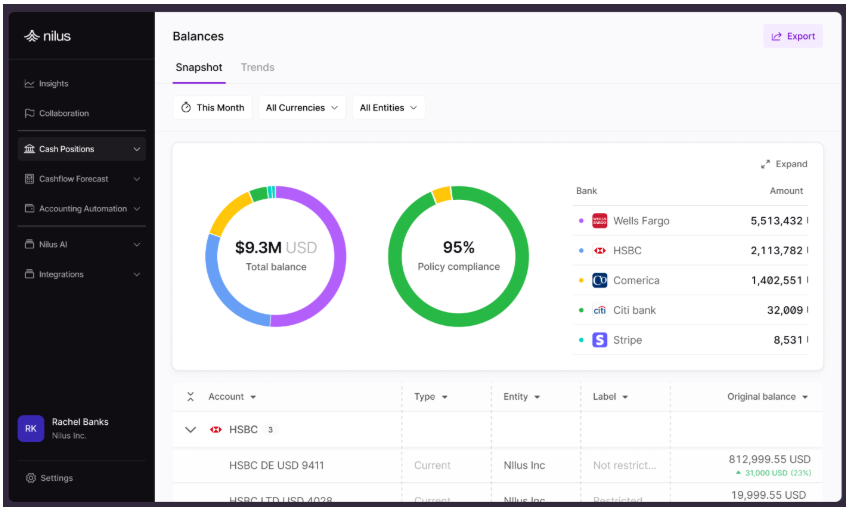
With real time visibility comes live cash positioning to support the movement of cash to avoid the risk of overdraft on any given account. Teams that do not have this visibility will typically have to compensate by holding additional idle cash to mitigate this risk.
3. Idle cash is “trapped”
Without global visibility or centralization of bank accounts, cash is susceptible to sit in pockets that become siloed and difficult to access without the appropriate mechanisms in place to move the cash to where it can be put to work, e.g. repatriation.
Further, if a company does not have any structured liquidity management protocols in place, such as cash sweeps or cash pools, cash balances can remain stuck within a legal entity and/or specific currency. It is important to establish these practices to minimize idle cash balances that can be used to support business operations elsewhere or invested more optimally.
If your Treasury team does not have these systematic mechanisms in place, then the management of cash will continue to be manual and associated risks will exacerbate over time. This can impact the business directly if cash is tied up when it is needed elsewhere to support a funding event. Without the right tool in place, Treasury teams have limited transparency into idle balances, restricting their ability to take action swiftly.
4. Managing bank account administration in spreadsheets
Managing your bank accounts in a spreadsheet isn’t too onerous when you have a handful of accounts to manage. As the portfolio of accounts grows, maintaining the necessary data points within spreadsheets becomes more and more challenging.
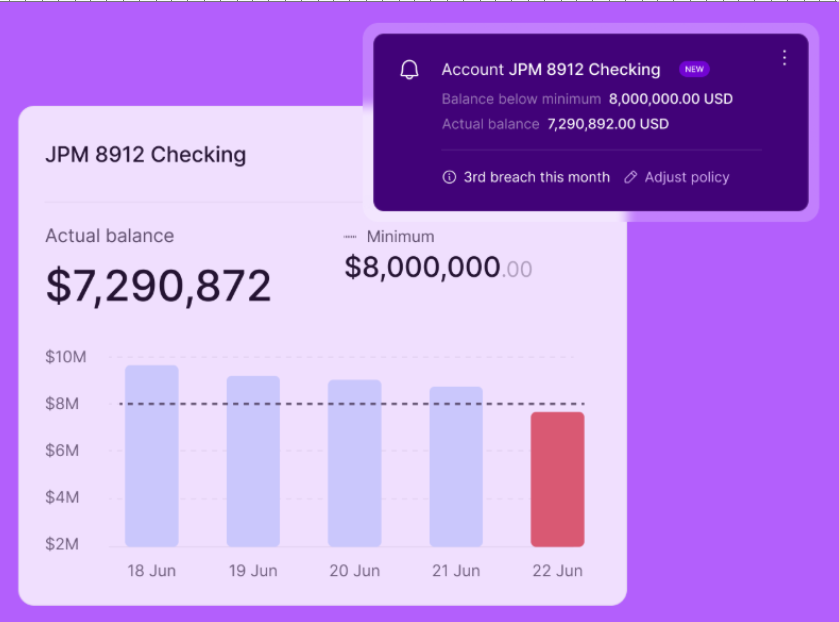
The tracking of approved signers, approval limits, associated effective dates, etc. is important, yet often this data finds itself siloed in a spreadsheet that is difficult to locate. These data points are not needed regularly, but when they are needed it is typically tied to compliance, so speed is of the essence. The lack of central visibility means that these data points cannot drive real time action. For example, if you have your account minimum balances maintained in a separate spreadsheet, you are relying upon manual checks and balances to ensure the associated account balances remain within any covenant limits.
Having the right system in place allows a company to manage these key data points directly within their Treasury operations, tied directly to each bank account. So the next time you are preparing your FBAR reporting or validating your account balances for compliance, think about how helpful it would be to run a single report to get the necessary data or how helpful it would have been to receive a real time alert that an account was close to its minimum balance.
5. Multi-entity and multi-currency handled offline
As companies grow, they will expand into new jurisdictions, countries and continents. With that comes growing complexity and local statutory requirements that must be complied with.
These same companies will have systems configured to support local USD reporting and compliance, but often lack the system capabilities (or business processes) to support international compliance with the same level of autonomy.
Converting financial statements from USD to another currency outside the core financial applications is not so straightforward, especially when applying different rates for different account types. This process doesn’t scale, and while ERPs will often have the capability to automate this process, it will often be a low priority to implement.
For companies that need to take it one step further and account for local GAAP and IFRS accounting standard adjustments, this becomes even more onerous as they scale. If you’re still preparing local statutory financial statements outside of your core Finance technology, it might be time to automate and if your current tech stack does not support this functionality, it might also be time to revisit the tech stack itself.
6. Manual FX processes and reporting
Rapid growth will often lead to increased cash positions and the introduction of new operating currencies to support customer (and vendor) requirements. This brings about a whole new level of risk for companies to manage, especially in the current market where FX rates are more volatile than they have been.
To manage this risk, companies will hedge their FX exposures to minimize the impact of FX movements over a given period. To support the effectiveness of these hedges, Treasury teams require real time visibility into FX exposures by currency. This becomes challenging when this real time insight is not available.
Manual hedging processes will lead to the manual recording of hedge transactions. Booking these entries to the general ledger can be time consuming depending upon the level of activity for a given period. These entries can (and should be) automated with the right tech stack and integrations between ERP/TMS. If these entries are booked automatically, it doesn’t matter if there were two hedging events in an accounting period or 200. The level of effort is the same. That is not likely to be the case if the entries are still being booked manually!
Without a clear line of sight to FX exposures at the end of each period and to the movement of these exposures across a period, it can be very difficult to provide management with a breakdown of realized and unrealized gains/losses that result from FX movements in the period. Next time you are preparing for a hedging event or preparing a report on FX movement for a period, consider how much time it takes, because with the right solution in place these processes can take just a matter of minutes.
Spotlight: See how Freightos moved faster on decisions with real time cash data and insights here
7. Lack of intercompany automation
Intercompany transactions are often the bane of many Finance teams. They can be difficult to calculate (e.g. cost plus and repatriation amounts), as well as difficult to process (e.g. booking manual entries into separate subsidiary subledgers that also need to be eliminated for consolidated reporting purposes).
Despite the underlying difficulty, calculations for transactions like cost plus entries are formula driven and many companies are still preparing these calculations manually today. As intercompany arrangements become more complex, the preparation of related intercompany transactions also becomes more complex and not scalable for the longer term.
When Treasury teams are settling intercompany balances they will either need to prepare the entry for posting to the general ledger or provide supporting documentation to the Finance team so the entry can be processed. This step is fully automated within companies that have been able to configure their tech stack to scale, making the lives of their Finance teams much easier!
8. Manual AP/AR Cash Application
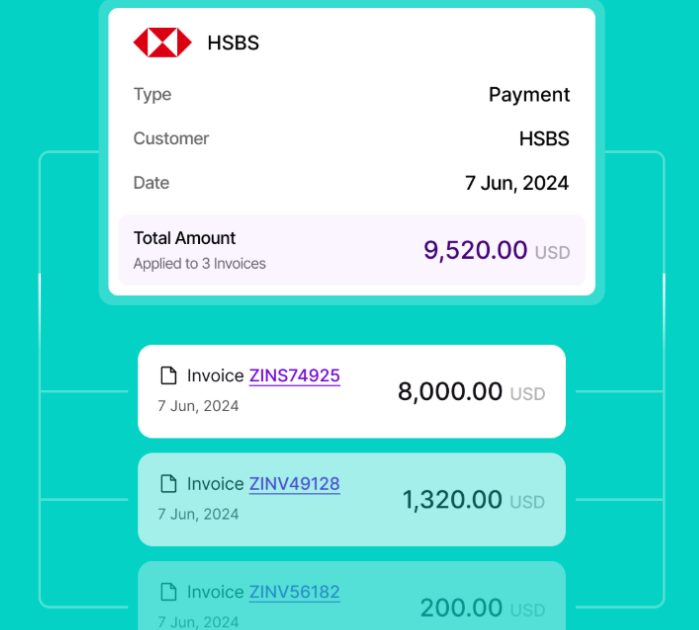
Manual application of payments to invoices is a thing of the past. Auto-matching solutions are no longer “nice to have”, but tools needed to support speed and scalability.
It’s true that auto-matching solutions do not achieve a 100% match rate and nor should they. Exceptions can (and inevitably will) occur periodically and it is important for a human to review in order to correct the auto-match suggestion or apply the cash manually in lieu of a suggestion. The great thing about these solutions is that you can create your own business logic rules, so that these exceptions can be processed automatically in the future. In the past, it would have relied upon someone writing down the exception and remembering it for when it happens in the future. This was not reliable and only increased the risk of human error.
Volume spikes will directly impact the team members applying cash manually, as they are tasked with matching all transactions in the same amount of time, irrespective of volume for a given day/week. This is especially true during month end when teams are looking to lock down the AP and AR subledger as quickly as possible after the last day of the month. If the volume spikes significantly, it can (and does) lead to delays in period close activities.
If cash is still being applied manually today, spare a moment for your accounts payable and accounts receivable colleagues, because applying cash manually when others have 85%+ automated isn’t fun!
9. Duplicative and redundant approval processes
You may have the right tech stack to support your company’s operations, but how often are you seeking approvals across the various applications and are any of these processes redundant or considered a “rubber stamp”?
For example, when considering the end-to-end procure to pay process you will have numerous approvals throughout the life of a single purchase, for example:
- Vendor setup approval
- Purchase order approval
- Invoice approval
- Payment batch approval
- Payment release approval
This is a lot of approvals to process a single payment for one vendor, so is it necessary to have each one? If you have an approved vendor, purchase order and invoice, do you really need subsequent approvals to pay this invoice within agreed upon terms from your bank? In some cases this is warranted. However, companies often default to an approval structure like this one when it is not necessary. Payment batch and payment release approvals are often managed by more senior members of the Finance team, so imagine what other value-add tasks they could be focused on vs approving and releasing payments for invoices that have already been reviewed and approved for payment in accordance with terms.
The same thing happens when bank accounts are being reconciled. If there are miscellaneous bank charges or small differences to be written off, they may require an additional review and approval prior to posting to the general ledger, typically via manual journal entry. With the right technology solution in place, these immaterial differences can be written off automatically, allowing management to focus on the review of larger exceptions where judgment might be required.
10. Loose integration between ERP and TMS
If your Finance and Treasury teams are running disparate processes and need to “translate” these processes across various systems, then it’s a sure sign that your ERP and TMS are not tightly integrated, or not integrated at all.
When these teams operate in silos it will inevitably lead to duplication of efforts. For example the tagging of bank account transactions within the TMS to support Treasury forecast reporting might happen at the same time the Finance team is tagging these same transactions within the ERP.
Treasury teams cannot operate with agility if they are disconnected from the data that lives within the ERP. They need the ability to sync live AP and AR balances from the ERP to account for delayed (or advanced) payments that need to be factored into the latest cashflow forecast. Without this integration it will be challenging to forecast accurately and could have a domino effect, such as leading to excessive idle cash balances being maintained or running into an overdraft position unexpectedly.
With a tight integration between your ERP and TMS, you are setting your Finance and Treasury teams up for success, through collaboration, visibility and the elimination of redundant (often duplicative) work.

Top 10 checklist
Here are the Top 10 signs your finance tech stack won’t scale, summarized with a few simple bullet points.
- You’re still living in Excel - Manual reporting in Excel doesn’t scale. If you can’t report in-platform, do you have the right platform?
- Bank connectivity is file based - Just because SFTP is broadly available doesn’t mean it is the right connectivity option. High volume accounts connected via API will give real time visibility and support same day recons, while other teams wait for the next day!
- Idle cash is “trapped” - Without visibility, cash may sit idle for long periods of time, leading to a loss in potential return on that cash, but result in liquidity issues if not addressed in the long run.
- Managing bank account administration in spreadsheets - Excel to start, but not to scale! Manage all key bank account metadata within your TMS for a single source of truth.
- Multi-entity and multi-currency handled offline - Reporting local currency and accounting standard requirements offline will not support scalability. Automate these processes.
- Manual FX processes and reporting - Effective hedging and reporting rely upon accurate, real time data from your ERP. Without this, hedges will be less effective and reporting will continue to be tedious and time consuming.
- Lack of intercompany automation - Preparing and posting of manual intercompany transactions is difficult and error prone. It’s time to automate these processes, so you can easily support the movement into new countries.
- Manual AP/AR Cash Application - Cash application matching solutions are getting smarter and achieving higher levels of match rates. Don’t let your AP and AR teams start their day at 0% matched, when others are starting at 85%+.
- Duplicative and redundant approval processes - If you have a lot of “rubber stamp” approvals in your core business processes, it might be time to revisit these processes. You will be preparing for scale, while giving time back to more senior members of the company.
- Loose integration between ERP and TMS - Without a tight integration between ERP and TMS you will run into siloed processes between Finance and Treasury, which often results in duplication of effort. This is not scalable.
{{blog-cta}}
Final thoughts
After reading this article, if you are seeing some of these signs in your own business it might be time to start thinking about whether your current tech stack is going to support on a longer-term scale. Whether it’s new operating models, operating in new countries or acquiring a company, the need for business processes to scale is paramount to success and having the right tech stack makes a world of difference.
Is your team ready for the next evolution of treasury operations? Ask yourself these 10 questions before choosing an AI treasury platform!

Written by
Your next treasury move is waiting
Get an ROI assessment, and find out where you’re leaving cash on the table.


Your next treasury move is waiting
Get an ROI assessment, and find out where you’re leaving cash on the table.
More Resources
Your next treasury move is waiting
Get an ROI assessment, and find out
where you’re leaving cash on the table.

