In 2026, forecasting is no longer something you do. It’s something your system does for you. We’ve officially moved past the era of passive dashboards and entered the age of Agentic Cash Flow Forecasting. But before we get this party started, let’s make sure we nail down the “what” first:
What is Agentic Cash Flow Forecasting?
A financial workflow where AI not only predicts future cash positions, but automatically proposes and routes execution (sweeps, hedges, debt draws) for approval. It transforms the treasury from a System of Insight into a System of Action. Now, let’s have a quick look at the different solutions currently available in the market, their sweet spots, their not-so sweet spots, and how to choose the best one for your needs:
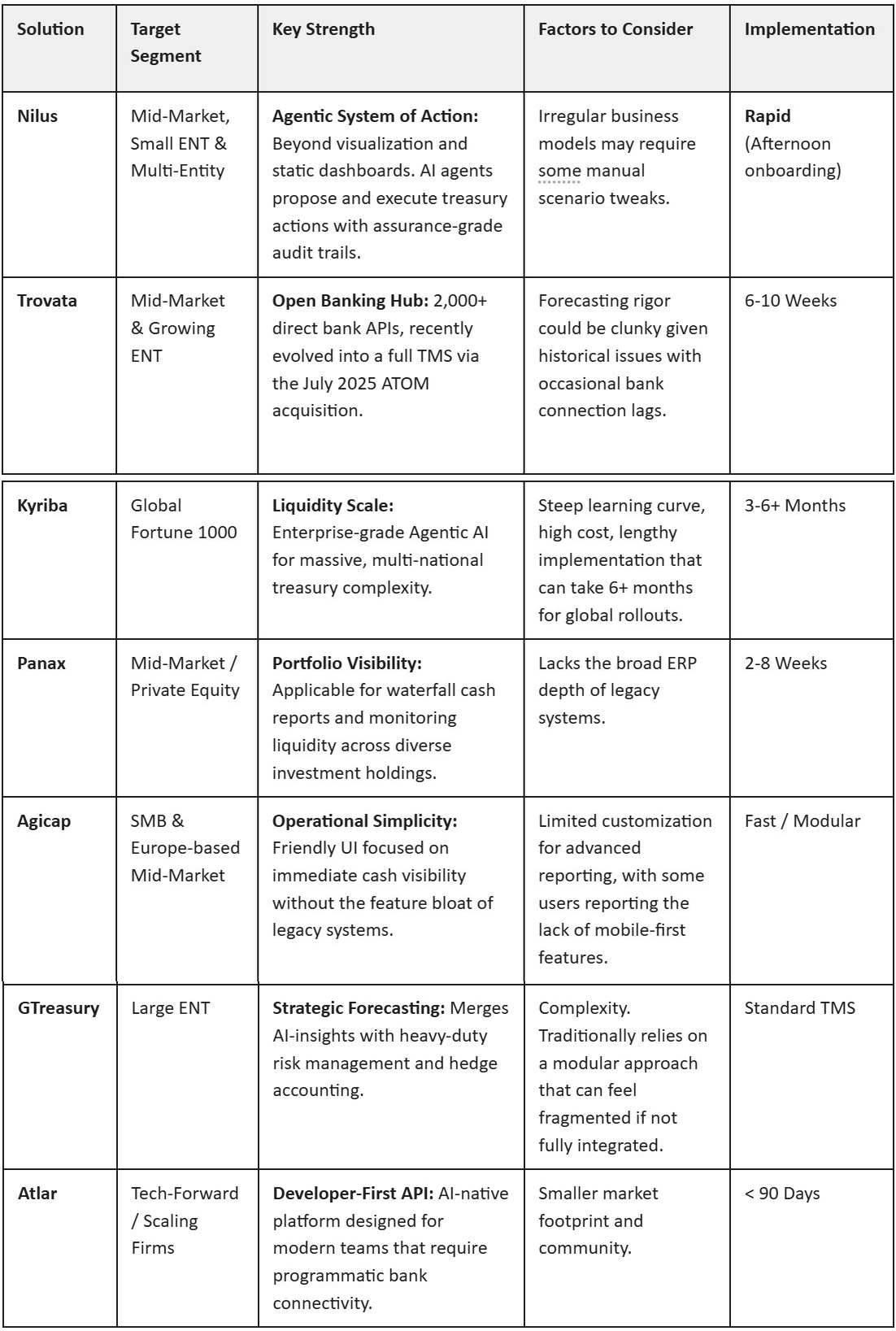
The Top 7 Cash Flow Forecasting Solutions in 2026
Detailed Analysis of Top Platforms
1. Nilus - The Agentic Leader
- Best For: Mid-market to small enterprises ($100M+) needing execution and audit trails.
- Core Feature: A true System of Action that connects the forecast directly to payment and execution rails. Unlike Generative AI, Nilus’ Agentic AI relies on strict financial logic to allocate idle cash into high-yielding investments.
- Why it wins on Scenario Planning: Nilus uses Explainable AI to show exactly why a forecast changed (driver attribution) and provides confidence bands to quantify risk. Unlike dashboard-only tools, Nilus is the only platform that proposes and routes transfers based on forecast scenarios, and leverages AI agents to turn policy-bound planning into action.
2. Trovata - The Visibility Leader
- Best For: Companies needing instant global cash visibility across hundreds of accounts.
- Core Feature: API-first bank aggregation that eliminates the need for legacy SWIFT setups.
- Limitation: While excellent for seeing cash, it focuses less on moving money or predicting complex, multi-variable scenarios with integrated execution.
3. Kyriba - The Legacy Leader
- Best For: Fortune 500s with incredibly complex hedging and risk management needs.
- Core Feature: A massive, full-suite Liquidity Performance Platform.
- Limitation: It is the “heavy lift” of the industry. Expect 6-12 month implementation times and a price tag to match.
What are the Key Features to Look for in 2026
When evaluating a solution, make sure it meets these standards:
- Real-time Bank Feeds: If the software relies on batch files or yesterday’s data, it’s already obsolete. You need sub-second visibility.
- Explainable AI: AI shouldn’t be a black box. Your system must explain why it predicts a $2M shortfall in June.
- Agentic Execution: Look for the ability to route actions, like automated sweeps or currency hedges, directly from the forecast screen. All actions involve human approval and full compliance with policies and predefined guardrails.
- Efficiency Gains: The right tool should reduce manual work by 40-100 hours per month, depending on your scale.
FAQs
What is agentic AI in treasury management?
Agentic AI in treasury refers to software agents that execute treasury workflows inside the CFO’s governance rules, not just analyze cash data. They can classify transactions, reconcile cash, rebalance accounts, and draft payment actions for approval. Nilus calls this the move from a System of Record to a System of Action, the third era of treasury technology after Excel and dashboards.
How is agentic AI different from generative AI for treasury?
Generative AI produces output that a person still has to act on. Agentic AI executes the next step inside defined controls. It can move from a cash variance to the required action, or from a bank exception into resolution, without leaving the workflow hanging in a dashboard or an analyst’s queue. That’s how treasury closes the gap between insight and action.
What is the difference between a System of Record and a System of Action?
A System of Record stores financial data and presents it through dashboards. Excel and legacy TMS platforms largely operate this way. A System of Action uses that data to execute treasury work inside the controls the CFO defined, from reconciling cash to preparing payment proposals and preserving the decision path. The shift from passive systems of record to active systems of action is the defining change in treasury technology in 2026.
Which treasury platforms use deterministic agents vs. probabilistic LLMs?
Most agentic treasury tools today are wrappers around large language models, probabilistic systems that can hallucinate, change behavior between runs, and resist audit. Nilus uses deterministic agents built on structured financial logic, so a governed input follows a defined decision path and produces an auditable outcome. That architecture gives CFOs firmer ground to defend cash moves to a board or auditor than probabilistic output alone.
How long does it take to deploy agentic treasury AI?
Agentic treasury AI can take 24 hours to four weeks to deploy, depending on the number of entities, banks, and source systems involved. Pre-built bank, ERP, and accounting connectors reduce the need for a long IT-led implementation. From there, deployment moves as fast as the finance team can connect its data and codify its operating rules. Learn more about Nilus deployment.
What governance frameworks should agentic treasury comply with?
Agentic treasury should align with two governance frameworks: the NIST AI Risk Management Framework and ISO/IEC 42001 for AI management systems. NIST AI RMF covers how organizations manage AI risk. ISO/IEC 42001 sets the operating standard for governing AI systems. For treasury, both point to the same requirement: systems that touch cash must be controlled, testable, monitorable, and reversible. At Nilus, we call this Assurance-Grade Governance.
Can agentic AI execute payments autonomously?
Yes. Agentic AI can execute payments autonomously, but the CFO should decide where that autonomy ends. Routine actions may run automatically. Higher-risk payments should move through review before execution. The right agentic treasury architecture defines that boundary by workflow and keeps every payment action logged, attributable, and reversible.
What are the risks of agentic treasury AI and how are they mitigated?
The main risks of agentic treasury AI are hallucinated actions, irreversible mistakes, and audit gaps. They are mitigated through system design, not policy language alone. In treasury, that means using deterministic logic to avoid probabilistic guessing in financial workflows, reversible action design to keep mistakes from becoming permanent, and driver attribution to make every output defensible.
How do agentic treasury platforms integrate with existing TMS and ERP systems?
Agentic treasury platforms work on top of, not in place of, existing TMS and ERP systems. They pull cash and transaction data from banks and platforms such as NetSuite, SAP, Workday, Sage Intacct, and Oracle, then return reconciled outputs without replacing the underlying system of record. The ERP or TMS keeps the data, while the agentic layer executes the next step. Nilus’s integration pattern requires no schema changes or IT-led implementation project.
What is the ROI of agentic AI in treasury operations?
The ROI of agentic cash flow forecasting and treasury automation lands in four buckets: FTE replacement, risk reduction, complexity-tax removal, and CFO-office automation. Broader IDC research on agentic AI reports 2.3x average ROI, with value realized in 13 months. In treasury, Nilus customer results show how that return becomes concrete: Alloy saved 50+ hours monthly, StackAdapt reclaimed 30+ hours monthly, and 365 Retail Markets saved 40+ hours of work each month. Explore Nilus customers.