Introduction
For many companies, operating globally is no longer an ambition, but the very key to long-term growth. Growth can come in many forms. M&A is a great example that can often lead to international growth. Organic growth is achieved with new product offerings or targeting new markets. It can also come through establishing operations overseas to achieve a particular operating model, e.g. offshore shared services model. Whatever the case may be, global expansion will lead to more legal entities, more bank accounts, more currencies and more regulations to comply with. Treasury teams are charged with keeping pace with the business, often with somewhat limited resources. In this blog post, we’ll explore the impact of global expansion and strategies to keep operations as simple as possible. Simplicity scales. Complexity doesn’t. Spotlight: See how Freightos moves faster on decisions with real-time cash data and insights for their global operations here
Complexity
Complexity is inherent when moving to a multi-entity business model. Treasury is no exception to experiencing this complexity. Banking relationships now stretch continents and time zones, making it more challenging to maintain those key relationships with your bankers. Targeting a global banking partner can help mitigate this challenge, but there is no avoiding the need to contact local banking partners from time to time. Even when working with the same global banking partner, Treasury teams still have to manage multiple bank accounts and banking portals to access those accounts. Two-factor authentication is essential from a security standpoint, but it can certainly get confusing when you’re using tokens for some platforms, push notifications to your cell phone for others or any other form of 2FA. Wouldn’t it be nice for Treasury teams to manage their global banking relationships from a single platform?
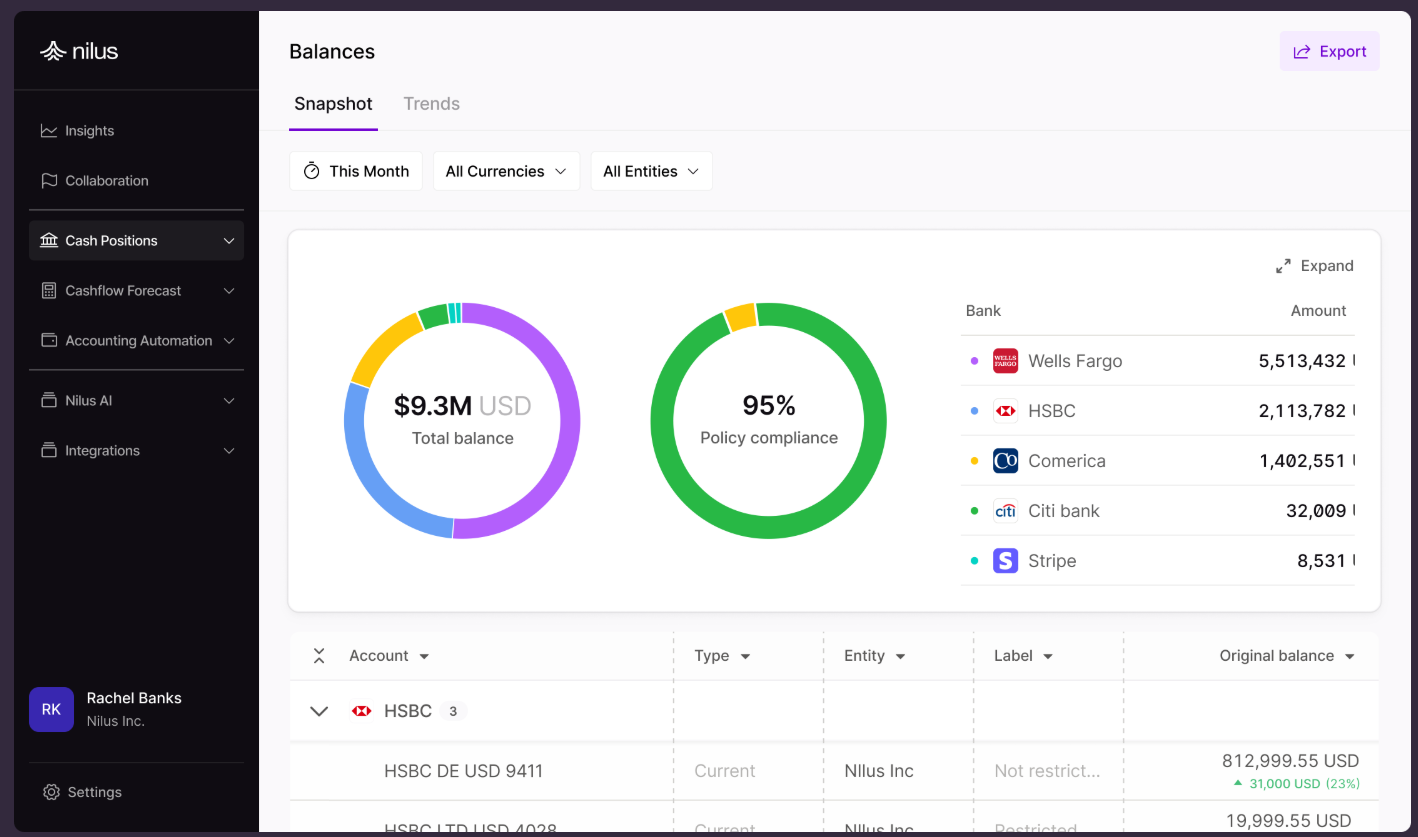 Screenshot from Nilus showing visibility into global bank account balances from a single dashboard
Cash management becomes more challenging. With more account balances to manage and transactions flowing in/out of each, forecasting becomes a burden and cash pooling becomes a “nice to have” vs a strategy to manage liquidity within the business. Forecasting becomes even more complex when teams are managing accounts in numerous currencies. As currency balances grow, the risk of FX market shifts impacting the business grows with it. If you don’t have visibility into the expected movements in these account balances it makes hedging against FX market shifts almost impossible. With that, it’s critical to have your financial systems connected end to end to support accurate forecasting across all material balances held in each currency. And the more accounts to be managed, the more work it is to configure integrations, as well as maintain them. Monitoring for account balances breaching covenant thresholds becomes an after the fact exercise, which exposes the business to undue risk. Now that we understand the complexity that is introduced with global expansion, let’s look at how this directly impacts the business.
Business Impact
Nobody wants to work 24 hours a day, yet many Treasury teams are tasked with partnering with banks operating in North America, Asia and Europe, sometimes all on the same day. This is not a sustainable model, so businesses either shift resources in-region to support these operations or they end up with burnt out teams, typically in North America. Global expansion can cost the business in the form of additional headcount when not managed effectively. Without visibility into cash balances across continents and currencies, forecasting becomes more of a guessing game than a driver of key liquidity decisions. How can businesses hold their Treasury team accountable to a forecast they weren’t confident with in the first place? So how do these same Treasury teams mitigate some of the unknown? They “hedge” against it and no, not with a forward FX contract, but by maintaining excess cash balances to ensure there is very little risk of any account balance falling below covenant thresholds or slipping into an overdraft position. This “idle cash” is now trapped in overseas accounts and cannot be invested or utilized elsewhere in the business. From an investment perspective there is a direct opportunity cost on the foregone investment return (say 3% annually, to be conservative) and the bank account interest earned, if it’s even above 0%! As we saw earlier, FX market shifts can have a real impact on businesses with significant cash balances overseas. If the Treasury function is not enabled to support consistent hedging strategies, there is risk of the hedges themselves being inefficient. Inefficient hedges can work in the business’s favor, but relying upon luck vs strategy is not a way to manage the liquidity of any company. Inefficient hedges cost real Dollars in the long-run, Dollars that could have been utilized elsewhere, such as implementing a system to enable Treasury teams to operate more effectively and efficiently! Despite all of these challenges, the decentralization of Treasury operations will inherently lead to slower responses to business requests and ultimately slower (or even incorrect) business decisions. The monetary impact of this is harder to quantify, but could be much more significant when compared to trapped idle cash or inefficient FX hedges. So what can companies do about this? Only operating domestically is clearly not an option.
Strategies to Simplify and Scale
We just discussed the impact of decentralized Treasury operations, so the first strategy to explore is keeping your Treasury function centralized, even if some global support is still needed. One central team should be accountable to the business and support critical business decisions tied to liquidity and investments. To support this effort, standardizing your Treasury processes is essential and one of the easiest ways to do that is by operating from a single source of truth. Why have your Treasury teams manually extracting data from banking portals and ERPs to derive a cashflow forecast or a FX balance that needs to be hedged, when all of these systems can be connected end to end and centralized within a single platform? With all of your business’s bank accounts managed centrally, cash pooling and automated sweeps become much easier to manage. With real time visibility into account balances, a centralized platform can automate these efforts and eliminate manual transfers. Policy-driven hedge strategies can be executed seamlessly when FX exposures are visible within a centralized platform. FX exposures from across the company can be considered, including forecasted cash flows and then measured against risk tolerance levels. Imagine having an AI-first Treasury platform that could recommend hedging instruments( e.g. forwards, options or swaps), based upon the cost, liquidity and market conditions. The platform doubles up as a Bank Account Management (BAM) solution. No need to track account signatories, limits, paperwork, etc. in an external system or folder structure when it can live in the system the Treasury team operates in on a daily basis. With all of this data housed centrally and with a layer of the latest AI to analyze this data, not only will you be saving Treasury teams countless hours of manual work, but you can have the system working for you 24 hours a day! The AI layer can spot trends and patterns that would be difficult for even the sharpest minds to trace, as well as detect anomalies in banking transactions. This can be especially difficult for Treasury teams working in a high transaction volume environment. No more overdrafts, not when logic can be established to move funds real time to avoid these situations altogether.
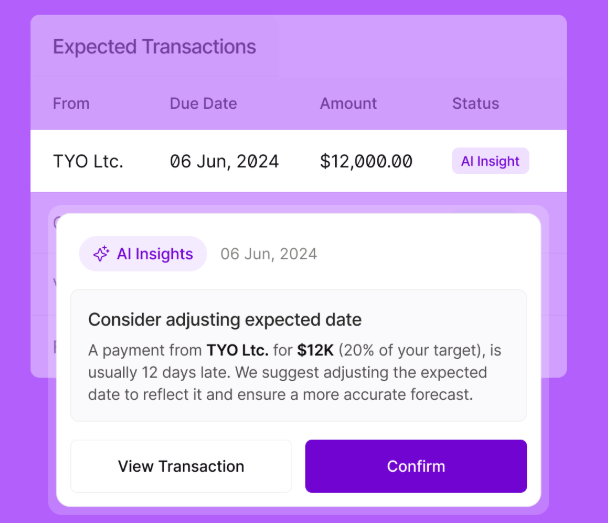 Screenshot from Nilus showing how its AI-first platform leverages smart collection predictions beyond invoice terms
It all starts with centralizing your Treasury operations. Now this is easier said than done, so how can companies enable their Treasury teams with the right architecture?
Scalable Architecture
The goal is to take the Treasury function from fragmented and reactive to integrated and proactive. When you’re thinking about centralizing your end to end Treasury operations, a great starting point is taking the time to unify your data model. When your banks, ERP and TMS are talking the same language, it is much easier to automate your cashflow forecasts. With consistent bucketing “tagging” of transactions, it will be clear where the forecast met expectations, where it fell short, and where transactions that were expected to clear did not and need to be included in the subsequent forecast.
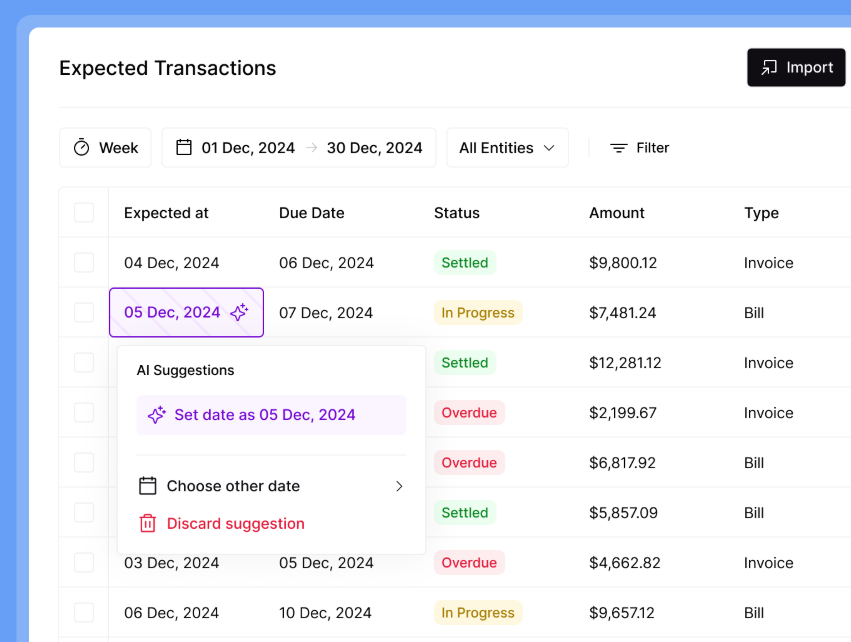 Screenshot from Nilus showing direct visibility into transactions that were expected to clear during a given forecast period and the status for each
With a unified data model in place, you should be targeting real time insights into your account balances. Legacy, file-based integrations cannot support this, so taking an API-first approach is going to be essential. This will be a big change for many companies and not all banks offer API integrations. With that, it won’t be an overnight shift to API integrations, but steps in the right direction here promote real time visibility. Prioritizing your high balance/high transaction volume accounts is going to give you the best ROI.
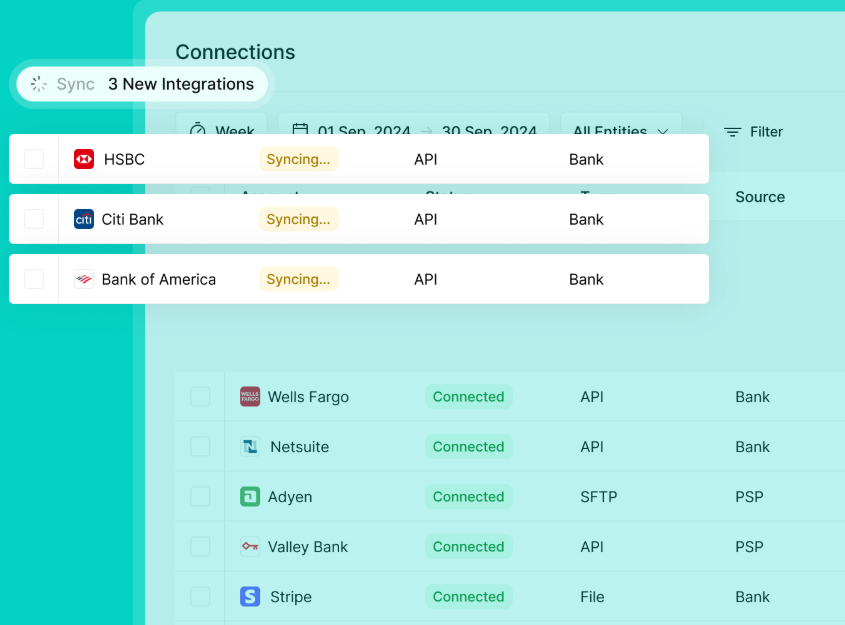 Screenshot from Nilus showing how accounts can be synchronized from within the platform itself, via API
Establish business logic within your TMS to automate intercompany settlements, hedging against FX exposures and maintaining balances within covenant terms. By automating these processes, or at least getting to a “human in the loop” solution, you alleviate the burden on Treasury teams and allow them to focus on value-add analysis to support the continued growth of the company.
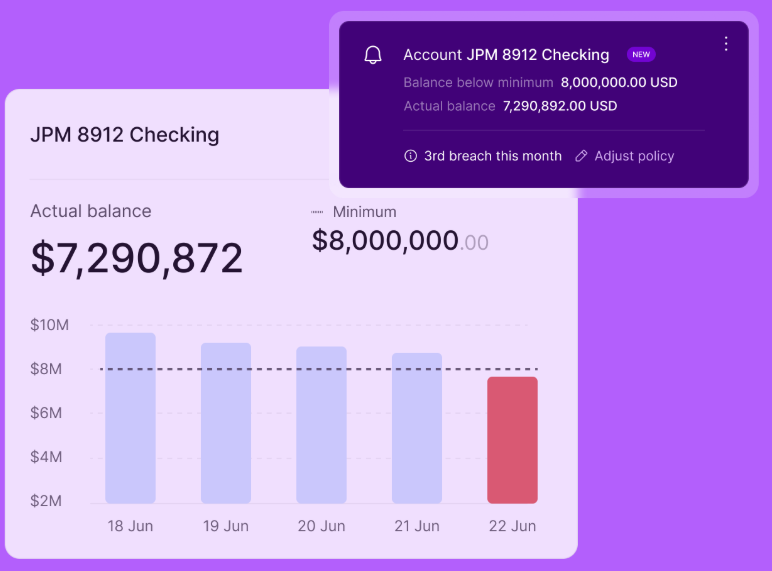 Screenshot from Nilus showing how the management of account policies can be automated in-platform to provide real time visibility vs manual, periodic calculations
Remember: Simplicity scales. Complexity doesn’t.
Final Thoughts
Scalability is not just about volume, but maintaining visibility, agility and control across all global operations. To support the growth of their business, Treasury teams are looking to modernize their operations now, because every day they wait has a monetary consequence as we saw earlier in this blog post. Is your team ready for the next evolution of treasury operations? Ask yourself these 10 questions before choosing an AI treasury platform!