
This post was written by Ernie Humphrey, CEO of 360 Thought Leadership Consulting & Treasury Webinars Increased volatility in global markets, driven by persistent uncertainty around trade policies, new regulations, tariffs, supply chain disruptions, and geopolitical tensions, has made understanding how to leverage AI in treasury a top priority at companies of all sizes. How are treasury teams leveraging AI related functionality to deliver strategic value in the midst of unprecedented cash management dynamics? What is driving the adoption of AI in treasury? What is holding back treasury teams in adopting AI in areas where it can have impact? These are three main questions that inspired The Treasury in 2026: Challenges, Opportunities, The Role of AI Survey. The cross-industry survey launched in September of 2025 and focused on companies headquartered in the United States of America. The survey garnered 264 responses from treasury and finance leaders with roles including Cash Manager, Treasury Manager, Director, Treasury, Director, Finance, Assistant Treasurer, and Treasurer. The industries represented in the responses include Software/Technology. Healthcare, Retail, Energy, Construction and Transportation.
The Current Role of AI in Treasury
AI is playing a role across treasury operations among survey respondents (Figure 1.). AI specific initiatives in treasury and/or finance are already taking place at 40% of companies and will take place at another 38% of companies (Figure 2.).
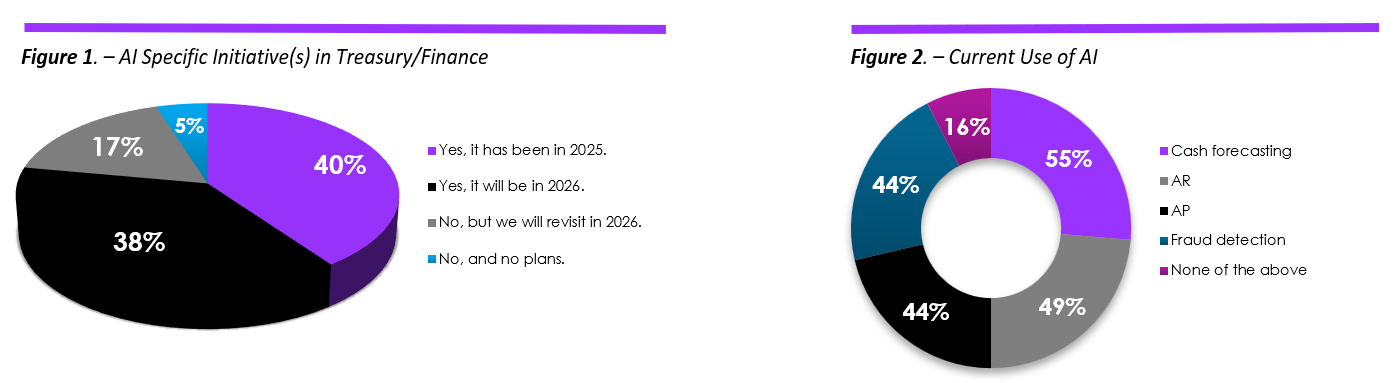
These results suggest that the adoption of AI in treasury has been a priority and will continue to be one in 2026 among the companies surveyed.
What is Driving the Adoption of AI in Treasury?
There is strong momentum in leveraging AI related functionality in treasury at the companies surveyed, why?
AI adoption in treasury should be backed by company support prior to implementation, and the treasury team must possess sufficient AI expertise before integrating it into their operations. Sixty-three percent of survey respondents report their companies support the use of AI within and beyond treasury and fifty-one percent revealed that their treasury teams are knowledgeable or deeply knowledgeable of AI.
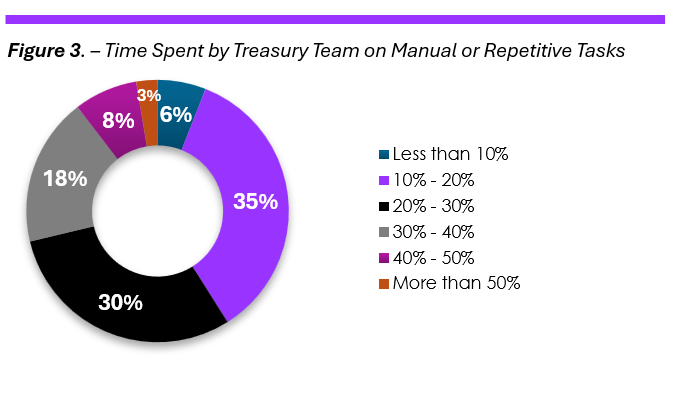
The culture for AI adoption is right at the majority of companies surveyed, and that set the stage for them to realize the benefits of AI to them in addressing challenges treasury teams face. The cash management challenges by the companies surveyed face include time misallocation to non-value add tasks. Only 6% of treasury teams are not spending at least 10% of their time on manual or repetitive tasks (Figure 3.). Over 65% of treasury teams are spending at least 20% of their time on non-value add tasks.
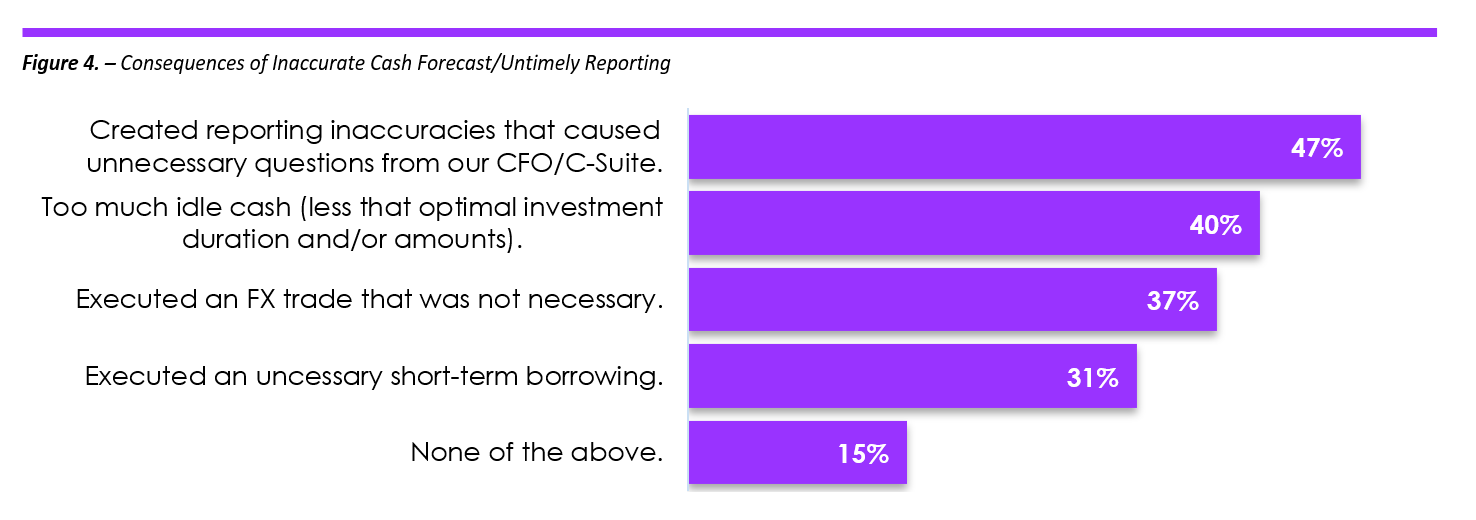
Motivation for AI adoption in treasury is also evident in negative bottom line impacts that are the direct result of inaccurate cash forecasting and/or untimely reports are having These consequences are depicted in Figure 4. Treasury leaders aspire to be consulted by the C-Suite, but questions that are the result of erroneous and untimely reports waste the time of C- Suite executive and treasury teams. Idle cash leads to suboptimal yields which means money left on the table. Uniformed FX trades lead to unnecessary costs in addition to hindering effective currency risk management. Executing a borrowing that is not needed is costly not only in terms of interest expense, but also costly in terms of time wasted in executing and the accounting related activity to a borrowing.
What is Hindering the Adoption of AI in Treasury?
Treasury teams face headwinds from market volatility impacting their company’s suppliers and customers, and from inaccurate and untimely cash forecasting and reports that damage profitability. Why aren’t all companies adopting AI-related functionality in all areas of treasury?
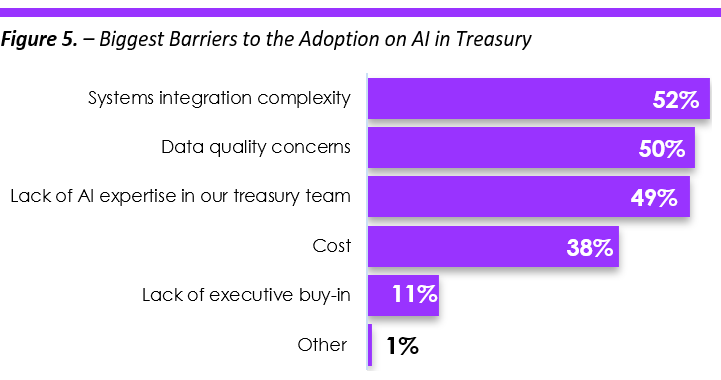
It is encouraging that only 11% of survey respondents shared that there is a lack of executive buy-in as a barrier to the adoption of treasury. The three most commonly identified obstacles to the adoption of AI in treasury are systems integration complexity, data quality concerns, and a lack of expertise within treasury teams.
The ROI of Adopting AI in Treasury
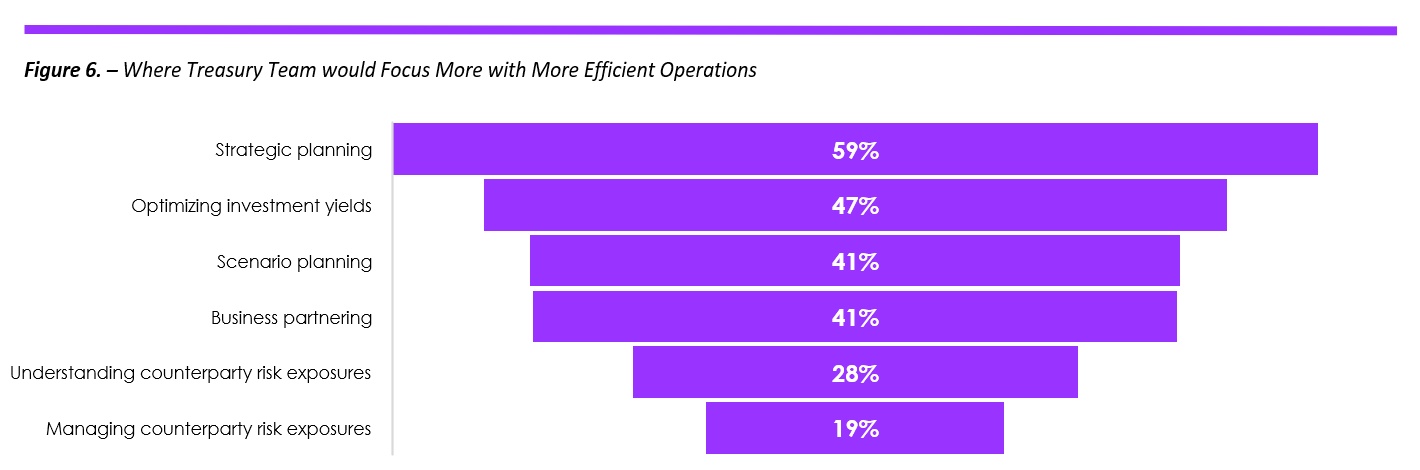
The benefits of adopting AI in treasury can have many dimensions including better decision making related to all cash movements, improved collaboration within and beyond treasury, and mitigating risk exposures which impact company profitability. There is also more time for treasury teams to focus on strategic activities. Survey respondents were asked where they would spend more time if they had to focus less on manual or repetitive activities. It is clear that there are many opportunities for treasury teams to deliver more strategic value from treasury encompassing a better understanding and managing counterparty risks, investing in business partnering, and optimizing invest yields (Figure 6).
The momentum for the adoption of AI across treasury operations is warranted given all of dimensions and scale of benefits that can be realized with the right culture and investment in AI knowledge including the risk exposures. Companies of all sizes across industries would do well to consider the role that AI should play in empowering their treasury teams to deliver the most impact and being a strategic partner to the C-Suite. You can learn much more about the current and emerging role of AI in treasury by downloading the full survey report: The Role of Treasury in AI: The How, the Why, the Why Not.
hbspt.forms.create({ portalId: “21935103”, formId: “5ad4f225-2d37-4e31-952d-fa2fe8e7abbf”, region: “na1” });