
Introduction
Treasury teams across the globe are entering into a new operating environment. Not one that is just defined by cash management and controls, but by agility and scalability. Despite this, many Treasury functions are still executing processes that were designed for managing fewer bank accounts, fewer jurisdictions and less volatility, along with lower expectations for more real-time execution. These processes still work today, but they are slow, manual and challenging to keep pace with modern infrastructure. This can still work for low complex/low volume environments, but as complexity (and volumes) continue to increase in the Treasury space, the need for modernization is no longer a “nice to have”, but a strategic advantage. In this blog post, we’ll explore the cost of not modernizing Treasury operations, but let’s be clear on one thing - this cost is not only measured in process inefficiency or the need for additional headcount. It shows up throughout the entire spectrum of Treasury operations, such as slower liquidity, larger idle cash balances, increased risk exposure, and higher cost of capital. This all ultimately leads to a lack of agility within a business, and when the Treasury function cannot move at the same pace as the business it can lead to the business slowing down to match the pace. Spotlight: See how Taboola achieved 95% automated transaction tagging and managed 100+ Accounts in a single dashboard here
Increased complexity
Globalization is here to stay. Companies are managing more and more bank accounts across a broader country base than ever before. This means more cash to track, manage, and optimize for Treasury teams. This increased complexity is unmatched by the infrastructure supporting these same Treasury teams.
Along with operational complexity, the Treasury function is seeing increased demand from the business to support more real time decision making, such as: Leadership seeking real time liquidity to support fast decisionsIncreased risk mitigation against higher volatility in FX and interest rate varianceRolling forecasts on a weekly or even daily basis
This results in a significant gap between how the Treasury function operates and expectations from the business. The gap hasn’t arisen from neglect nor a lack of expertise, but the operating model itself was not built for the level of complexity we are seeing today.
If Treasury teams cannot keep up with the increased complexity they will need to seek an alternate operating model, as slowing down the business is just too costly.
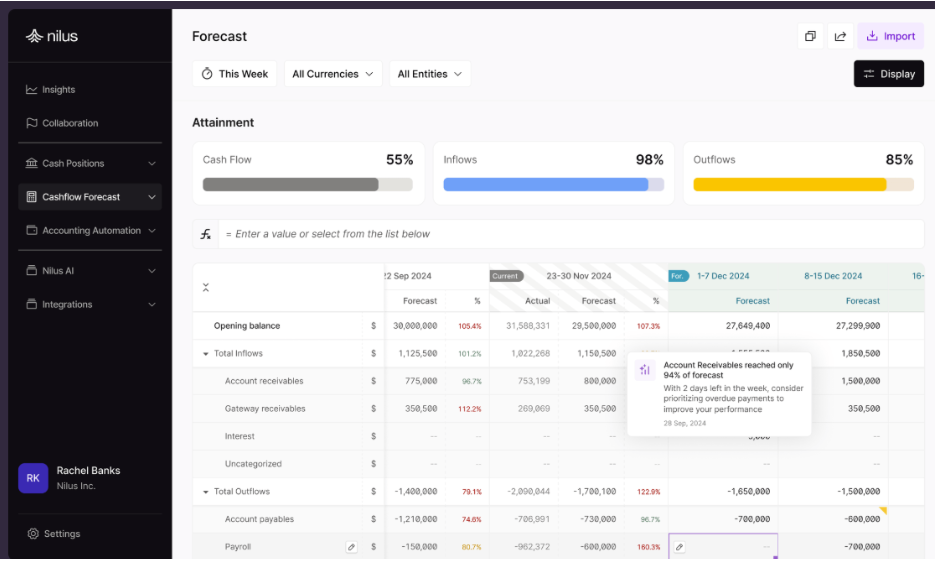 Screenshot from Nilus showing how you can connect your historical cash flows with your future transactions across all systems
Compounding manual processes
To put it bluntly, manual processes do not scale. This is as true in Treasury as it is in other Finance functions. This is not a prioritization issue - Treasury teams are still prioritizing the right things and doing their best to operate in real time, but the reality is that exposures are calculated less frequently than desired, forecasts are updated less frequently than desired, and reconciliations are a burden.
These processes are often “solved” with incremental headcount, but that will only get a Treasury team so far before they are back to where they were and the cycle continues. At the same time, this is not always apparent to the broader Finance team. Late nights to keep up, consistently putting out fires, and deferring more strategic projects can make it seem like Treasury operations are running smoothly, when in fact they are paddling like a duck under water!
If Treasury teams cannot continue to co-exist for highly manual processes they will need to seek an alternate way of working. We’ll discuss talent risk/burnout later!
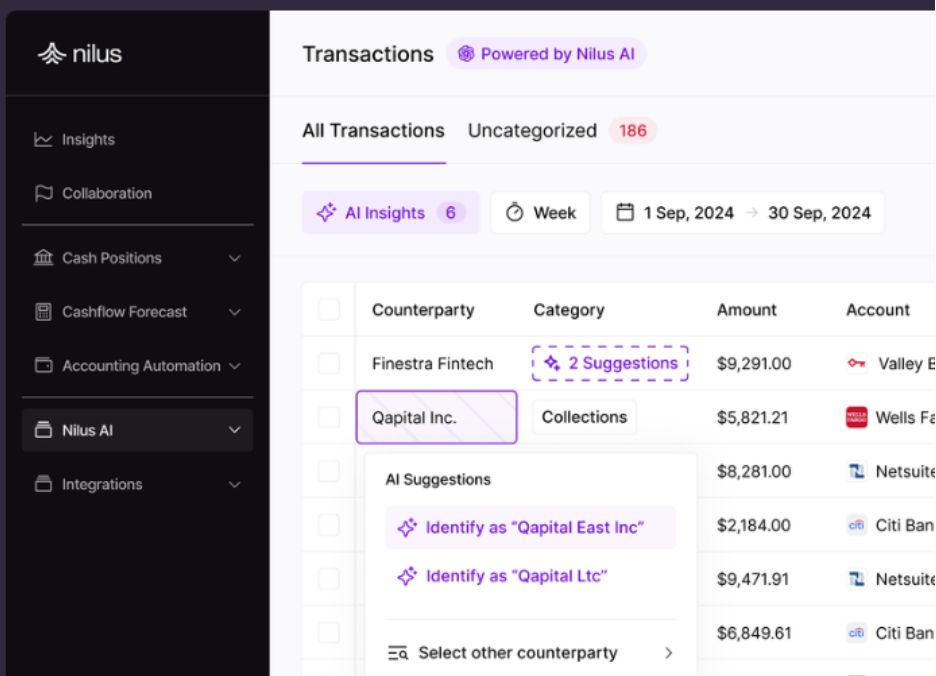 Screenshot from Nilus showing how you can perform your repetitive treasury and reconciliation workflows in a fraction of the time
Fragmented systems
On top of juggling manual processes, Treasury teams are faced with disparate systems to support these processes. Some have daily feeds from their bank accounts flowing to their ERP, but typically not for all of their accounts. It is common to integrate high volume accounts as well as primary banking institution accounts with an ERP; however, even if those feeds are fully automated, they’re not perfect. For example, some bank feeds are missing critical data points that are available in the banking platform but which are not passed to the ERP natively, requiring either a custom built integration or an acceptance that some information just won’t be available in the ERP.
Forecasts continue to be managed offline in Excel or tools not directly connected with banks or ERP. So even if a Treasury team has their bank accounts fully connected with their ERP, they are still commonly extracting data as an input into their cashflow forecast.
The cost here is obvious. Data latency becomes an immediate problem, especially as exceptions that need to be managed continue to stack up. This will ultimately lead to forecasting errors in one way or another, whether through human error due to a focus on upstream issue resolution or inputs that are stale. Fragmented systems require “heavier” controls to maintain them, which can be a drag of resources beyond the Treasury team.
This drag on business resources is another cost of not modernizing your Treasury technology operations - think about this when you’re considering measuring ROI to support the justification of a new Treasury tech stack.
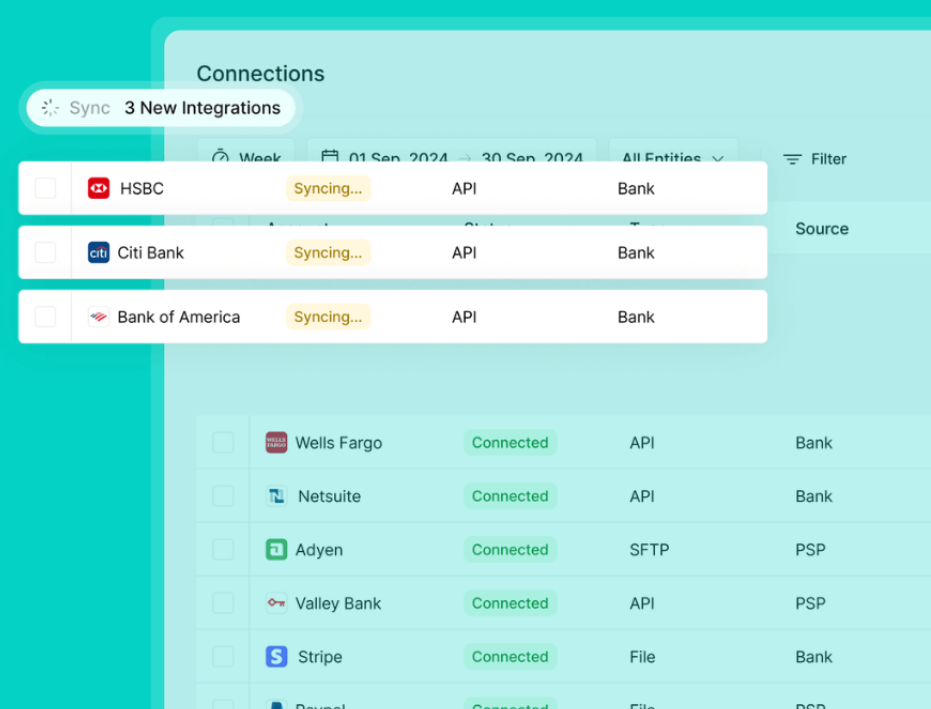 Screenshot from Nilus showing how to manage all of your fully integrated systems from a single window
Technical debt
Related to fragmented systems is the technical debt or “tech debt” that comes with supporting them in daily operations. Think about the number of custom reports, custom integrations and general system customizations needed to maintain the current state of Treasury operations.
We often say that the process should come first and the systems should enable the process. While this is the right approach, it fails from the start if the process is outdated, inflexible and doesn’t scale to support a growing business. As a result, businesses end up with a myriad of patches and quick fixes (which become long-term fixes) to maintain the status quo.
This burden will directly impact the IT team supporting Treasury operations, but there is an opportunity cost to be considered as well. The time, effort, and energy put into maintaining the systems used by the Treasury team on a daily basis could be put to use elsewhere. This could be supporting other functions across Finance or even better, supporting customer-facing initiatives to drive value for customers. This is not to say that the Treasury function is not important, it is, but every manual process that needs to be supported by technology has a cost, even if it’s not hard Dollars.
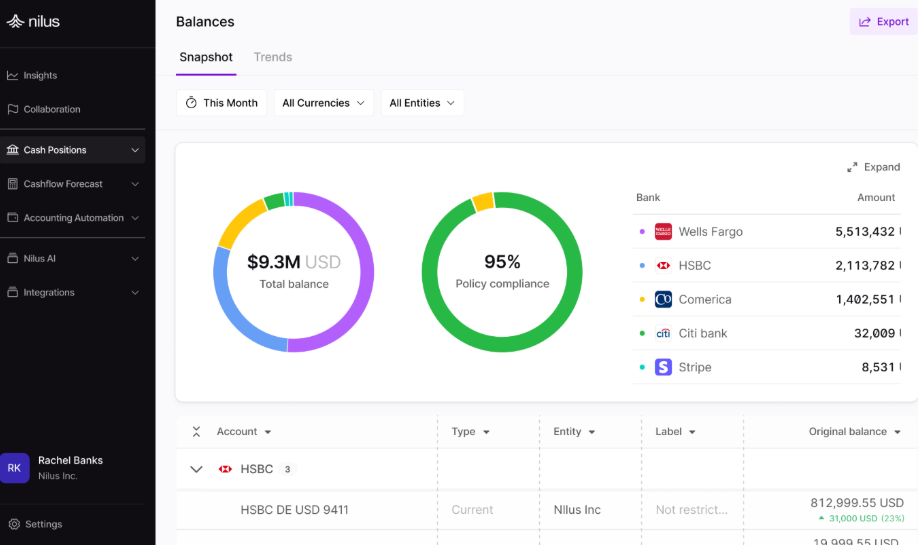 Screenshot from Nilus showing that your cash positions, forecast, accounting automations, and integrations can be managed from a single menu
True “cost”
Speaking of “hard Dollars”, there is, of course, a true cost of not modernizing Treasury operations in your business. We have touched on some of these points already, but once you home in on areas where speed is a challenge, the real cost becomes much more vivid. Although it can be hard to measure this cost, because there isn’t a magic calculator to see it, the cost does show up in numerous areas that can be measured.
We already mentioned idle cash, but the inability to move funds effectively and efficiently will have a real monetary impact. If cash is tied up in a low (or even zero) interest generating account when it could generate interest or an investment return elsewhere, the cost can easily be measured as the balance of idle cash multiplied by the difference in expected return.
If FX exposures are not mitigated with timely instrument purchases, the business can expect to see an increase in the fluctuation of its FX gains/losses balance month over month. Fluctuation causes uncertainty and nobody likes to hear the words “financial statements” and “uncertainty” in the same sentence!
Operational risk can creep in, in the form of fraud, duplicative payments or unintentional deviations from internal policies. Treasury teams are still tracking compliance with internal policies and external covenants manually, after the fact. In some environments this can work if a company is cash rich or has no strict covenants to adhere to, but regardless, the operational risk remains and falling out of compliance can result in much more significant headaches.
When Treasury teams cannot operate with speed and precision, the business will need to allow additional margin for error, and that margin is expensive!
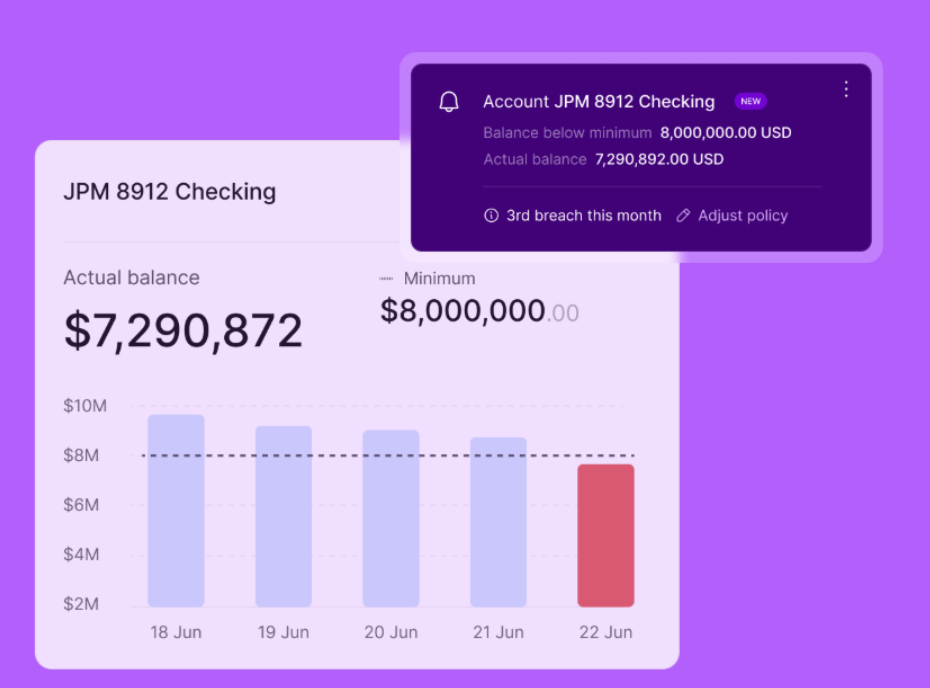 Screenshot from Nilus showing how you can manage all of your internal cash policies in a single system
Burnout
Earlier we touched on burnout within the Treasury function, and it is as real of a cost as the hard Dollars we saw above. Most businesses operate with lean Treasury teams and while this makes sense it can quickly lead to the creation of single points of failure.
How many times have you come across a “guru” who is the only person that knows exactly how the forecasting model works? Or perhaps they are the only person that can troubleshoot and resolve the difficult system issues. What happens when that person leaves?
Yes, we are told to document our processes and build redundancy into knowledge sharing and that is important, but wouldn’t it be better to have a process that is quick to learn and simple to operate? I expect we’d find significantly less Treasury analysts in “burnout mode” if this was the case vs typing up pages and pages of notes on how to execute the current, manual processes.
Treasury talent wants to perform strategic work to support the growth and scale of the business. They don’t want to be performing manual transaction tagging or manually preparing forecasts week over week. When this doesn’t change, companies will see performance start to degrade and the risk of burnout rise. There are plenty of articles out there that speak to the heavy cost of replacing employees and the Treasury function is no exception.
The cost of implementing an effective Treasury tool, with continued training and support, is often less than the cost of backfilling just one member of the Treasury team, and businesses are starting to realize this. Modernization isn’t about eliminating people, but enabling them to focus on more expert-driven, strategic work by removing the noise around them.
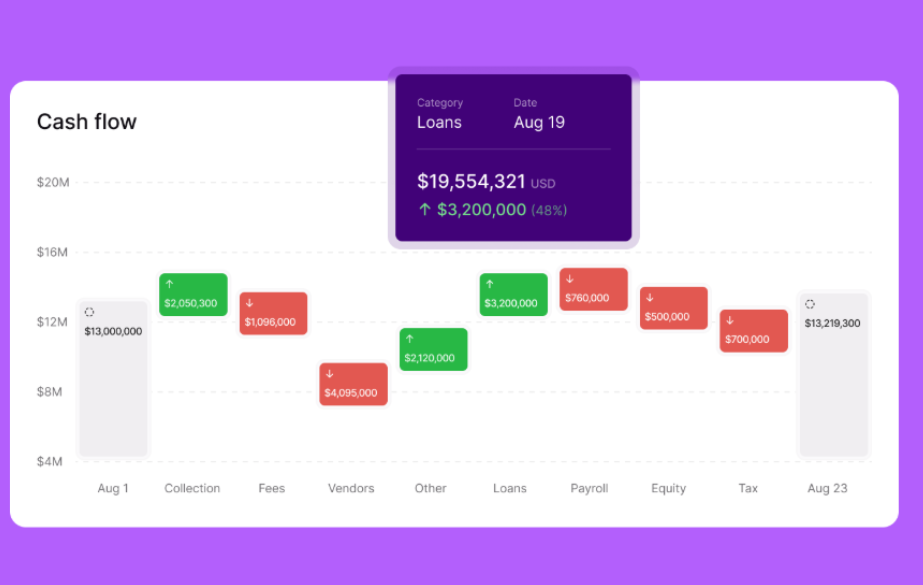 Screenshot from Nilus showing how you can instantly report on your actuals with AI - without working overtime
Final Thoughts
So what is the real cost of waiting to modernize your Treasury operations? It is not as if the Treasury function is broken. However, as we have explored, the cost in both physical Dollars and opportunity cost is very real. The Treasury landscape continues to grow in complexity with globalization. Manual processes compound over time. Fragmented systems are error prone and control heavy. Tech debt relies on heavy IT support that could be utilized elsewhere. Idle cash and FX exposures lead to direct loss in Dollars. The Treasury team takes the brunt of it, resulting in burnout. It is no longer a case for whether a Treasury team should modernize their operations, but to consider the cost of not starting now. Is your team ready for the next evolution of treasury operations? Ask yourself these 10 questions before choosing an AI treasury platform!